

Earlier this week, economic analyst and former advisor to President Obama, Steve Rattner, posted a commonly shared chart of the declining labor share of economic output. Rattner noted that this metric had fallen to the lowest point on record in 2026.
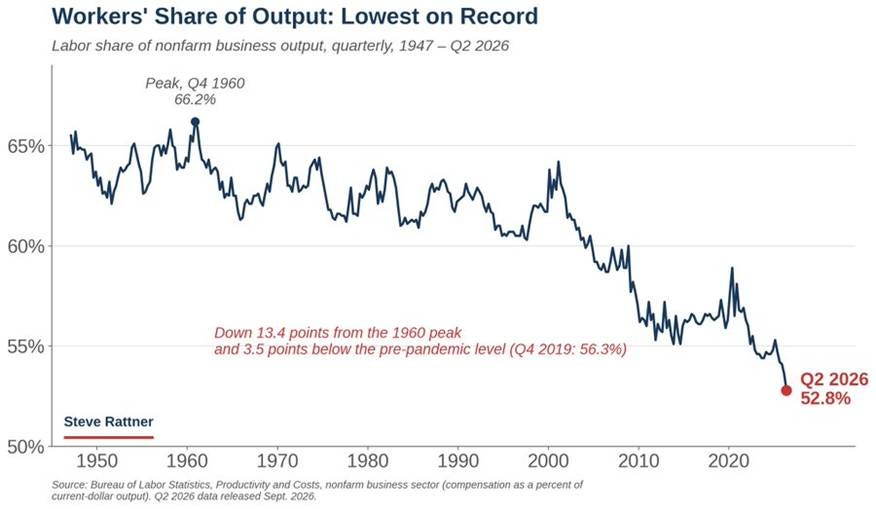
The misuse of this BLS data to spread doomerism about declining worker welfare, billionaire enrichment, or economic injustice is not new.
Mismeasurement of income shares inflates the growing gap
Before diving into why a growing capital stock is not in itself a problem, but actually a blessing, it is worth pointing out what others have noted in the past. The decline in workers’ share of national output is largely a reflection of the fact that capital income is largely a residual of many different things. The Bureau of Economic Analysis separates several categories of income in the national accounts.
Many common measures of capital share are calculated using gross income, which includes depreciation, or the cost of maintaining the economy’s capital stock. The rising capital share, therefore, could reflect a more capital-intensive economy with greater depreciation expenses, not a larger flow of economic rents to wealthy owners.
Another factor explaining the decline in labor’s share of income is the increasing exposure of American industries to international competition. Imports rose from 5 percent of GDP in 1970 to about 15 percent in recent years, reflecting the integration of domestic firms and workers into increasingly global supply chains.
Greater import competition and the offshoring of labor-intensive production may have reduced employment in some sectors, shifting domestic income toward capital and other forms of intangible wealth. For example, an iPhone sold in the U.S. involves American engineering and software, but it is assembled overseas.
These dynamics inflate the capital share, which is integrated into global supply chains, and deflate the labor share, which reflects the wages of the domestic workforce—this isn’t apples-for-apples.
A 2013 Federal Reserve working paper sought to unwind what drove a 25-year decline in the labor share of income in the U.S. The authors confirm that offshoring of labor-intensive parts of the U.S. supply chain is responsible for about 3 to 4 percentage points of the labor share decline over 25 years.
But a far bigger factor that explain the growing income share gap visible in the data is the progressive understatement of the labor income of the self-employed. Overall, this mismeasurement of self-employed wages, evident since the 1980’s, is responsible for about one third of the decline in the labor share of income.
Americans workers benefit from a growing capital stock
But even if we look past the mismeasurement issue inherent in the income share data, there is good reason to be upbeat about what the data is fundamentally pointing towards: a growing capital stock.
Importantly, the period of declining labor share has coincided with rising real wages, higher living standards, greater worker ownership of capital, and significant improvements in technological progress. But sadly, optimism doesn’t sell as well as doomerism.
Suppose labor income rises from $60 to $110, while national income rises from $100 to $200. Under this scenario, workers real compensation, consumption, and employment opportunities are all improving, even while the labor share of national income falls from 60 to 55 percent.
Another point to highlight here is that a growing capital stock is immensely beneficial to workers, regardless of the distributional share of income. A growing capital stock means that each worker is more productive, which is largely why real earnings have increased significantly over time.
Thanks to the growth in capital over time, a typical American worker today is twice as productive as a typical worker in the early 1990’s, three times as productive as a worker in 1970, and four times as productive as a worker in the 1950’s.
A construction worker with site-surveying drones and LiDAR is more productive than a construction worker with 2D paper prints and manual surveying teams. The same goes for a nurse with modern diagnostics equipment or a computer programmer with powerful computing tools.
Ultimately, the capital-driven rise in productivity has driven long-term gains in the well-being of American workers.
Another point to consider when reviewing the declining worker share doomerism narrative is how it largely overlooks how markets have transformed over the years, and how workers participation in the market has transformed too.
For instance, in 1975 only about one in eight Americans owned stocks or mutual funds. Today, roughly six in ten American adults own stock, including through retirement accounts, a dramatic expansion of ordinary people’s participation in the ownership of American businesses.
For the typical American family with financial assets, the average value of pooled investment funds increased more than 8-fold between 1989 and 2022. This includes holdings of exchange trade funds, index funds, and real estate investment trusts, among other private investments.
At the same time, the percent of financial assets of all families in retirement and investment funds has more than doubled from 26 percent to 58 percent.
In other words, a larger share of American’s today earn income from investments, meaning that wage income is less important than it was in the past. This is especially true for older American’s who might be living off investment income and retirement accounts. In this sense, a declining compensation share of economic output would be expected.
Beyond the labor share doomerism
The labor share of economic output is a poor measure of worker welfare, and an even worse proxy for billionaire enrichment. It confuses relative shares with absolute gains, treats capital income as a residual, includes depreciation, overlooks ordinary Americans’ growing ownership of capital, and fails to account fully for globalization and self-employed income.
Of course, doomerism sells better than optimism, but the data broadly tells a positive story: capital accumulation, rising productivity, expanding investment ownership, and technological progress have materially improved the opportunities and living standards available to ordinary Americans.