

The conversation around how data centers are impacting energy markets is, like many other debates in the energy or climate space, quite polarized. On one hand, you have the “data center alarmists,” who claim that data centers are causing electricity prices to skyrocket. And on the other hand, you have a series of “data center apologists,” who claim that data centers are, in fact, good for energy markets. Which of these, if either, is true?
There are two ways that data centers can affect consumers. One is through an increase in the electricity infrastructure required to power them. When power lines are built to reach new data centers, utilities distribute the costs across all their users to recoup the loss. This is essentially the socialization of a cost, and it increases electricity prices for consumers. The other way is by increasing energy demand, which also passes the cost onto consumers.
The Follies of the Data Center Alarmists and Apologists
Right off the bat, this view of data centers and their interactions with prices seems to give the alarmists a point over the apologists. The story is not so simple, however. It’s inaccurate to say that throughout the entirety of the United States, data centers have been causing electricity prices to skyrocket. It isn’t true that data centers are eating water and accelerating climate change at unprecedented rates. Certainly, some of this is true—but how much, exactly?
In 2023, data centers accounted for 4.4% of all electricity consumption in the United States, which is around 176 TWh (terawatt-hours). By contrast, the residential sector consumed 38%, or around 1,479 TWh, that same year. At least on a large scale, it seems data centers have insufficient market share to perform the feat that is unilaterally causing prices to skyrocket.
This gives the space for data center apologists to squeeze their way into the conversation, and since the demand-side price point seems to have been addressed, they choose to focus on the cost of infrastructure. A common claim is that “data centers pay their way with electricity.” In other words, a data center would pay for the increased cost of added infrastructure, thus sheltering consumers from any of the negative effects. But while this is frequently claimed, it is almost impossible to verify. Being able to directly correlate an increase in the rate a consumer pays with a specific change in the market is not easy, and ratemaking is complicated enough to obscure much of the information.
What is true, though, is that prices in much of the United States have not seen the spike that many data center alarmists argue is expected. Some apologists even claim that energy prices, when adjusted for inflation, have not grown and are even declining broadly. This simply is not the case. Electricity revenue per kilowatt-hour from November 2024 to November 2025 grew by 6.8%, non-inflation-adjusted. The Consumer Price Index grew by 2.7% from 2024 to 2025. This means that, on average, prices rose by 4.1% in the energy sector. But this is simply the average. Regional fluctuations occurred that were motivated by various other factors.
Another typical claim for a data center apologist is something along the lines of “data centers aren’t contributing to electricity prices,” or “data centers aren’t nearly as energy-intensive as other, bigger industries.” Both these claims are true to a point, but they also have some shortcomings.
For one, it is impossible for data centers to not be contributing to the price of electricity. The easiest way to check this is to consider the counterfactual, a world without data centers. If they didn’t exist, then, at least in the short term, it is obvious that electricity demand would be lower, and thus so would the price of electricity. For another, to claim that data centers aren’t as big an issue as something like the industrial sector is to accept that, yes, data centers are contributing to increasing costs.
But is there any proof that data centers are a real problem? Are data centers the source of the faster-than-inflation growth rate that we saw in 2024?
Data Centers and Electricity Prices
This question isn’t so easily answered with a yes or a no. In some places, data centers have had little to no direct, observable impact on price growth. In other places, however, such as in the PJM interconnection (PJM), which includes Virginia, Washington, D.C., Maryland, parts of Chicago, and most of the Mid-Atlantic, the story is different.
Quite clearly, as seen in the graphic below, data centers are not uniformly distributed throughout the United States. Instead, they are largely concentrated near cities, with the place of highest concentration being Washington, D.C., and Northern Virginia. This, coincidentally, was the region with the highest electricity price growth in 2024—25.9%, hugely outpacing the rate of inflation at only 2.7%. In fact, studies show that this increase in electricity prices was due in part to data center growth. Even research that appears generally to fall into the data center apologist camp agrees that PJM has seen at least some electricity price growth that could be attributed to data centers.
Locations of Data Centers in the Contiguous U.S.
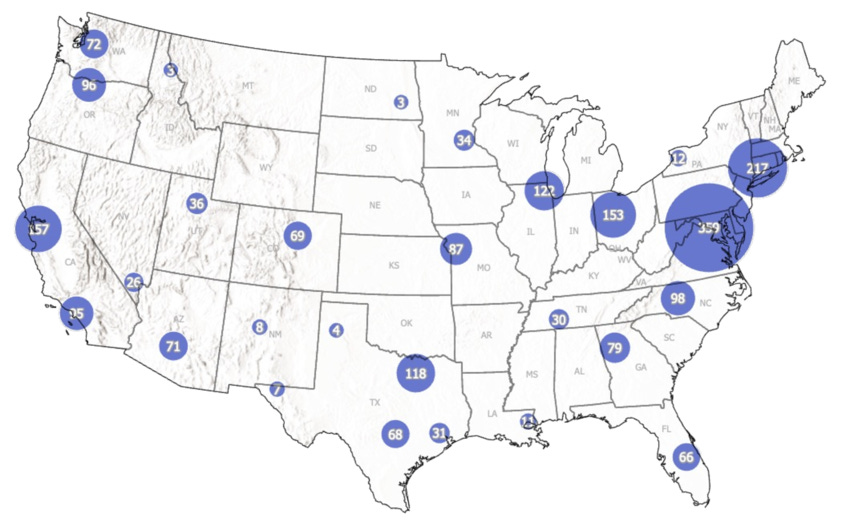
So, what’s the takeaway, then? Well, it depends on where you live. If you are in Northern Virginia, Washington, D.C., or even Chicago, the answer appears to be clear: data centers are influencing electricity prices and are actively driving them up. Elsewhere, the effect is less obvious, but the economic logic stands. An increase in electricity demand and the infrastructure required for its distribution will, all else equal, result in an increase in electricity prices.
Regulatory Responsibilities
Regulators seem to have a responsibility to prevent this from becoming a bigger issue. Those who wish to act often suggest either implementing price controls on electricity to artificially keep prices low or regulating data center construction to prevent more from being built. What these actions neglect, however, is how influential data centers have become in our current economic landscape. Rather than regulating their usage or construction, policymakers should deregulate the electric grid to provide further flexibility and thus decrease electricity prices for consumers.
One clear method to allow for data center operation without causing other issues for the electric grid would be to allow consumers to construct power plants themselves. If a data center can be fully independent of the electric grid, by having either a small, modular nuclear reactor or a solar and wind farm, then the costs faced by consumers as a result of increased electricity demand would be mitigated by the similar increase in electricity supply.
This article sheds a light on the impact of data centers and should be shared across our country.
Love the idea of onsite power generation for the data centers. Roof top solar with battery storage, small modular reactors, or better yet fusion generators! Unfortunately regulations will make this unlikely in the near term. Great article!