
This is a guest post by a Fiscal Team intern Cameron Ewine.
The United States’ gross federal debt of 39 trillion dollars has become so incomprehensibly large that many citizens and politicians alike now simply choose to ignore it. To put 39 trillion dollars into perspective, if every citizen, baby and grandma alike, paid their share of the debt, we would each owe roughly $114,000. All the while, with this looming debt rain cloud overhead, the current administration’s spending cuts target relatively small discretionary programs while allowing the largest spending categories to balloon in size.
In FY2025 the federal government spent 7 trillion and brought in only 5.8 trillion in revenue. That 1.2 trillion-dollar gap is larger than the GDP of all but 19 countries. But instead of trying to rework the main drivers of debt such as entitlement programs like Social Security, Medicare, and Medicaid, our current government sticks to either targeting smaller, politically motivated cuts like the ones in the recent Rescissions Act of 2025 or performs fiscal judo in order to move spending from one area to another in disguise as budget cuts.
Compounding the problem, rising debt also leads to rising interest costs, forcing taxpayers to devote more resources simply to servicing past borrowing. Look below at how our government breaks down its own spending.
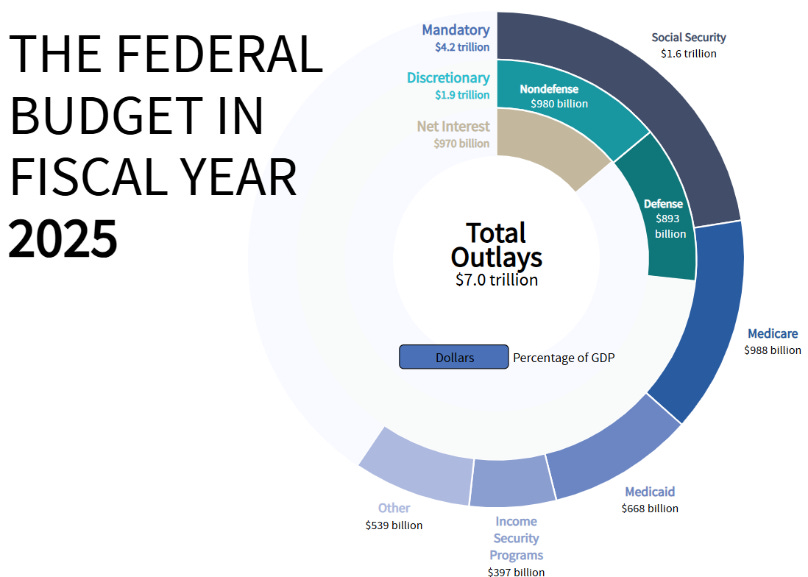
Source: cbo.gov
Social Security, Medicare, and Medicaid together account for roughly half of all federal spending, and their costs are projected to grow as the population ages and heath care cost increase, making them the primary drivers of long-term budget deficits.
The Rescissions Act of 2025 was put into place to cancel 9.4 billion dollars in funds that were provided to various government agencies for tasks that the Trump administration deemed unnecessary. The cuts primarily targeted foreign assistance and international programs, including Contributions to International Organizations, Contributions for International Peacekeeping Activities, Global Health Programs, Migration and Refugee Assistance, and the Complex Crises Fund. Notably, the rescissions avoided major entitlement programs, which account for the bulk of federal spending.
While 9.4 billion is no small number, it represents a very small portion of federal spending, and an even smaller amount of the federal debt. At current debt levels, these rescissions amount to shaving less than three-hundredths of one percent from the total federal debt burden.
Keep in mind that Social Security alone spent about $1.575 trillion in FY2025. At that rate, the entire $9.4 billion rescissions package equals about two days of Social Security spending. This highlights a larger problem in our current political system, which is a willingness to spend more, and an apprehension to any meaningful spending cuts.
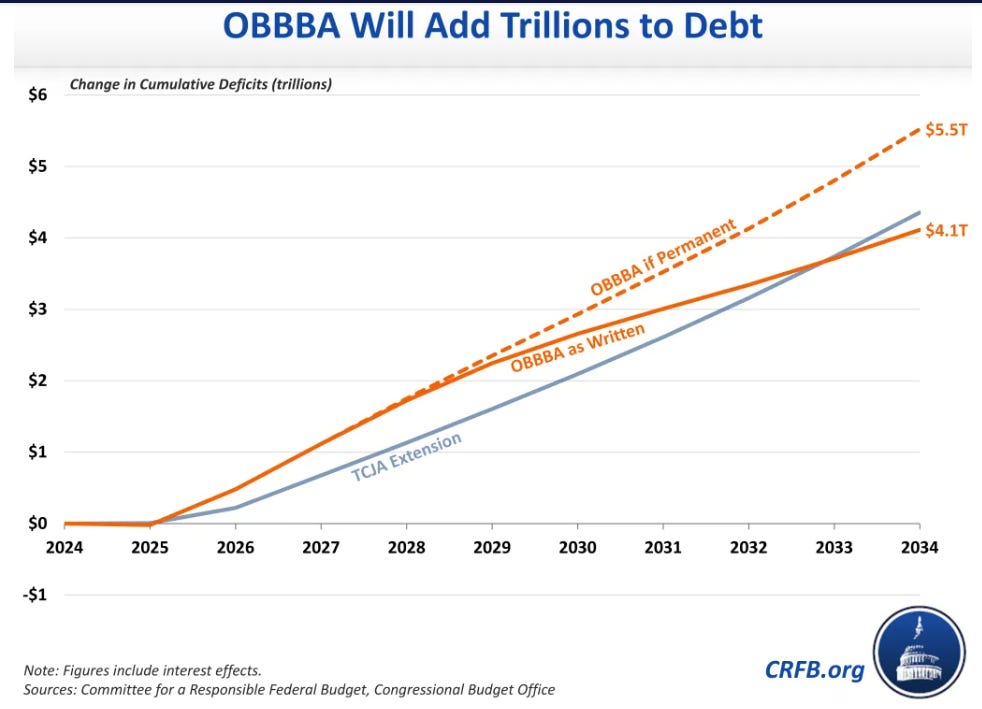
This figure shows that even when the current administration ostensibly makes “spending cuts”, they just use the cuts to move money from one area to another Whether or not the temporary provisions of the OBBBA expire or are extended, it will add trillions of dollars to the debt. The act pulled funding from programs such as SNAP and Medicaid while dramatically increasing spending on immigration enforcement, border security, and other favored priorities.
Restructuring SNAP and Medicaid through spending cuts could be good policy, but not when you also go and spend 500 billion dollars largely on immigration and border enforcement, defense and farm subsidies. And not only did the OBBBA increase spending, but the bill also cut back taxes.
The result is that even after these cuts, the Congressional Budget Office estimates the omnibus bill will increase federal debt by trillions of dollars over the next decade. When spending cuts lead to an increase in the federal deficit and overall debt, they simply aren’t what they claim to be.
This isn’t to say the government shouldn’t look to cut costs anywhere possible. In fact, I’m generally for more rescissions. But this politically charged shaving of costs doesn’t get us meaningfully closer to working off our debt. Because instead of looking into how we can rework our entitlement programs, our government is more interested in pulling funding from the other parties’ programs. I believe this will only give motivation for the other side to do the same, creating an artificial cost-cutting war that ignores the real drivers of debt.
This may leave some of you wondering: why not just tax more? Well, the numbers show spending policy, as compared to tax policy, has a drastically greater influence on our debt problem. In a recent article by Jack Salmon, he found that “98% of the long-term structural deficit can be attributed to spending policy decisions, while just 2% is attributed to tax policy.” And of that 98%, the largest driver of the debt is Medicare. Mandatory spending programs are the main driver of our nation’s long-term structural deficit. Therefore, if our goal is to work towards lowering the deficit and eventually the debt, mandatory spending policy is the place to target.
Ultimately, while the Rescissions Act may save billions, America’s debt problem is measured in trillions. Instead of targeting politically motivated easy wins when it comes to spending, the real solution will require confronting the structural drivers of spending and having an honest conversation about the tradeoffs necessary to restore fiscal sustainability. Until then, lawmakers will continue celebrating small victories while the debt marches steadily upward, passing the costs of today’s political convenience onto future generations.
So, let me get this straight: Spending policy is more important than tax policy????? SO cut Medicare. Because it’s so expensive. Let me explain something. Medicare is public health care for people who are 65 or older. There’s a lot of people in the USA who have gone bankrupt due to medical debt. Do you want older people to bankrupt themselves with medical debt because “spending policy is a bigger driver of debt than tax policy”?????????
Fuck you.
Cancel the estate tax. Rewrite it to give the $1mm tax free, 20% on the next $4 mm and 40% on the balance. So if I get $10 million in inheritance (first I’m throwing a huge party!) I pay $800,000 plus $2,000,000, so I get to keep $7,200,000?? Sign me up!
Alternate Minimum tax: If your income exceeds $2 mm, pay 40% and deduct all the taxes yu already paid. If your assets are worth $30 mm, assume you make an income on a portfolio that theorretically is ( 40% of the S&P 500 + 40% of the Nasdaq + 20% of MSCI ex USA). The tax is 40% on that theoretical income.
Same tax for all corporations - doesn’t matter where they are domiciled, if they belong to an American tax payer, they have that tax.
Change the payroll tax so there is no upper limit on income (currently around $200,000).
I expect that solves your problem.
Great article!
The unfortunate reality is that we are unlikely to reduce the debt through spending cuts or tax increases alone. Those approaches treat the symptoms, not the mechanism producing the debt.
To recover, we need to change the incentive structure itself.
- Stop taxing creation more than extraction. Labor and entrepreneurship are taxed immediately, while asset-backed spending and financial extraction often escape taxation altogether.
- Tax economic activation, not accumulation. Savings, productive investment, and retained capital should be encouraged. Rather than taxing money when it enters an account, tax it when it leaves to impose demand on the economy. Whether purchasing power comes from wages, dividends, capital gains, or asset-backed borrowing should be irrelevant. Inflows remain tax-free; outflows are taxed progressively.
- Grow productive capacity instead of credit expansion. Debt is manageable when genuine productivity outpaces interest costs. It becomes unsustainable when GDP growth is increasingly driven by leverage, asset inflation, and financial engineering rather than real value creation.
- Reduce structural extraction. Strategies like Buy-Borrow-Die, tax-free credit expansion, and arbitrage are not isolated loopholes; they are predictable outcomes of a system whose incentives reward extraction over production.
- Modernize fiscal infrastructure. Our tax code was built for an industrial economy where most purchasing power came from wages. Today's economy is driven by credit, leverage, and digital finance. Until we modernize the infrastructure that measures economic activity, we will continue trying to solve twenty-first-century problems with twentieth-century tools.
The debt crisis is not simply a spending problem or a taxation problem. It is an incentive problem. Until we align incentives with value creation instead of value extraction, deficits will continue to compound regardless of which party is in power.