

This November, Colorado voters will decide whether to replace their 4.4 percent flat income tax with a graduated income tax that tops out at 8.4 percent. The ballot measure is known as Amendment 87.
Colorado was one of the earlier states to adopt a flat tax system in 1987. In the years since, 10 additional states have adopted flat income tax systems, bringing the total number of states to 15.
Some of the key benefits of a flat tax system over a graduated system include simplicity, lower compliance costs, better incentives to invest, neutrality, and faster economic growth. On that last point, the Cato Institutes Adam Michel recently published an excellent briefing paper demonstrating the growth effects of flat tax adoption.
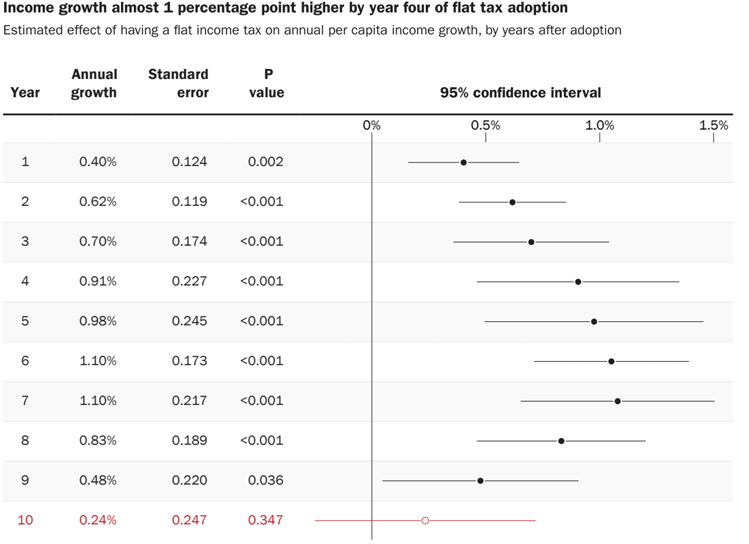
In The Flat Tax Advantage, Adam Michel uses 45 years of data to empirically test whether states adopting flat taxes grow faster after adoption than graduated-tax states with similar average tax burdens.
Michel finds that the economic benefits of flat tax adoption are visible in the first year after adoption, and by year 5 per capita growth is about 1 percentage point higher than graduated-tax states. The effects are similar for annual GDP growth, with the largest effects 4-to-7 years after adoption.
Michel then analyzes Colorado’s flat tax adoption by conducting a difference-in-differences event study comparing the state to 13 graduated-tax states. 10 years after adopting the flat tax, Colorado’s per capita income was about 5 percent higher after 10 years compared to non-flat-tax states, or about $4,600 in 2025 dollars.
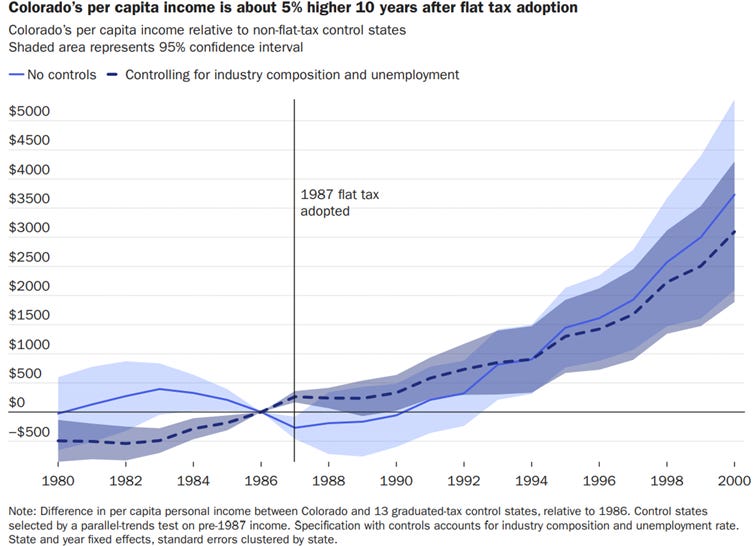
If Colorado were to replace its flat tax with a graduated system, it would also be repealing an engine of growth for the state.
Based on the broad economic literature, I have previously made the case for adopting a flat tax system at the federal level, precisely because of its pro-growth effects. My assessment of the potential macroeconomic effects of transitioning the US tax system toward a simplified flat tax model is that we could benefit from an additional 0.4 to 0.8 percentage points of annual growth during the transition period.
The economic benefits of a low-rate flat tax system are why only 1 state (Massachusetts) has switched to a graduated system in 3 decades, while 10 states have abandoned their graduated systems in favor of a flat tax during that same period.
Adopting amendment 87 and replacing the flat tax would also raise the broad income tax burden in the state. Differing tax burdens between states have significant impacts on the incentives of workers, businesses, and mobile residents.
In a recent project, I explored what factors are most closely associated with the net movement of Americans of across state lines. Every year roughly 7 million Americans pack-up and move states. Data covering the period 2018-2023 suggest that Americans are systematically moving to states with lower tax burdens.
So, raising Colorado taxes by $2.7 billion a year as amendment 87 proposes to do will likely result in mobile households, high earners, and entrepreneurs relocating towards lower tax states, reducing growth and narrowing the tax base.
Neighboring Utah has a competitive flat income tax, nearby Arizona has a 2.5 percent flat tax rate, Wyoming has no income tax, Nebraska’s top rate drops to 3.99 percent next year, and nearby Texas has no income tax. If the tax burden rises, Coloradan’s will vote with their feet.
However, amendment 87 also suggests that the revenues raised from these changes will allow the state to increase spending on K-12 public school education, health care, and early childcare and education services. This begs the question, do states that spend more per state resident on such services attract more new residents?
One way to answer this question is to observe the association between the level of government spending per resident, and the net movement of people across state lines.
Looking at the data plotted on the chart below, it seems that the general association runs in the opposite direction of what proponents of more government spending and program expansions might advocate for.
States spending less than $8,000 per resident averaged 25.4 net new residents per 1,000 people, while states spending more than $8,000 averaged a net outflow of 4.8 residents per 1,000. When residents vote with their feet, they tend to prefer states leaner governments, not big governments.
Having said that, if Colorado policymakers want to keep their state competitive, while also raising additional revenues, there is way to do that in a way that is consistent with the flat tax model.
According to a 2024 tax expenditure study conducted by the Colorado Department of Revenue, state revenues are roughly $9.7 billion lower than they would otherwise be due to the many dozens of tax expenditures in the state’s tax code. The authors also note that this is an understatement as some data is not collected, not retrievable, or incomplete.
While some of these provisions serve a legitimate purpose, such as preventing the repeated taxation of goods as they move through the supply chain, many of them distort economic decision-making, create unfair advantages, and complicate the tax system.
The total list of expenditures includes nearly $900 million in various income tax credits (EITC, CTC etc.), approximately $1.2 billion in income tax deductions, and nearly $6.9 billion in sales-and-use-tax expenditures and other carve-outs that narrow the state’s sales-tax base.
Rather than abandoning the flat tax and imposing higher rates on work, investment, and entrepreneurship, policymakers should preserve the flat structure, broaden the tax base, and eliminate preferential carve-outs wherever possible. That would make the tax code simpler and more neutral while raising revenue with less economic damage.
Abandoning the flat tax would move Colorado in the opposite direction. It would unwind one of the state’s most successful pro-growth reforms, increase the incentive for people and businesses to leave, and fund a larger government that residents in other states appear increasingly willing to escape.