

The incoming Democratic majorities in the House and Senate are making reviving the Affordable Care Act’s (ACA) enhanced premium tax credit a top priority. As The Hill reports, party leaders are prioritizing restoring the subsidies once they take power in January.
Last December, I wrote in The Hill that lawmakers should let these subsidies expire because they were expensive, regressive, and supposedly temporary. Now, the question before Congress is should taxpayers once again foot the bill for a pandemic-era program that primarily benefits upper-income households and pads the margins of large insurance companies?
A Temporary Policy That Was Always Meant to Expire
The enhanced premium subsidies were created through the American Rescue Plan Act (ARPA) during the global pandemic. At the time it was clear to everyone, including policymakers in both parties, that these were supposed to be temporary emergency measures. As the Kaiser Family Foundation made clear in its 2021 analysis of the legislation, this “COVID-19 relief” was “temporary, lasting for two years.”
Congress already chose to ignore that promise after 1 year, extending the subsidies in the Inflation Reduction Act (IRA) of 2022. As my colleague Veronique de Rugy observed, every Democrat voted for that sunset clause. The subsidies finally expired at the end of 2025, and a House-passed three-year extension stalled in the Senate.
Now lawmakers are attempting to normalize what was sold as temporary emergency relief.
The debate has been muddied by a deliberate conflation of two very different policies. The ACA’s original premium tax credits were targeted to lower-income families—those earning up to 400% of the federal poverty level.
The enhanced credits, by contrast, eliminated that income cap. Suddenly, households earning half a million dollars or more became eligible for taxpayer-funded subsidies. For example, a family of five in Prescott, Arizona earning $500,000 could still qualify for an $8,423 subsidy, and the benefit did not fully phase out until income exceeded $599,000.
As the pie chart below shows, less than 10% of those who became eligible for enhanced subsidies in 2021 were what we might consider middle class. Most of the newly eligible beneficiaries were high earners, with household incomes that are often double or triple the median household income.
This feature makes the policy deeply regressive. As the bar chart below shows, the largest gains flow to higher-income households who would have purchased health insurance anyway, hardly the group in need of federal assistance. By contrast, low-income households gain little, as their monthly premiums were already heavily subsidized under the original ACA structure.
Reviving these temporary subsidies means asking middle-income taxpayers, already stretched by inflation, tariffs, and high gas prices, to underwrite health insurance for affluent households who were never meant to receive assistance in the first place.
We Cannot Afford to Pretend This Is Free
The first thing that should give Congress pause is the simple fact that we cannot afford it. In 2024, CBO and the Joint Committee on Taxation estimated that making the enhanced ACA subsidies permanent would increase the cost of the premium tax credit by $415 billion over fiscal years 2025–2034. By 2035, CBO estimates imply the cost would exceed $11,500 per newly insured person.
When Congress first scored ARPA in 2021, the Congressional Budget Office projected a modest, temporary bump in subsidy costs. But in reality, total federal spending on premium tax credits has more than doubled since the enhanced subsidies were introduced, even after adjusting for medical inflation. Between 2021 and 2025, cumulative outlays exceeded the combined ARPA and Inflation Reduction Act cost estimates by tens of billions of dollars.
Washington’s “temporary” generosity has permanently ratcheted up the baseline cost of the ACA marketplace. At a time of persistent $2 trillion deficits, reviving an expensive pandemic-era benefit is nothing short of fiscal malpractice.
Lining the Pockets of Insurance Companies
These subsidies are not primarily helping consumers; they’re lining the pockets of insurance companies. Because subsidies are tied to the sticker price of insurance premiums, insurers can capture a large share by quietly raising gross premiums. Consumers see lower net prices, but taxpayers make up for the difference.
The JEC, citing research by Maria Polyakova and Stephen Ryan, finds that for every additional federal dollar spent on ACA subsidies, 34 cents lower consumers’ premiums, 38 cents go straight to insurers and intermediaries, and 28 cents are lost entirely as deadweight losses that benefit no one.
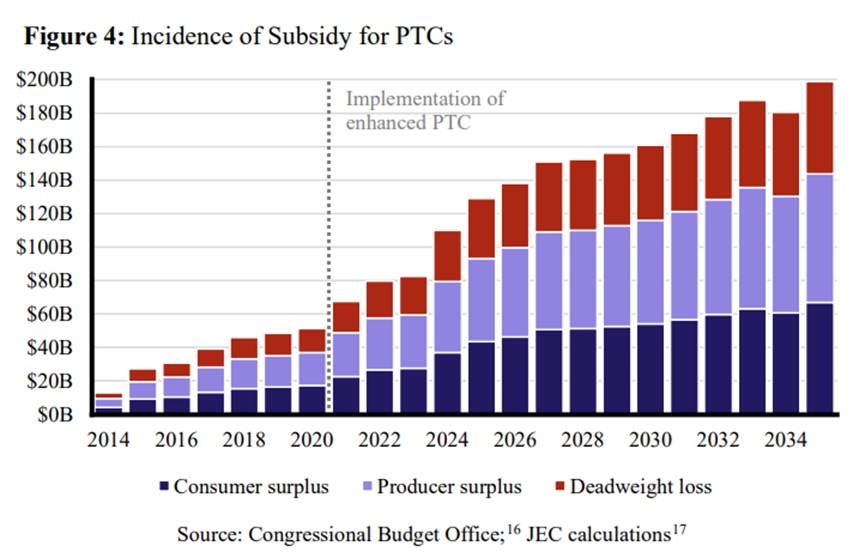
In other words, taxpayers spend three dollars to deliver one dollar in benefit.
The enhanced credits also inflated what the JEC calls a “subsidy bubble.” Since 2021, insurers’ gross premiums have risen by 31%, while the average net premium paid by consumers has fallen by 32%.
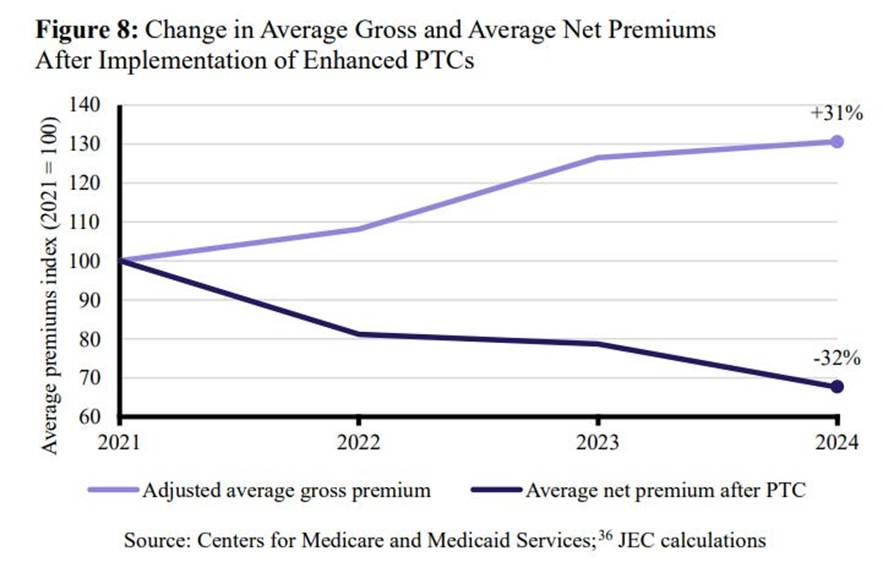
The divergence between gross premiums and net premiums after PTCs is a clear signal of hidden inflation. Consumers saw “stable” prices, but only because taxpayers were subsidizing the increase. Reinflating the bubble would lock in higher costs and ever-growing subsidies.
As the share of consumers paying little or nothing in premiums soared to 42%, price competition eroded. Insurers faced less pressure to cut costs or innovate and more incentive to pad margins. It’s no wonder that 38 cents in every dollar of premium subsidies goes straight toward lining the pockets of the insurance companies.
Fraud and Waste
Another, often overlooked, impact of the temporary expansion of subsidies to high income households is the massive uptick in fraud and waste that came along with it.
The creation of enhanced subsidies, combined with regulatory changes that weakened income verification, triggered a massive increase in fraudulent enrollment. According to the Paragon Health Institute, some 6.4 million enrollees were improperly enrolled in 2025, costing $27 billion that year alone. In effect, the program grew faster than auditors or administrators could keep up with.
Washington’s Inverted Priorities
The fight over the enhanced ACA subsidies epitomizes Washington’s inversion of priorities: policymakers tripping over themselves to protect a temporary pandemic perk for the well-off, while ignoring the long-term drivers of fiscal imbalance. Meanwhile, Medicare, Medicaid and Social Security continue to crowd out everything else in the budget.
What message would Congress send by once again forcing hard-pressed taxpayers to fund the health care plans of high-income households? Should legislators force middle-income Americans to pad the margins of multi-billion insurance companies?
Keeping the enhanced subsidies expired does not dismantle the ACA. Instead, it would signal an end to a temporary pandemic giveaway that had become an enduring transfer to the affluent and the politically connected. If lawmakers are serious about fiscal responsibility, they should focus on reforming the ACA to make premiums more competitive and transparent, not endlessly layering subsidies that enrich insurers at taxpayers’ expense.
This fight is not just about health care. It is about whether Congress is still capable of honoring its own deadlines, and whether “temporary” still means anything in Washington. Fiscal responsibility requires the courage to stop funding programs that don’t work.