

If being more like Denmark means lowering marginal taxes, more competitive corporate rates, and public finances strong enough to support both, Bernie Sanders may be onto something.
Denmark is cutting taxes on work and business. On November 12, the government announced a political agreement to reduce personal income taxes, lower the corporate tax rate, and simplify parts of the tax system. Implementation would begin in 2027, subject to the legislation needed to put the agreement into effect.
In 2024, Denmark collected more tax revenue as a share of GDP than any other OECD country. That starting point makes its decision to cut taxes on work and investment all the more striking. The direction and reasoning of these tax cuts merits attention
A country with a substantial welfare state is choosing to leave more of the return to work and investment with the people undertaking them. Even more noticeably, as comments by the tax minister demonstrate, it explicitly understands that lowering top marginal tax rates is a pro-growth policy. Reducing the heavy burden of top marginal rates will make Denmark more attractive to highly skilled labor and increase marginal incentives for productive workers to work more.
The agreement also chooses to support businesses by reducing their corporate tax burden, while simultaneously removing tax credits for R&D spending. Lowering corporate rates while reducing preferential tax credits is a sober and sound approach worth imitating elsewhere.
A welfare state cannot distribute income that nobody has produced. Denmark’s reform recognizes this relationship. It reduces penalties on additional earnings and business profits while using fiscal room accumulated through budget discipline. Americans who want to borrow from the Danish model should pay attention to that part of it too.
Making the next krone worth earning
Denmark currently taxes wage income through four layers of national income tax: the base, middle, top, and “top-top.” Workers first pay an 8% labor-market contribution on their wages. A 12.01% base tax applies above the personal allowance (the Danish equivalent of a standard deduction). Higher incomes face additional levies of 7.5%, another 7.5%, and finally 5%, each applying only above its respective threshold. Municipal income tax comes on top, as does church tax for members of the national church.
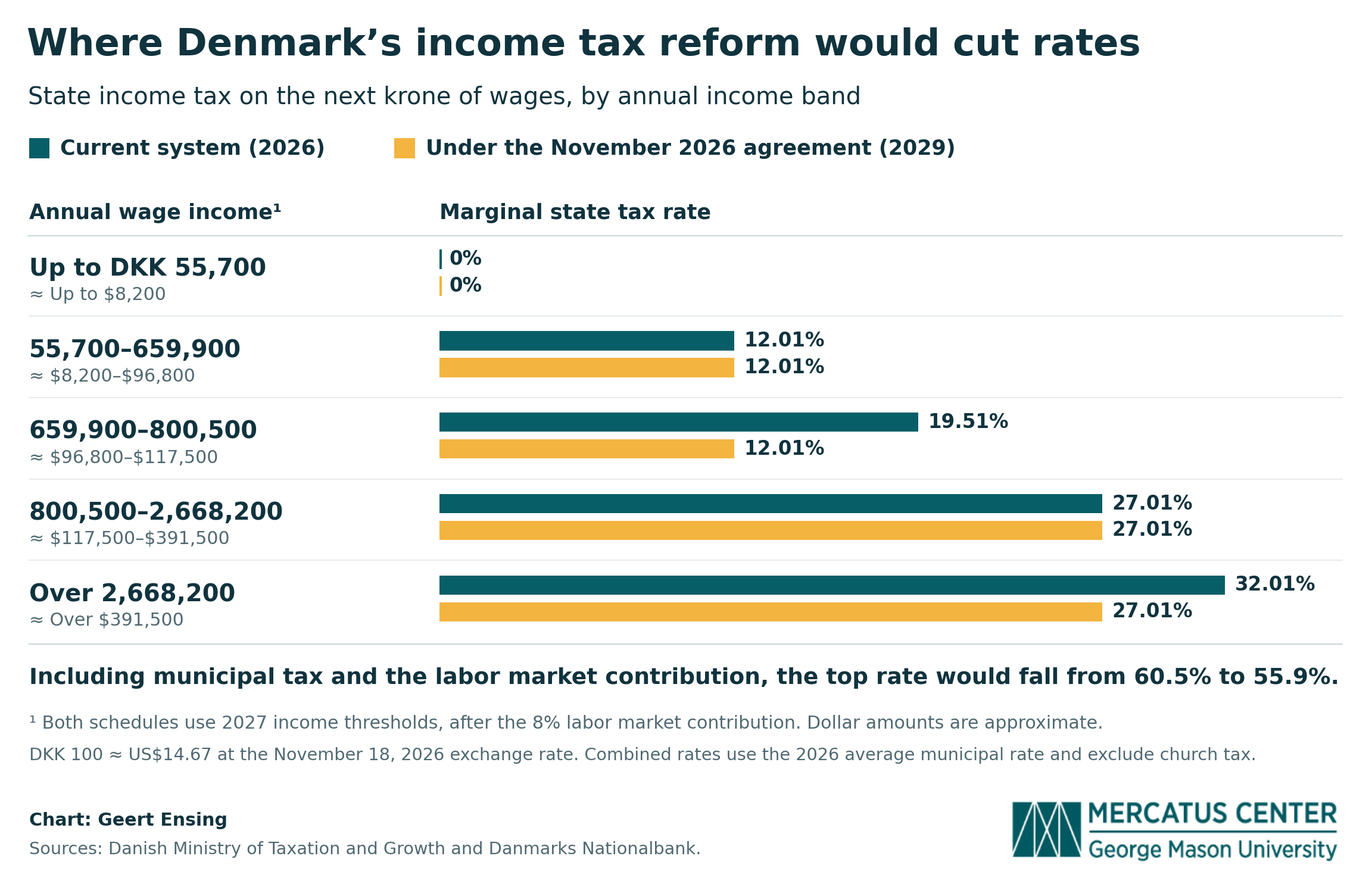
The reform would remove two of those layers. The top-top tax would disappear in 2028. The middle-tax threshold would rise during the transition, and from 2029 the middle and top taxes would be replaced by a single 15% tax layer on income above DKK 800,500 ($117,500). That threshold is expressed in 2027 terms and applies after the labor-market contribution. For someone earning only wages, it corresponds to approximately DKK 870,100 before that contribution.
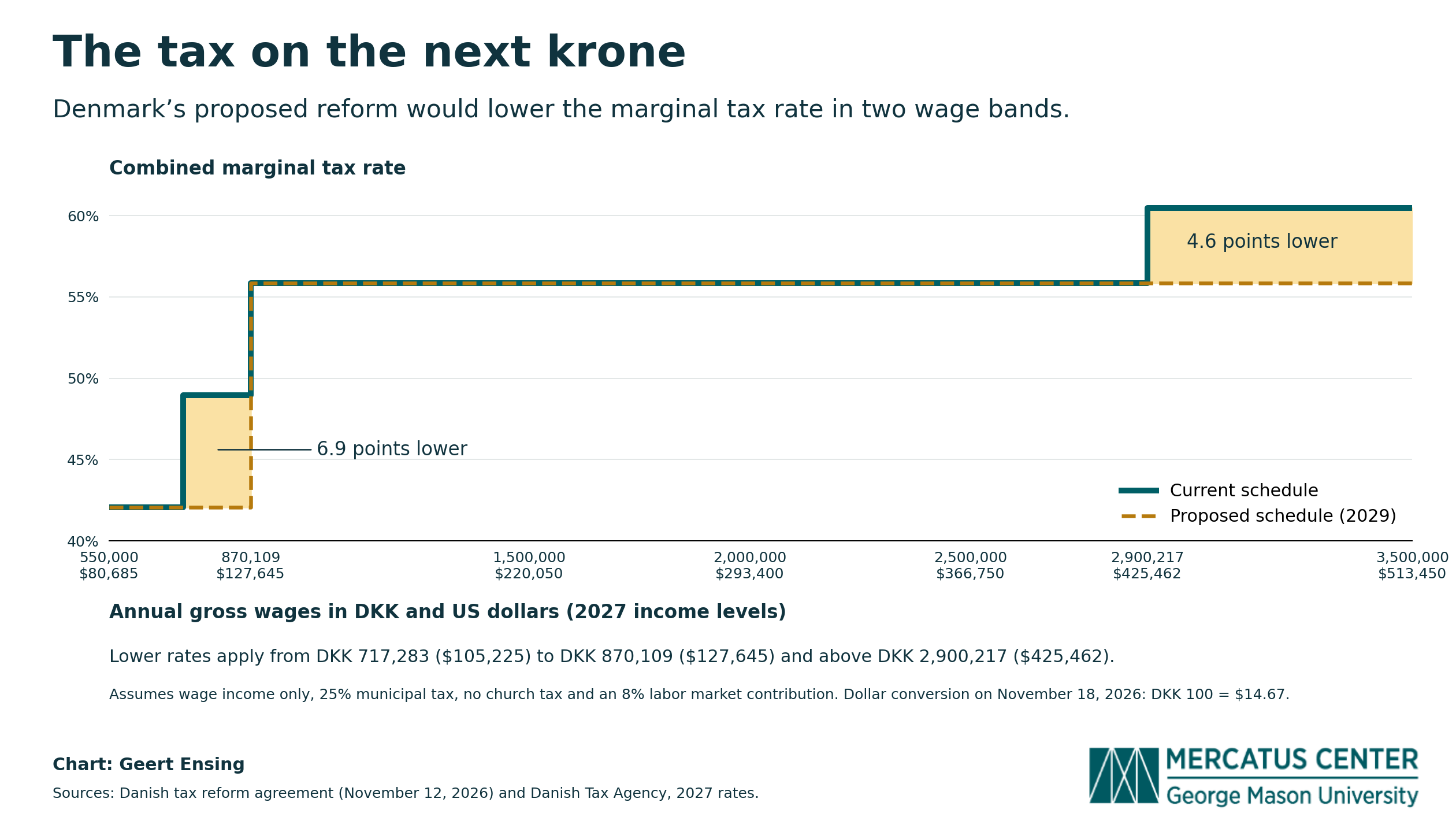
In the income band relieved of the middle tax, the national marginal rate would fall from 19.51% to 12.01%. Accounting for the labor-market contribution, this increases take-home pay by DKK 6.90 for every additional DKK 100 earned in that band. Eliminating the top-top tax similarly leaves the highest earners with an additional DKK 4.60 per DKK 100 of marginal earnings above its threshold.
Denmark’s “middle tax” kicks in well above the middle of the income distribution. Median annual income is 351,100 kroner (about $51,600), and the average is 428,800 kroner (about $63,000). Even at the 75th percentile, annual income reaches only 527,700 kroner, well below the middle-tax threshold of 659,900 kroner in 2027 terms.
Nonetheless, Denmark’s government estimates that abolishing the middle and “top-top” taxes would still cut taxes for about 619,000 people and reduce annual revenue by 2.9 billion kroner in 2030, after accounting for changes in taxpayer behavior and related tax receipts. Those currently paying the middle tax would receive an average increase in disposable income of DKK 7,200 ($491) in 2030 from its abolition alone.
Even if the tax cuts are concentrated around top marginal rates, they create significant pro-growth incentives. The marginal tax rate determines how much of the next krone a worker keeps. Reducing it makes an additional shift, a promotion, or greater professional responsibility more financially rewarding. The gains can extend beyond those receiving the immediate tax cut when additional work produces services and income that would otherwise not have existed.
The agreement gives Denmark a simpler, flatter income tax. Letting top earners keep more of each additional krone will increase Denmark’s international competitiveness for skilled labor.
Lower rates instead of special treatment
The agreement also applies to corporate taxes and credits. The general corporate rate would decline from 22% to 21.5% in 2027, 20% in 2028, and 19% from 2029. The reduction will increase after-tax profit by 3.8% more on the same pretax return. Due to an EU-wide VAT exemption for financial services, the Danish government applies a separate compensatory corporate rate, which will remain at 26%.
The broader agreement also makes choices about how to pay for the cuts. The reform pairs the lower rate with the removal of a special preference for research and development. The existing R&D superdeduction allows eligible expenditure to be deducted at 114% in 2026, rising to 116% in 2027. Under the agreement, the deduction would return to 100% in 2028.
Any deduction above 100% is a form of tax credit because the write-off is larger than the expense. With a 114%, for DKK 100 of eligible expenditure, it allows DKK 114 to be deducted from taxable income. At a 22% corporate rate, the extra DKK 14 deduction saves DKK 3.08 in tax beyond the ordinary deduction. The reform removes that additional preference while preserving the deduction for the underlying expense.
There is a coherent principle here: improve the general return to profitable activity while relying less on special tax treatment for selected expenditure. Businesses have more reason to pursue investments because customers value their output, rather than because the expenditure fits a favored tax category.
Fiscal discipline creates room to reform
Denmark also approaches these changes from a position many larger economies would envy. According to Statistics Denmark, its general government surplus was 2.9% of GDP in 2025, while gross public debt stood at 27.2% of GDP. It has room to reduce taxes because it has maintained control over its public finances.
The agreement does not assume that the cuts will pay for themselves. Its fiscal table explicitly incorporates revenue feedback and behavioral responses, yet still records a budget cost. By 2030, the measures providing relief cost an estimated DKK 11.4 billion annually, offset by DKK 6.55 billion in financing measures, leaving DKK 4.85 billion in net costs (in 2027 DKK terms). Denmark can afford the costs of these cuts because it consistently runs fiscally responsible budgets.
That is the right distinction. Recognizing that tax rates affect economic activity does not require believing that every tax cut raises revenue. Governments should account for the work and investment their taxes discourage, then make explicit choices about how to finance reform. Denmark is combining that approach with changes to tax preferences and other financing measures.
The lesson is especially relevant to politicians who admire Denmark’s public services. Those services require a productive economy, and maintaining that economy requires attention to the incentives facing the people who finance it.