

Last week, billionaire and Democratic candidate for Governor of California, Tom Steyer posted the following on X:
“For decades, the top tax rate on the wealthiest Americans — like @JeffBezos — was much higher than it is today.
What did we do with that money? We built roads and bridges, expanded healthcare, and invested in education. We grew the middle class.”
Yes, top tax rates were significantly higher in the past than they are today. This is about the only part of Steyer’s post that is accurate.
Today, in several states, the top earners pay combined federal and state marginal tax rates north of 50%, but for the sake of simplicity, let’s focus on federal income taxes over time. Then we can address Steyer’s other points that lead on from this one.
Let’s take 1952 for example, when the top income tax rate was 92 percent (compared to 37 percent today). Steyer asks what did we do with all that money? Well, first we need to observe how much “all that money” amounts to with a 92 percent top rate.
In 1952, the federal government raised 18 percent of GDP in tax revenues. This compares with federal revenues of 17 percent of GDP today. So, relative to today, “all that money” amounted to only about 1 percent of GDP in federal revenue, roughly $300 billion in today’s economy, or about 2 weeks of current government spending.
Steyer then argues that with “all that money”, we built roads and bridges, expanded healthcare, and invested in education.
Let’s start with roads and bridges. In the 1952 fiscal budget, Congress spent $1.69 billion on transportation and communication. In 2025 dollars, this is about $20.5 billion. By comparison in the FY 2025 federal budget, the federal government spent $145 billion on transportation.
In other words, when top tax rates were 92 percent, the federal government spent 7 times less on transportation than it does today.
What about health care and education? Well, the federal government provided tiny amounts of funding to healthcare in the 1950s, as this was before the creation of health care entitlements in 1965. As for education, about $5.8 billion in 2025 dollars was provided by the federal government in 1952, compared to $124 billion in the FY 2025 budget, or more than 20-times the amount.
I want to be fair to Steyer, so I will review a second federal budget where the top tax on the rich was still high by historical standards but includes post-1965 entitlement program spending. Let’s review the 1979 budget when top income tax rates were 70 percent.
Adjusting for inflation, in 1979, the federal government spent $222 billion on all health care programs. Compare this to the FY 2025 budget which allocated $1.66 trillion to Medicare and Medicaid combined, or more than 7-times the amount in 1979.
For transportation and education spending in 1979, the federal government spent roughly half as much on both as it does today, adjusting for inflation. Even if we adjust for population growth, the federal government still spends significantly more today on transportation, education, and especially on health care.
So, we have determined that “all that money” that exorbitantly high taxes on the rich raised amount to a measly $300 billion in today dollars, and we’ve also determined that Steyers claim that this money was used to fund transport, health care, and education doesn’t stand up to the scrutiny of the actual budget data.
Before moving onto Steyers final claim, it is worth noting that, even though top marginal tax rates on the rich were significantly higher than today, almost no one actually paid income taxes at those levels. This is exactly what the empirical literature tells us about how high earners adjust behavior in response to high tax burdens.
In 1952 when the top income tax rates were 92 percent, the top 1 percent paid an effective rate of less than 17 percent, while the top 0.1 percent paid a 21 percent effective income tax rate.
Today, both the top 1 percent and 0.1 percent pay effective income tax rates above 26 percent. So, with a top rate of 37 percent, the wealthiest Americans pay higher effective income tax rates than they did with a top rate of 92 percent.
Now, we can address Steyers final claim that follows from his priors: “We grew the middle class”.
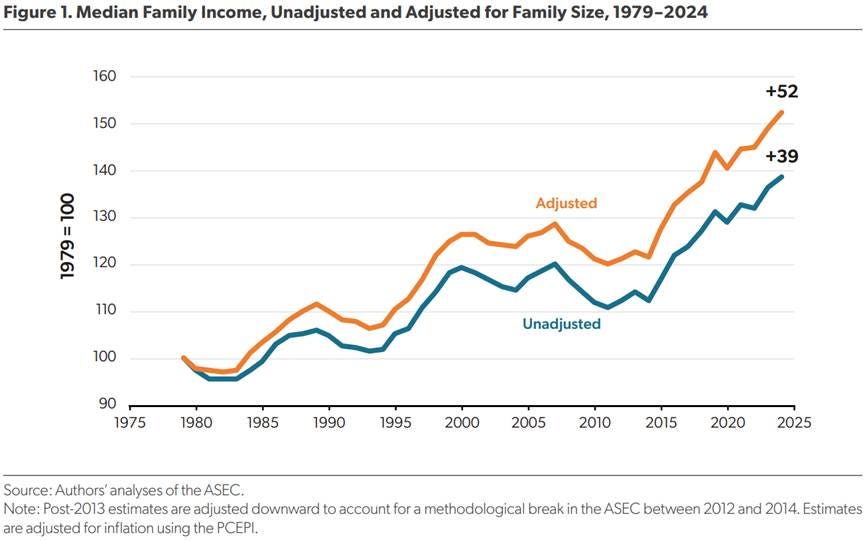
Stephen Rose and Scott Winship at the American Enterprise Institute have done extensive work on measuring changes in the middle class over time as far back as 1979. The first notable datapoint they highlight is that median family income has risen by 39 percent since 1979, or 52 percent if we adjust for changes in family size over time.
Perhaps, more importantly, they find that, yes, the share of the population that is core middle class has shrunk over time, but this entire shrinking pattern reflects net upward movement. While fewer and fewer families are poor or middle class today, it is because they have moved up to upper middle class.
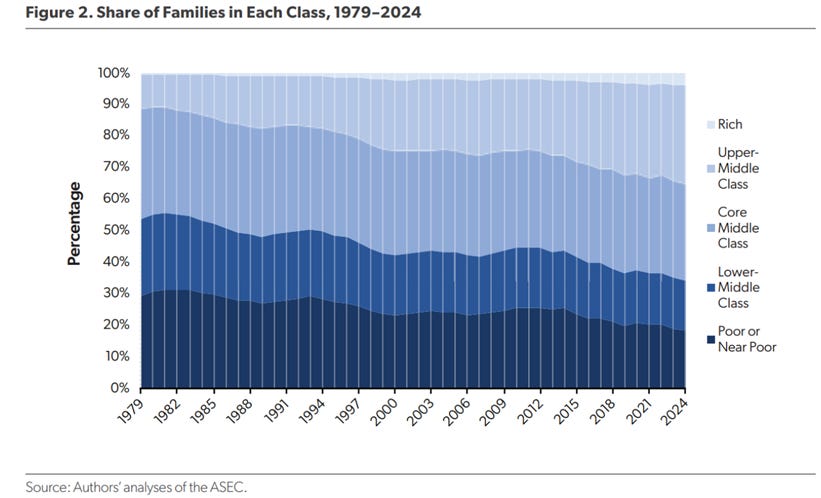
Contrary to Steyer’s argument about growing the middle class, most American families in 1979 were either poor or lower middle class, while today most Americans are core middle class or upper middle class.
All said and done, only the first sentence of Steyer’s X post is accurate. Taxes on the rich were notably higher in the past than they are today, but the government was also a lot less involved in transferring funds to transport, education, and health care among other income support and transfer programs. Perhaps most importantly, American families today enjoy substantially higher living standards than families did during the era of confiscatory marginal tax rates.
All true data, but cherry-picked data. The REAL MYTH is that high nominal tax rates seldom translated into high effective tax rates from tax loopholes in 1950s, 60s, 70s (also, most other taxes were regressive: property tax after shifting, sales, fees, payroll taxes (Social Security the most regressive public PENSION plan on Earth, and most other nations let short-life span, poor laborers retire at 55, not long-lived teachers and police "triple dippers"); every Academic research study found the NET IMPACT OF ALL GOV'T at most was Proportional (never progressive), since government contracting firms pay so well. Also, most capital gains are never taxed, but instead bequeathed as untaxed TRUST FUNDS, so most such U.S. wealth has never been taxed; meanwhile, these "locked in" unsold shares assure that inefficient CEOs are never fired (and only the U.S. allows stock buy-backs to inflate stock option value). And Economics was mastering how to fine tune the macro economy (JFK/Johnson flipping the yield curve stimulated investment and growth and Nixon coordinated Fiscal with Monetary Policy for the first time, Humphrey-Hawkins bill dealt with Phillips Curve new realities of supply shocks), internalized externalities of pollution and education, subsidized deficient local public services from bloated federal budgets, restrained hi-tech monopolies (IBM and Ma Bell) to restore real competition, risk-taking, innovation, and deregulated transportation, utilities, and professional services (doctors, lawyers, stock brokers, opticians, realtors, etc.) via Carter's entire cabinet of Economists.
But once econ became ideological, policy disappeared from economics as far-right billionaires purchased New Classical School endowed chairs, think tanks, private granting groups, and took over academic journals. After 45 years of Reaganism's "public-policy can only make problems worse" mantra, the result was deregulations and defunding that gutted consumer, worker, and environmental protections from asymmetric information and monopoly advantages of big business, allowed to grow exponentially without antitrust enforcement. Four enormous tax cuts for the super rich quickly created the greatest wealth inequality in the industrialized world, enough multibillionaires and trillion dollar firms to buy (and rig) the government, a higher yield and lower risk "investment" than real investment!
So what were they spending the money on back then, defense?