

New York Mayor Zohran Mamdani wants to open government-owned and operated grocery stores, including one in East Harlem. Proponents of this plan argue that groceries are too expensive, food deserts are harming low-income communities, and corporate greed is to blame. Build a public grocery store, cut out the profit motive, and watch nutrition improve in underserved neighborhoods.
Each of those claims rests on assumptions that the evidence does not support.
The Profit Margin Myth
The most common argument for government grocery stores is that they’ll be cheaper because they won’t have to satisfy shareholders. The logic sounds plausible until you look at how razor thin grocery store profit margins actually are.
Grocery stores, on average, operate on net profit margins of about 1–2% after taxes. During the pandemic, when supply chains were a mess and demand was unusual, margins briefly hit 3%. These are not the fat profits of a cartel; they are the thin margins of an intensely competitive industry. Of those profits, roughly 35–40% is returned to shareholders in the form of dividends. The rest is reinvested into operations, capital expenditures, expansion, and debt reduction.
There is no pot of shareholder gold waiting to be redirected to lower prices. The grocery market is competitive precisely because margins are so thin. Eliminating the profit motive doesn’t magically make groceries cheaper, it removes the incentive to operate efficiently in the first place.
The Affordability Myth
The second premise, that groceries are increasingly unaffordable, fares no better when you look at the historical data.
In 1930, Americans spent 21% of their disposable income on groceries. By 1960, that figure had dropped to 14%. By 1990, it was 7%. Today, Americans spend less than 5% of their disposable income on food at home. Whatever legitimate concerns exist about food prices, and the recent inflationary episode was genuinely painful, the long-run trend is unambiguously in one direction. Groceries have become dramatically more affordable relative to income over the course of living memory.
Food Deserts and The Nutrition Gap
This brings us to the central claim: that government grocery stores will address food deserts and improve nutrition in low-income communities.
A quick look at the proposed East Harlem location reveals 45 supermarkets and grocery stores within a 35-minute walk (Google Maps, Amanda Macias). If that qualifies as a food desert, the term has been stretched well past the point of usefulness.
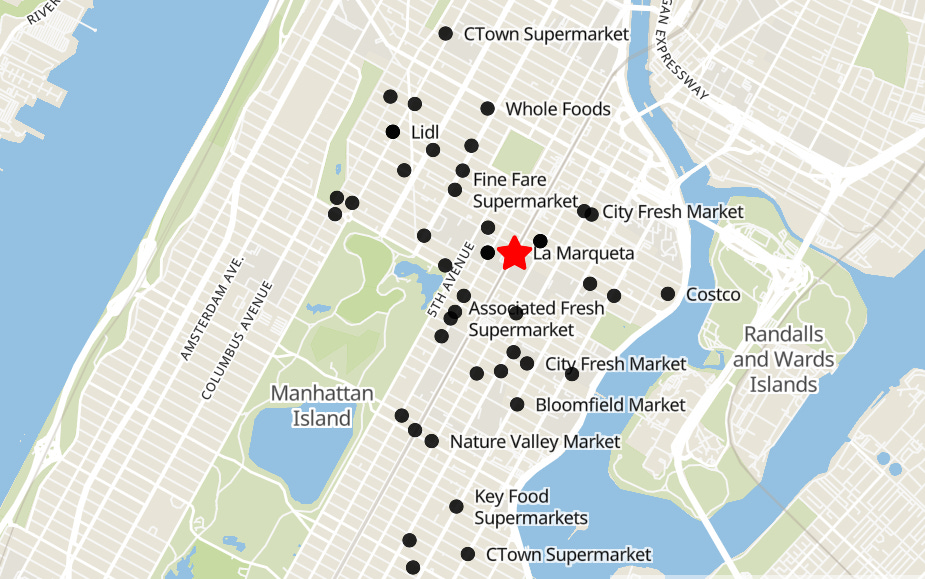
But let’s set the definition aside and take the underlying question seriously: does building new grocery stores in low-income communities actually improve nutrition? The literature here is remarkably consistent, and the answer is no.
A 2013 study in California analyzed data from nearly 98,000 adults and found that the number and type of food outlets within walking distance were not strongly associated with dietary intake, BMI, or obesity. A 2014 study evaluated the impact of a new supermarket opening in a Philadelphia community designated a food desert under the Pennsylvania Fresh Food Financing Initiative. The result? No meaningful changes in fruit and vegetable intake or body mass index.
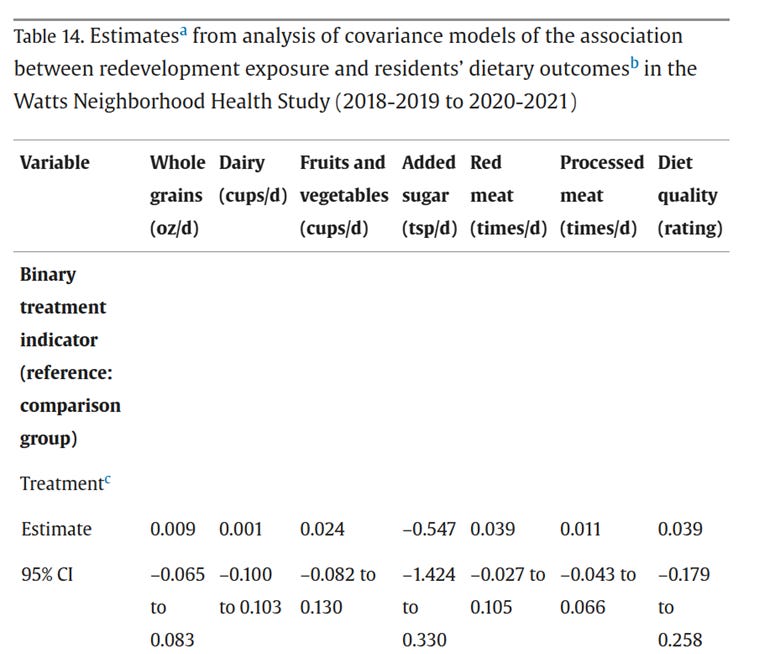
New York City too offers some evidence on this question. A 2017 difference-in-difference study compared two South Bronx neighborhoods, one of which received a new supermarket through tax and zoning incentives. The authors found that the new supermarket “did not result in substantial or broad changes in purchasing patterns or nutritional quality of food consumed.” A 2025 study of a new supermarket opening in a Los Angeles public housing neighborhood found no statistically significant differences in dietary outcomes.
The National Picture
These aren’t cherry-picked local studies. The most comprehensive analysis of this question, a 2019 study published in The Quarterly Journal of Economics, tracked 700,000 households and scanner data from over 42,000 stores across a 13-year period. The authors found no detectable increase in healthy purchases following supermarket entry, even two years after opening. This held in food deserts specifically.
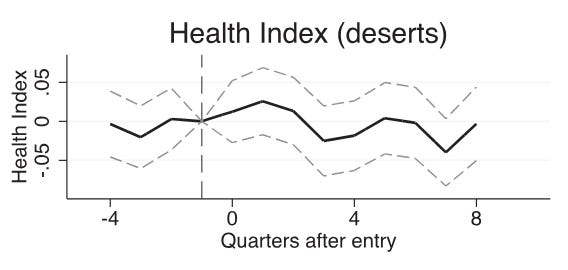
Crucially, the study also tested the obvious alternative explanations. Lower-income households often work long hours, which might favor convenient, shelf-stable, or processed foods. The authors control for this. It doesn’t change the result. When lower-income households experience the same prices for produce as higher-income neighborhoods, consumption barely moves. When stores in lower-income neighborhoods take on similar characteristics to those in higher-income neighborhoods, the effect is again negligible.
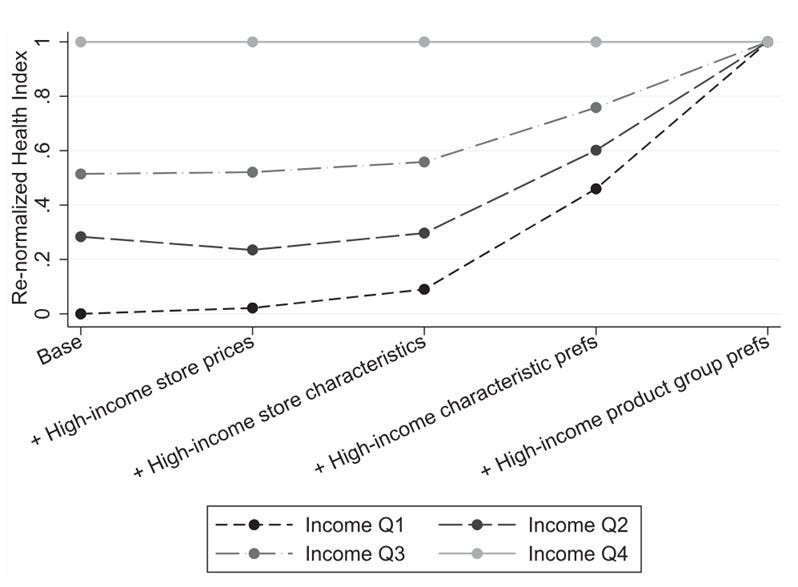
The only factor that closes the nutritional gap, in a statistically and economically meaningful way, is when lower-income households have the same preferences for healthy food as higher-income households.
Supply Isn’t the Problem
That finding is the key one. The gap in nutritional outcomes between income groups is not a supply problem. It is a demand problem. And the strongest predictors of that demand gap, according to the same research, are years of education and nutrition knowledge, not employment status, not weekly hours worked, and certainly not the distance to the nearest supermarket.
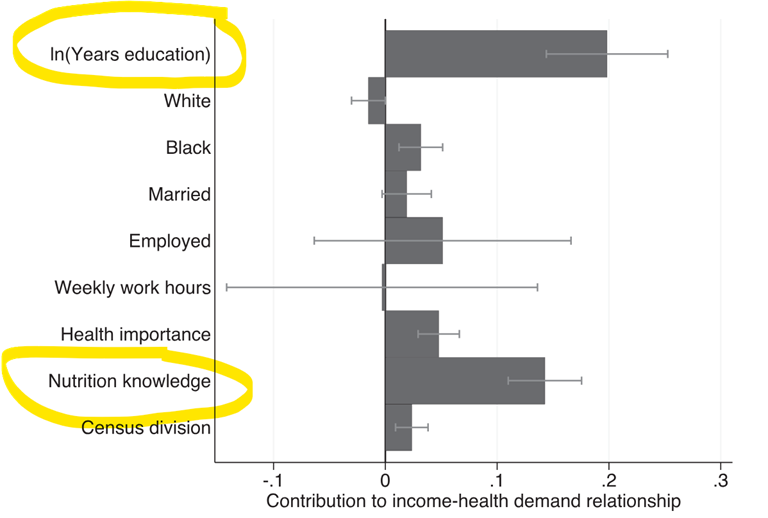
This is uncomfortable, because supply problems are easy to solve with government programs. You can build a store. You can open a clinic. You can draw a policy on a map. Demand problems, reflected in differences in education, knowledge, and preference formation, are harder, slower, and less photogenic.
But discomfort with the answer is not a reason to pretend the question has a different one. The literature is clear. Building a government-run grocery store in East Harlem will not close the nutritional gap between low-income and high-income households. It will cost taxpayers money to operate at a loss, compete with the 45 nearby stores that already exist, and leave the actual drivers of nutritional inequality untouched.
If policymakers nevertheless believe that some neighborhoods lack adequate grocery access, the first step should be to remove the regulatory barriers that discourage private supermarkets, neighborhood grocers, and specialty food retailers from entering those markets. Liberalizing zoning, streamlining permitting, and eliminating unnecessary parking requirements would make it easier for entrepreneurs to expand grocery access without requiring taxpayers to own and operate grocery stores.
The evidence also suggests that nutrition knowledge and consumer preferences matter far more than the location or ownership of grocery stores. If improving diets is the objective, policymakers should devote more attention to understanding how nutrition knowledge and healthy eating habits can be strengthened, rather than assuming that changing who owns the supermarket will change what people choose to buy.
Ultimately, the long-run solution to food affordability has never been government ownership of grocery stores. It has been economic growth, rising productivity, and competition. Those forces have reduced the share of household budgets devoted to groceries from more than one-fifth a century ago to less than five percent today. History suggests they remain a far more promising path to improving living standards than asking government to become America’s next grocery chain.
Minor suggestion: that 35 minute walk sounds intimidating when you consider it's 35 minutes back carrying those groceries too, and detractors will pick up on that as scary. But that 35 minutes is the maximum one-way distance, and assuming a random distribution, the average one-way walk is 17.5 minutes, and if there are 45 stores within that 35 minute radius, most must be a lot closer.
Better would be the largest circle with only 5 stores, or the longest walk to the closest store.
ETA but those calculations would be complicated. I wonder if Google's AI could do it.
As a mom, a lot of food preferences get wired quite early, starting from the womb. Pregnancy and postpartum are great windows of opportunity to change diets and eat better, especially as the body begs for more highly nutritious food. If things don't get changed at or around that intergenerational touchpoint, it's hard to change it elsewhere.