
This is part 3 in a series by our PGPF intern Dakota Stacy
A recent poll reveals 89% of seniors want to tax younger generations to pay for the social security shortfall doomed for 2032. This generational dispute is much the same in Japan too, where senior protestors with pensions in mind have hit the streets with a message to Takaichi’s administration: “Don’t lower the VAT rate!”.

Social security or pensions, both nations elders look to the government and its modes of taxation to deal with the existential crisis their nation’s debt has laid stage for.
Japan’s fertility rate seems to be all the talk in the mainstream; but surprisingly has one of the highest fertility rates in all of East Asia at 1.15. On the other end of the spectrum, the United States has a fertility rate of 1.54, but it too has dropped over 20% in the past two decades. While the U.S. does not carry the same existential danger as Japan, both countries reveal that government programs become political and increasingly difficult to cut. Thus, they are both holding onto the same problem: supporting entitlement payments.
The consequences
Outside of the looming entitlement payment issue, the $/JPY relationship is worth discussion.
Geopolitically the U.S.-Japan relationship wants to counter China, so beefing up Japan’s domestic industry via cheaper exports raises revenues and profits for Japanese domestic industries. This increase of revenue can help explain why the Nikkei is at an all time high after 30 years of a slow rebuild. Though how long that will last is up for debate.
The Quiet Implosion of Japan
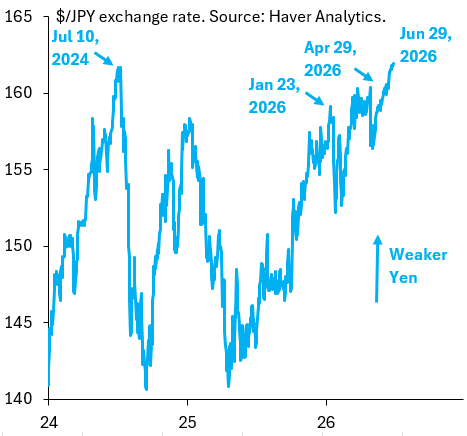
Robin J Brooks recently wrote about Japan’s foreign exchange (FX) issue in regards to the recent $/JPY exchange rate hitting 160. Critics may point to this graph and argue that ‘nothing ever happens’ because of a constant intervention threat from Japan’s government.
That intervention threat being the Bank of Japan capping bond yields to keep interest rates low for years.
But, because the artificially low interest rates fail to reflect the sentiments of the market, investors sell Yen as opposed to bonds. These interventions for supporting the depreciation pressure on Yen, as Brooks points out, might be precarious: “[the interventions] treat the symptom (Yen deprecation) and not the disease (too much debt)”. The worry is that interventions will become decreasingly effective over time and markets will ignore it entirely.
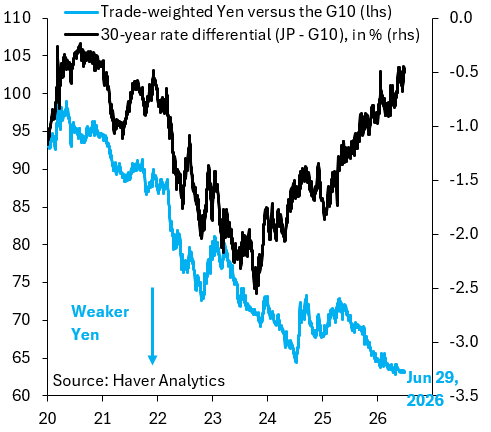
The graph from Robin above shows how the Yen averaged to the G10 (not just the Dollar) has failed to keep up with other 30 year bonds. He further wrote, “The fact that the rate differential keeps rising, i.e. Japan’s yields are going up vis-à-vis everyone else, and the best the Yen can manage is to tread water is a warning that Japan is in a very tricky spot”.
If we take it that the Yen will continue to depreciate, another important question to look into is how this may play with the United States.
How the $/JPY exchange rate affects the bond market
As touched on earlier, the Japan-U.S. relationship is real. Japan is the largest foreign holder of treasuries at $1.21 trillion, and one method of Yen depreciation intervention is to sell off these assets and buy back Yen with the dollar to strengthen it. If Yen continues to depreciate, renewed intervention becomes likely and to what extent depends on how uncertain markets view Yen. In 2024 for example, Japan sold roughly $95 billion of U.S. financial assets. If this number grows considerably higher in future selloffs — and it just might if the Yen continues to depreciate — we will see a higher supply of treasury bonds in the U.S. market, and when bond prices fall, yields rise. Higher yields means higher costs of borrowing, and an even larger interest payment on fiscal debt for both countries.
The Weakening of a Fragile Fiscal Position in The U.S.
One U.S. fiscal experiment can be found in Illinois. With a budget over $55.9 billion and an additional $800 million increase in taxes, what distortions may arise?
One particular distortion can stem from Japan.
Many states like Illinois often issue municipal bonds as opposed to treasuries. Yet, the municipal bond yield is closely tied to treasury bonds. As you may imagine, this is problematic.
For example: Japan sells dollar assets (most likely treasuries, Japan’s largest holding by far) → Treasury prices face pressure → Treasury yields rise → muni yields rise too → Illinois borrows at higher rates → Illinois pays more.
This is not speculation either. A Goldman Sachs report noted: “Munis underperformed Treasuries across the curve in March as heavy supply and renewed inflation concerns pressured valuations.”
What does this mean for Illinois? Well, The Illinois Policy Institute (IPI) reported, “Despite lawmakers’ claims of budget cuts, the 2027 budget will begin $700 million higher than the fiscal 2026 budget. Governor Pritzker has grown Illinois’ budget by $16 billion and enacted at least 57 tax increases that cumulatively have cost taxpayers more than $77 billion.”
All of this spending can have major implications if things remain the same — but things never do as the ancients teach us. If Japan (or other forces for that matter) inadvertently raise the yield of treasuries, it will spillover in states like Illinois already facing immense fiscal pressure.
Illinois plans roughly $3.2 billion in FY2027 bond sales, so a one-percentage-point increase in borrowing costs would add about $32 million in annual interest on that new debt alone. The larger problem is what this means in context. Illinois also carries roughly $143.5 billion in unfunded pension liabilities, with its pension systems less than half funded. If the pension gap were hypothetically treated like market debt, a one percentage point increase would represent about $1.4 billion in additional annual cost. While higher interest rates do not reprice that entire pension shortfall like a floating loan, they do make the state’s fiscal tradeoff harder: every additional dollar spent servicing new debt is a dollar unavailable for pensions or services.
Japan-related Treasury selling would not be the root cause of Illinois’ fiscal stress, but it could worsen the environment in which Illinois borrows as illustrated above. Put eloquently by Desmond Lachman at AEI, “Japan’s bond market woes might shine unwanted attention on America’s unsustainable public finances and on Trump’s relentless efforts to undermine Federal Reserve independence”.
Moreover, how will Illinois continue to pay for all of the borrowing? Their population and economy is shrinking.
Illinois’ Entitlement Issue & Decreasing Population
Illinois is not only a sharp example of bond market risk, but entitlement risk too. As mentioned, they have over $143.5 billion in pension debt and actuaries say the state needs to contribute at least $17 billion to truly fund the systems. They had a shortfall of more than $5 billion this year as well noted by the IPI, which means Illinois’ finances are almost certain to continue to deteriorate and put even more pressure on state spending in future years.
Pew found that from 2010-2025, Illinois’ population ranked 49th out of 50 states on a migration metric, and actually had a loss of 0.07% over those 18 years. Additionally, they are one of just three states expected to experience major depopulation within the next 30 years. How could this be?
Tax.
More specifically, 95% of people who left Illinois reported doing so because of taxes and stagnant economic growth. An additional 800$ million taxes in 2027’s budget doesn’t seem logical if the goal is to grow the population, a population needed to service the massive $143.5 billion pension debt.
Likewise, the Illinois Policy Institute found that: “since 2018, Illinois’ economy has grown just 7.4% – among the slowest of any state. In that same time, the state budget has grown over 36%, nearly five times faster than the economy. The U.S. economy has grown 18%, 2.5 times faster than Illinois’. To put that in perspective, that comes out to an average of less than 1% each year.
Taxes…
it seems Illinois illustrates the defects of Japan and the U.S. federal government’s cautionary tales in practice. As the state with the highest combined state and local taxes in all of the U.S., they spend over 30% of tax revenue alone on mandatory goods like state pensions and healthcare.
Japan’s population declines 0.75% each year and Illinois similarly declines 0.67%. Even more worrying, Illinois’ loss is voluntary and 60% of those who choose to leave are high net worth individuals — just about the last thing a state with high debt and stagnation needs.
Additionally, Jack Salmon points out that Illinois lost 429,034 residents over 5 years, which amounts to roughly $42 billion in income that state policymakers can no longer tax (over 2/3 of that income is from high earners).

At The Federal Scale
Replace Illinois’ 57% of pension to debt ratio with the federal governments 53% of social security / medicare / healthcare ratio and we find a similar issue with a familiar problem: entitlements. Perhaps a way to solve this issue is more taxes, and many argue that this should come from the wealthy.
But as the top 5% net worth individuals of the U.S. account for 60% of taxes, it seems in theory problematic to add more taxes on top of this minority. And in real life too, we see why this theory is true. Recall from earlier, 95% of illinoians left due to tax. And if you think it’s just Illinois where higher taxes encourage migration…
Millionaires are fleeing London, leaving Norway for Sweden (a country that removed wealth tax in 2006 after realizing the consequences of overtaxation), and South Korea’s wealthy too are leaving for Singapore and Hong Kong. Many more examples could be illustrated.
We see the effects of overbearing taxes in Europe, Asia, and domestically, too. Perhaps a lesson could be learned from Illinois for the rest of the states.
Conclusion
Japan is not an outlier so much as a warning. An aging population and falling fertility have left the country increasingly dependent on debt to sustain entitlement promises. The United States is not yet in Japan’s position, but it is moving in the same direction. Illinois shows what that trajectory looks like inside America: high taxes, large pension obligations, population decline, and shrinking fiscal flexibility.