

This is the eleventh part of a weekly project marking the 250th anniversary of Adam Smith’s Wealth of Nations. You can find the tenth installment here.
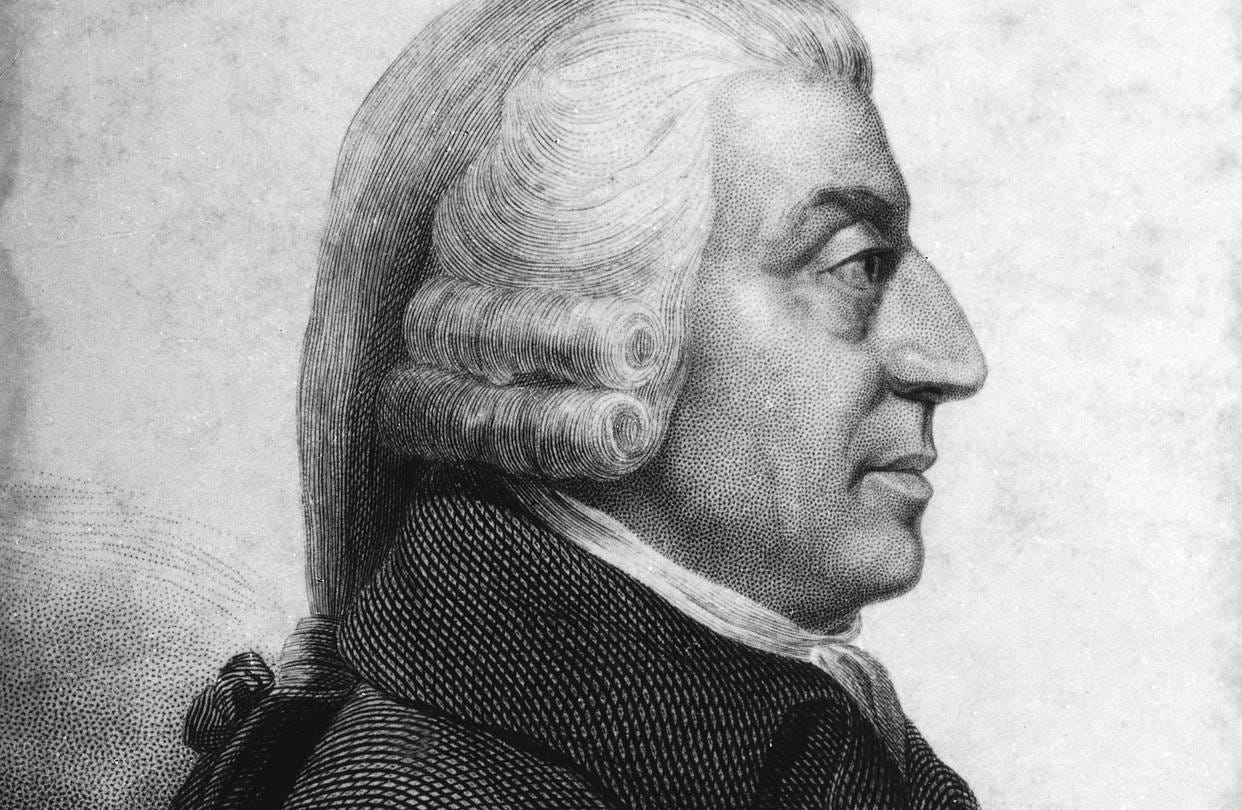
In Book V, Adam Smith turns from public works to another core function of government: taxation. If governments must raise revenue, the question is not whether to tax, but how.
Smith’s answer is both systematic and modern. Taxes shape behavior and alter decisions, making them as much a problem of incentives as of revenue collection. And badly designed taxes can do far more harm than the revenue they raise.
At the same time, his analysis is not without its limits. While he identifies many of the distortions taxes create, he does not fully account for how their burden is shared across individuals.
The Four Maxims of Taxation
Smith begins, unsurprisingly, with an enduring framework for thinking about taxation: his four maxims.
The first is that taxation should be proportional to ability:
The subjects of every state ought to contribute towards the support of the government… in proportion to the revenue which they respectively enjoy under the protection of the state.
It becomes clear later that Smith’s emphasis is less on proportionality than on participation, noting that he finds it “not very unreasonable that the rich” should pay a larger proportion.
The second maxim is certainty:
The tax which each individual is bound to pay ought to be certain, and not arbitrary. The time of payment, the manner of payment, the quantity to be paid, ought all to be clear and plain to the contributor, and to every other person.
The emphasis here is less on convenience and more on limiting opportunities for abuse by tax collectors, who could otherwise extract payments beyond what the law requires.
We don’t worry much about tax collectors trying to line their pockets in the U.S., but arbitrariness is a major issue here nonetheless, particularly the income tax.
Individual tax filers are responsible for calculating their income tax each year, often having multiple acceptable ways to do so. Utilizing additional methods to lower your tax bill, such as credits and itemized deductions, increases both the complexity of your tax return and the risk of being audited by the Internal Revenue Service—which also does not know what you are legally required to pay—even when you’ve followed all applicable tax laws.
The third maxim is convenience:
Every tax ought to be levied at the time… in which it is most likely to be convenient for the contributor to pay…
And the fourth maxim is efficiency:
Every tax ought to be so contrived as both to take out and to keep out of the pockets of the people as little as possible over and above what it brings into the public treasury of the state.
This is the most sophisticated of Smith’s maxims. Taxes impose costs beyond what they raise in revenue—costs for administration and collection, discouraging productive activities, resources used on attempted evasion, and the inconveniences from enforcement. A well-designed tax minimizes these additional burdens.
The Laffer Smithian Curve
By now, Smith’s incredible perceptiveness is more than obvious. But to highlight another unique insight he made almost 200 years before it became mainstream, see the following quote:
High taxes, sometimes by diminishing the consumption of the taxed commodities, and sometimes by encouraging smuggling, frequently afford a smaller revenue to government than what might be drawn from more moderate taxes.
When the diminution of revenue is the effect of the diminution of consumption there can be but one remedy, and that is the lowering of the tax.
In other words, Smith proposed an 18th century version of the Laffer curve—the idea that higher tax rates discourage activity (and encourage evasion), leading to lower revenues.
Why Property Is Taxed
Like many others, I’ve asked myself why the government taxes property, particularly land. “Is it really your property if the government taxes it?”
Smith offers a practical explanation for why taxes on property arose. Unlike capital or income, land is visible, immobile, and consistent:
the quantity and value of the land which any man possesses can never be a secret, and can always be ascertained with great exactness. But the whole amount of the capital stock which he possesses is almost always a secret, and can scarce ever be ascertained with tolerable exactness. It is liable, besides, to almost continual variations… Secondly, land is a subject which cannot be removed; whereas stock easily may. The proprietor… would be apt to abandon the country in which he was exposed to a vexatious inquisition, in order to be assessed to a burdensome tax, and would remove his stock to some other country where he could either carry on his business, or enjoy his fortune more at his ease.
Thus, the development of taxes on land appears to have been driven less by theory than by administrative practicality. Governments taxed what they could observe, measure, and collect without excessive cost or resistance. Land, unlike capital, could not be hidden, moved, or easily revalued, making it a stable and reliable tax base.
But this also reveals a deeper point. Tax systems are not designed in a vacuum. They are constrained by what can be enforced. The prevalence of property taxes is not necessarily evidence of their efficiency, but of their administrability. What is easy to tax is often what gets taxed.
For all of Smith’s insight into taxation, however, his analysis is not complete.
Where Smith Falls Short
Smith falls short in one important area: tax incidence.
He clearly understands that the person legally responsible for a tax is not always the one who ultimately bears its burden. In discussing taxes on profits, he notes:
…the final payment of the tax… will fall upon the consumer…
And in discussing taxes on necessities, he argues that they raise wages and are ultimately passed on through prices.
But he tends to treat tax incidence as shifting entirely from one group to another—producers to consumers, or employers to landlords. What he does not fully consider is that the burden may be shared.
In reality, taxes are often distributed across multiple parties:
partially absorbed by producers
partially passed on to consumers
and partially reflected in wages or returns to capital
This matters because it complicates the analysis of who truly pays.
Smith’s framework captures the direction of these effects, but not their full distribution.
The Limits of Tax Design
Smith’s analysis of taxation is remarkably modern. He understood that taxes are not neutral—they shape behavior, alter incentives, and impose costs beyond what they raise in revenue. His maxims remain a useful guide: taxes should be certain, convenient, proportional, and efficient.
He also recognized that poorly designed taxes can backfire. High rates encourage evasion. Arbitrary systems invite abuse. Taxes imposed without regard to incentives can reduce both economic activity and government revenue.
But while he understood that taxes can be shifted, he did not fully account for how their burden is shared. In practice, taxes rarely fall entirely on one group. They are distributed across producers, consumers, workers, and owners of capital in ways that are often difficult to observe.
This matters because it complicates the question of who ultimately pays.
Tax policy is not simply about raising revenue from a defined group. It is about understanding how that burden spreads through the economy.
And it is in that spread—often unseen—that many of the real effects of taxation are found.