

One of the persistent frustrations in debates over “degrowth” is that its core claims—centered on the idea that economies must operate within a “safe and just space” defined by social needs and ecological limits—are often difficult to test. The arguments are typically broad, philosophical and, critics might say, slippery. But now we are seeing the emergence of empirical studies that test these core claims—and find them wanting.
A new article by Vincent Geloso, Aleksander Psurek and Ashruta Acharya does exactly that. In “The Hole in the Doughnut: Formalizing and Testing a Key Model of Degrowth,” the authors take the most influential framework in the degrowth literature, Kate Raworth’s “doughnut model,” and formalize it, derive its empirical implications and test whether it actually works.
From Metaphor to Measurement
Raworth’s doughnut, shown in the figure below, has become the defining visual of the degrowth movement. It posits that economies should operate within a “safe and just space” bounded by a social foundation (meeting human needs) and an ecological ceiling (respecting planetary limits). The implication is that modern capitalism pushes societies outside this zone, producing both inequality and environmental degradation.
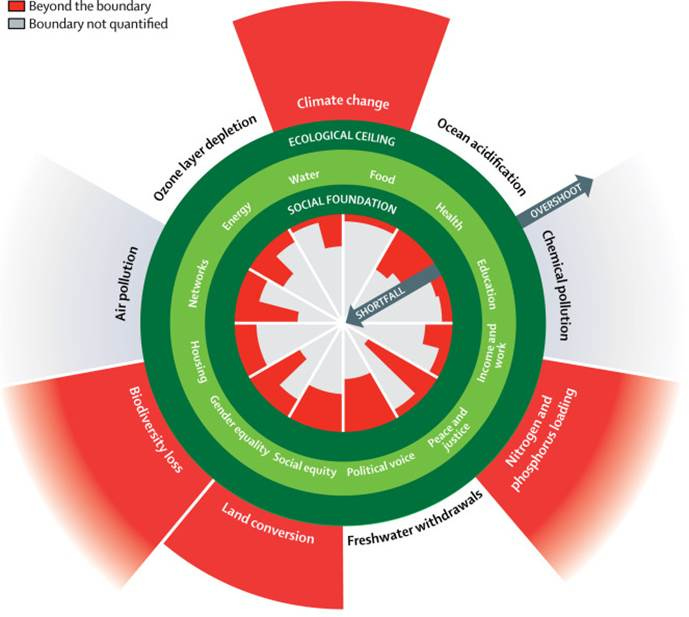
The appeal of the framework is intuitive, visually compelling and normatively attractive. Moreover, it’s not just a fringe idea in the economic and growth field—as table 1 of the Geloso et al. paper shows, it is one of the most widely cited degrowth models, gaining hundreds of new citations every year.
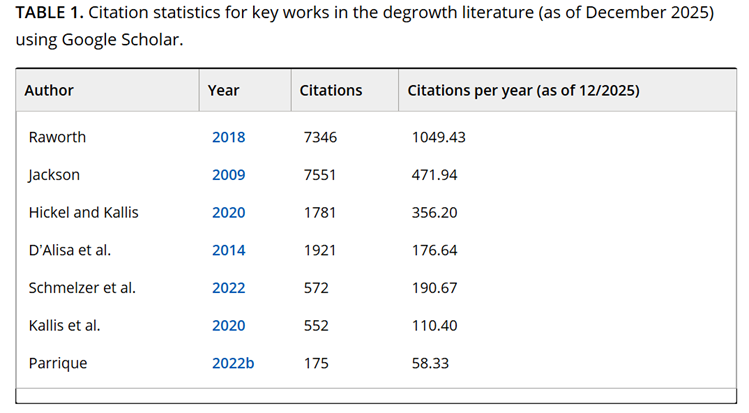
But until now, Raworth’s framework has largely escaped rigorous empirical scrutiny.
Geloso and his coauthors translate this doughnut framework into a measurable model. Social and environmental outcomes are expressed as normalized indices (ranging from 0 to 1), and “imbalance” is captured using the coefficient of variation (CV) across these indicators. Once formalized, the doughnut model generates a clear, testable prediction:
If capitalism (or economic freedom) drives unsustainable development, then more capitalist economies should exhibit greater imbalance, that is, a higher coefficient of variation across social and ecological indicators.
The Core Finding: The Prediction Doesn’t Hold
Using multiple datasets, specifications and indicator sets—including the Human Development Index (HDI) published by the United Nations Development Programme, inequality-adjusted HDI, Yale University’s Environmental Performance Index and Raworth’s own preferred measures—the authors test whether more economically free (i.e., more “capitalist”) countries exhibit greater imbalance.
Across panel regressions and cross-sectional analyses, the relationship between economic freedom and social/ecological imbalance is either statistically insignificant or runs in the opposite direction. In other words, more capitalist economies are not systematically more “unbalanced” in the sense the doughnut model predicts. If anything, they tend to be more balanced.
This conclusion is not a fragile result. It survives different measures of human development, different environmental indices, different functional forms and different samples and data constraints.
Each and every time, the doughnut model does not generate empirical results that match its own predictions.
Worse for Degrowth: Capitalism Improves the Levels Too
There’s an even more uncomfortable result for degrowth proponents. Not only does economic freedom fail to increase imbalance, it is often positively associated with higher levels of human well-being and environmental performance.
The authors explicitly note that economic freedom is “frequently associated with better outcomes” across measures like HDI, inequality-adjusted HDI and broader multidimensional indicators.
So, the data suggest two things simultaneously:
Capitalism does not create the tradeoffs the doughnut model predicts.
Capitalism is often associated with improvements across the very dimensions the doughnut cares about.
These findings directly contradict the central narrative of degrowth, that economic growth systematically undermines social and ecological outcomes.
This paper is significant not because it “debunks” every concern about growth or the environment. Rather, it shows that the leading theoretical framework of degrowth fails its most basic test: internal empirical consistency.
As the authors put it, before we argue about policy or ideology, we should ask whether the theory “can walk.” If it cannot generate predictions that match reality, there is little reason to build policy on top of it.
And that’s exactly the problem here. The doughnut model claims that growth and capitalism inherently produce imbalance. But when translated into measurable terms, that claim simply does not hold.
The Real Takeaway: Degrowth Adds No Explanatory Power
One of the most interesting aspects of Geloso et al.’s paper is what it doesn’t claim. The authors are careful not to argue that markets solve all environmental problems. Nor do they deny the existence of externalities, tradeoffs or policy challenges.
Instead, they make a narrower point: Everything the doughnut model tries to explain can already be explained within standard economic frameworks.
Whether you favor property rights and market-based solutions, Pigouvian taxes and regulation, or some hybrid approach, all these perspectives can account for the empirical patterns we observe.
Degrowth, by contrast, adds no explanatory power. It does not improve our understanding of the problem, and it fails to generate correct predictions. As the authors conclude, the model is “not empirically supported and may provide a limited guide for policy.”
The Doughnut Is Stale
Degrowth has gained influence not because it has been rigorously validated, but because it offers a compelling narrative: that growth is the root cause of modern crises. This new paper challenges that narrative at its foundation.
If the most prominent model of degrowth cannot survive empirical testing, even when evaluated on its own terms, then the intellectual case for degrowth becomes much weaker.
The debate over growth, sustainability and human well-being is not going away. But after this paper has tested the core claims of the degrowth literature, it is harder to argue that degrowth provides a serious analytical framework for that debate.