

For decades, the Earned Income Tax Credit has occupied a nearly sacred place in American social policy. The EITC is a refundable tax credit for low-to-moderate income workers, primarily those with children. Bipartisan, beloved, and backed by what seemed like ironclad research: the EITC expansions of the early 1990s caused the dramatic rise in employment among single mothers. Carrots work. Make work pay, and people will work. Case closed.
Except that the case was never really closed.
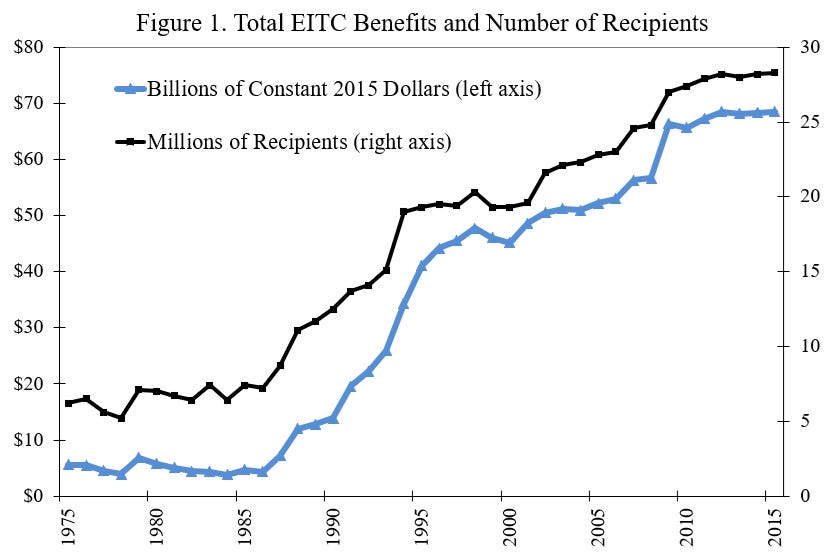
Years ago, Chris Edwards and I looked at the same data everyone else was citing and noticed something awkward. We had this chart:
And we wrote the following:
“Supporters of the EITC often point to the strong gains in participation of single mothers in the late 1990s as evidence of the EITC’s benefits. But while the number of EITC recipients soared between 1987 and 1994, the number was flat in the late 1990s, as shown in Figure 1. Yet the years from 1994 forward were precisely the years that labor force participation by single mothers was growing strongly. That suggests other factors caused much of the participation increase in the late 1990s—perhaps the strong economy at the time and welfare reforms that increased work requirements. Note that with the weaker economy after 2000, the participation of single mothers fell substantially, suggesting that it is the economy—not the EITC—that mainly drives participation changes.”
So we were skeptical about the EITC’s supposed work benefits based on the 1990’s experience, as were some other researchers such as Lawrence Mead. But the dominant narrative was that the expensive program was some sort win for everyone in the economy.
Now comes Adam Looney at Brookings with a formal replication of the four most influential studies behind the conventional view. What makes Looney’s paper different is not just the question he asks but the variable everyone else forgot to include, and the rigor with which he proves it was missing.
The standard approach in the influential studies of the 1990s was to compare employment trends across groups of mothers defined by the number of children. Mothers with two or more children received a much larger EITC expansion in 1993 than mothers with one child. So when mothers with two or more children showed larger employment gains in the years that followed, researchers concluded the EITC caused it or caused most of it. The logic seemed airtight.
The problem is that mothers with two or more children differed from mothers with one child in another critical way that those studies did not adequately account for: they were far more likely to be on welfare before the reforms began. Looney’s data show that before welfare reform hit, roughly 26.4% of mothers with two or more children were on welfare and not working, compared to about 12.8% of mothers with one child. When welfare reform tightened access to cash assistance, imposed new administrative hurdles, and pushed caseworkers to reduce caseloads, the families most entangled with the welfare system felt the greatest pressure to find work. Those were precisely the families with more children.
Previous studies sought to address the welfare reform concern by including state-level controls, essentially asking whether states with tougher welfare policies exhibited different employment trends. Looney shows why that is insufficient. The relevant variation was not which state enacted which policies, but which families within any given state were most exposed to those changes. Welfare reform operated at the caseworker level, proportionally to how dependent a family was on the system. State-level controls cannot capture that within-state variation.
Looney’s fix is a single additional control: an interaction of year dummies with each individual’s predicted pre-reform welfare exposure, estimated entirely from data before the reforms began. When he adds this one control to the specifications used in four of the most-cited studies in the literature, the estimated employment effect of the EITC collapses to zero in every case.
But Looney does not stop there, which is what separates this paper from a simple replication exercise. He runs two additional tests to rule out the concern that his welfare exposure control is simply absorbing the true EITC effect rather than correcting for bias.
The first is a reweighing exercise. He reweighs the one-child mother group to match the welfare-exposure distribution of the two-or-more-children group. Once the two groups are compositionally balanced on pre-reform welfare exposure, their employment trajectories become nearly identical. The divergence that the canonical studies attributed to the EITC disappears entirely when the groups are made comparable on the one characteristic that the original designs ignored.
The second is a placebo test. He constructs artificial treatment and control groups from within the same EITC eligibility category, meaning groups that by construction faced identical EITC incentives and for whom the true treatment effect must be zero. That nonetheless finds large spurious effects, and the size of those spurious effects is directly proportional to the difference in pre-reform welfare exposure between the placebo groups. The actual published estimates from the canonical literature fall on exactly the same line as the placebo estimates. In other words, knowing nothing about EITC policy and only knowing the baseline welfare exposure gap between the two groups is enough to predict what the published studies found.
He also runs a simulation that randomly removes mothers from welfare, with no differential effect by the number of children or any other characteristic, at rates matching the actual caseload reductions observed in the data. That simulation, with no EITC variation whatsoever, reproduces the canonical difference-in-differences estimates almost exactly.
As a final step, he shows that the same bias afflicts an entirely separate literature on welfare time limits that uses different treatment groups and an entirely different identification strategy. That those estimates collapse in the same way when welfare exposure is controlled for reinforces the conclusion: the problem is not specific to any one study’s design. It is a systematic failure to account for differential exposure to welfare reform that ran through an entire generation of research.
This is impressive work. But the data have always pointed in this direction, and I am glad that we now have a chance to have a better policy conversation without the reflective worshipping of the EITC. The EITC was never the miracle program its advocates described.
Unfortunately, the place where I point out that EITC is also a very expensive program, one of the reasons why so many people don’t pay any income tax. It is also a program that suffers from a massive rate of overpayments and some fraud. Finally, it creates some disincentives to work too.
While the credit doesn’t meaningfully boost labor supply, the phase-out part, where benefits are withdrawn as income increases, does discourage additional work. Chris and I pointed this out too.
“To summarize, people have an incentive to reduce hours worked in both the flat and phase-out ranges of the credit. As it turns out, about three-quarters of people taking the EITC are in those two ranges where the work incentives are negative.17 So economic theory indicates that a large majority of people taking the EITC have an incentive to work less, not more. Based on this factor, a Tax Foundation simulation found that the EITC reduces overall U.S. output and employment.”
For more on this, please read our piece with Chris Edwards. It turns out it is not that outdated after all.