

A question economist have been exploring for decades is whether we actually know what minimum wage increases do to employment. But an equally important question is whether the methods economists have increasingly relied upon to answer that question are as clean as advertised.
A new working paper by David Neumark and Antonio Rodriguez-Lopez, “Modern Difference-in-Differences, Same Old Answer,” lands a serious blow against recent high-profile research claiming that minimum wages have little to no effect on jobs. Their argument isn’t that event-study designs are bad. It’s that the null results attributed to these methods are artifacts of specific, defensible-sounding, but ultimately flawed researcher choices that, once corrected, yield the same old answer: minimum wage increases reduce employment.
The Methodological Sleight of Hand
The papers in the crosshairs are Cengiz, Dube, Lindner, and Zipperer (2019), known in the literature as CDLZ, and a recent Handbook of Labor Economics chapter by Dube and Lindner (2024). Both of these are influential studies. CDLZ’s stacked event-study design has become something of a gold standard in the minimum wage literature, cited over 3,000 times, with a majority of citations specifically referring to the stacked design. Dube and Lindner’s handbook chapter has helped cement the narrative that modern diff-in-diff methods “correctly show a null effect.”
Neumark and Rodriguez-Lopez, working with the same data, the same period coverage, and the same event-study architecture, identify several choices embedded in the null-results papers that are doing a lot of work.
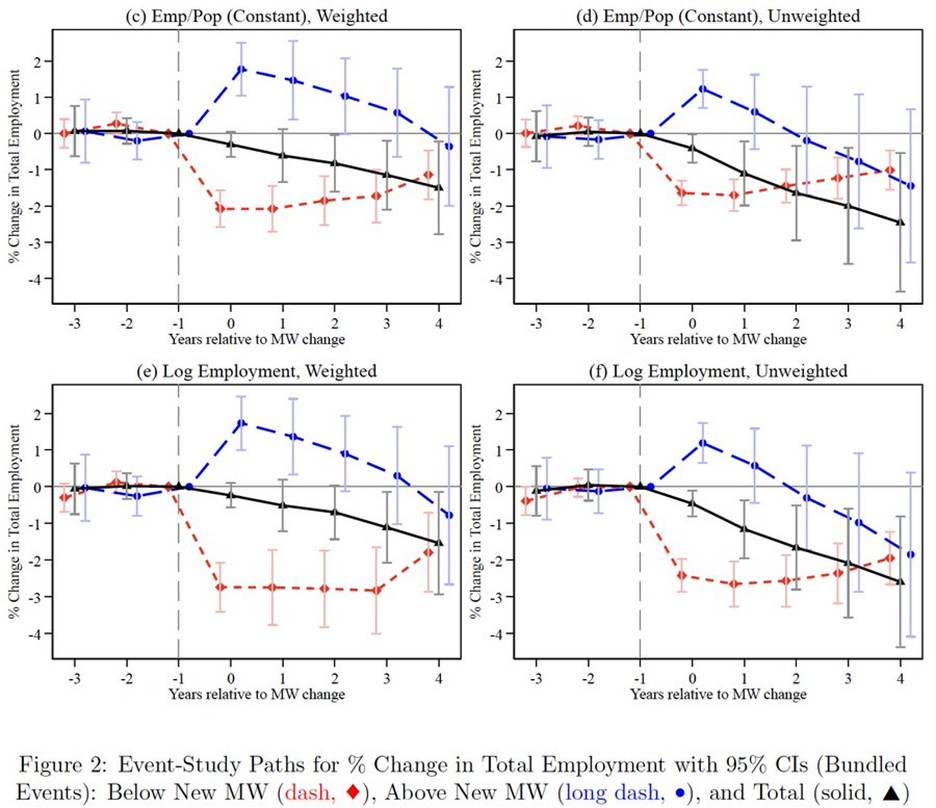
The most striking is the dependent variable. CDLZ measure employment as a share of a varying population, that is, the current population in each period, which itself changes in response to minimum wage policy. This matters enormously. There is a well-documented negative relationship between minimum wages and population: higher minimum wages tend to reduce population in affected areas, as workers and firms relocate. When both employment and population fall after a minimum wage hike, the ratio of the two can actually increase, making it look as though jobs were created when in fact jobs were destroyed. CDLZ never justify this choice, and it’s inconsistent with their stated goal of estimating effects on low-wage jobs.
When Neumark and Rodriguez-Lopez switch to either a constant population denominator or simply log employment, both more defensible specifications, the long-run employment elasticity shifts from a statistically negligible +/- 0.01 to a significant -0.09 (weighted) or -0.20 (unweighted).
The Range Problem
The second major issue is sample truncation. CDLZ’s stacked design focuses only on jobs in the four-dollar range below and five-dollar range above the new minimum wage. The implicit assumption is that minimum wage effects are zero outside this band and that firms don’t respond to a wage floor by cutting jobs across the broader wage distribution. Neumark and Rodriguez-Lopez show this assumption is wrong. When firms exit the market due to minimum wages, jobs are destroyed along the entire wage distribution, not just in the directly affected wage bins. Including employment effects outside the restricted range yields significant additional job losses.
Restaurants: Even Harder to Dismiss
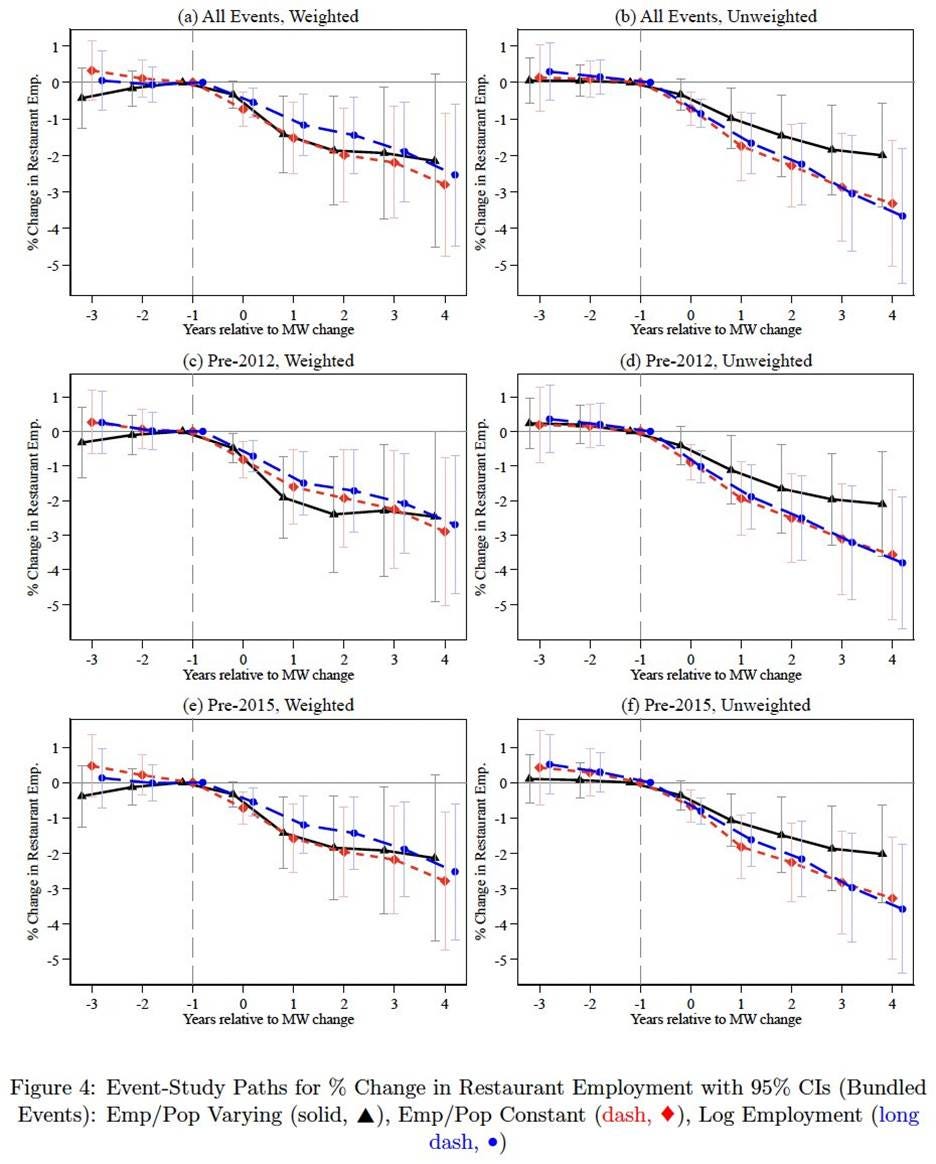
The restaurant sector has long been the canonical case study in minimum wage research, precisely because it employs many low-wage workers and faces thin margins. Even the null-results literature concedes something here: Dube and Lindner’s own estimates show a weighted own-wage elasticity of -0.03 for restaurants.
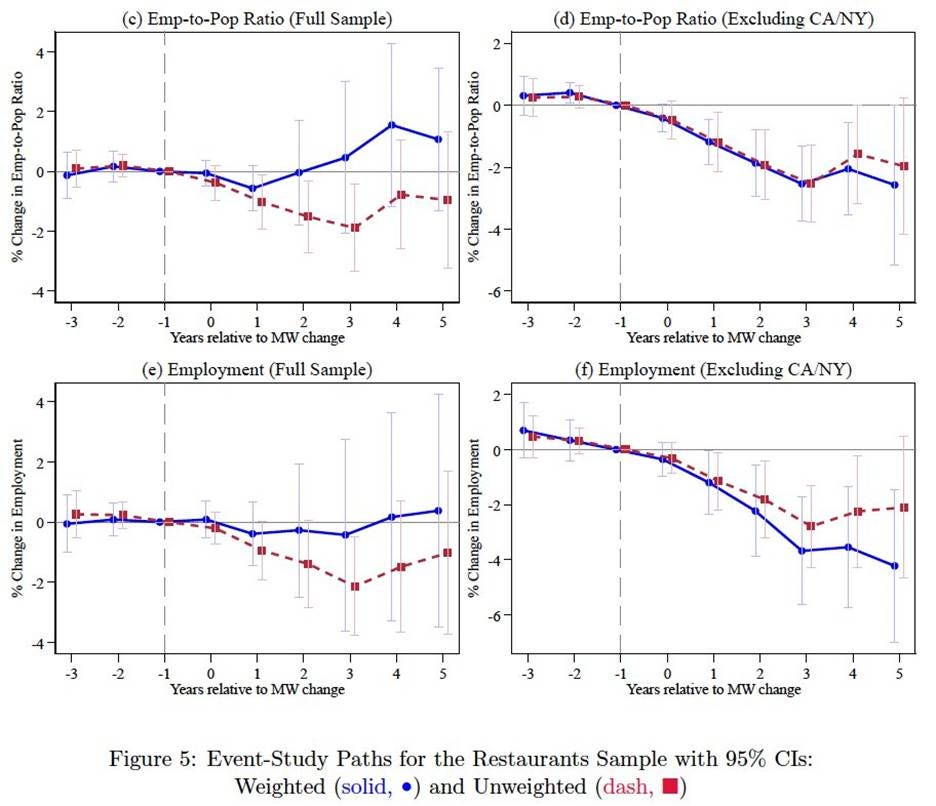
Neumark and Rodriguez-Lopez find something more striking: this estimate is so fragile it collapses under the weight of a single methodological choice. Switch from weighted to unweighted estimation and the restaurant own-wage elasticity moves from -0.03 to a significant -0.38. The difference turns out to be driven by California and New York, two enormous, high-productivity, high-wage states that dominate weighted regressions. When those two states are excluded from the Dube-Lindner analysis, both weighted and unweighted estimates point to job losses. What’s true in California isn’t necessarily true in lower-wage labor markets, and those markets are where minimum wage increases hit hardest.
In the restaurants sample excluding California and New York, the employment-to-population ratio declines steadily and significantly in the years following a minimum wage event, reaching -2 to -3 percent by year four or five. In the full weighted sample, that signal is swamped by the gravitational pull of two states whose labor markets are sufficiently tight that minimum wage hikes may genuinely be less disruptive.
What This Is Really About
This paper is a case study in what we might call methodology laundering, the use of ostensibly rigorous modern techniques to lend credibility to findings that ultimately depend on contestable underlying choices. The stacked event-study design is not the problem; it’s a genuine methodological improvement in many respects. The problem is that null results have been presented as if they follow inevitably from the design, when in fact they follow from the design plus a moving denominator, plus a narrow wage window, plus a weighting scheme that amplifies the most unusual labor markets in the country.
None of these choices are obviously wrong on their face. Some even have superficially plausible justifications. But taken together, they systematically push estimated effects toward zero in ways that would not be expected under genuinely neutral research design.
Getting the employment effects of minimum wage right isn’t an academic exercise. States and cities are setting wages well above historical norms, often relying on research that, as this paper shows, is more fragile than its prominence suggests.
The same old answer, it turns out, was right.
Who will read this and come to their senses about the loss of time and intellect being directed to these trivial exercises? None. Journals and universities will continue sponsoring faulty research that, rather than perfecting theory - positive economics - ends up looking more like an ideological pursuit in search of some distorted reality that conforms to prior established beliefs rather than novel evidence.
Thanks for this piece.
I am shocked - shocked - that leftists would put their thumbs on the scale in such a fashion.
The idea that minimum wage laws don’t decrease employment is idiotic - even if it’s fair to argue about the degree.
That the leftist-biased media-academia complex highlight the results that are most beneficial to the leftist worldview is… beyond unsurprising.
That they are no bothered by the fact that said laws disproportionately harm low-skill minorities in getting on the job ladder and learning valuable skills - as Thomas Swowell teaches in his books - is the even more indefensible point, in my view.