

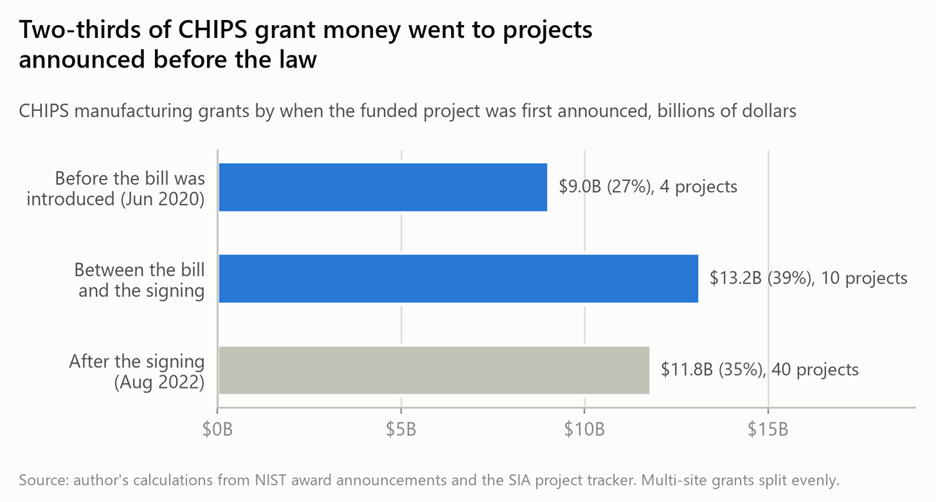
Congress is preparing to extend a semiconductor tax credit that is subsidizing investments companies had already decided to make. Of the CHIPS funds that I could match to publicly announced projects, two-thirds went to projects announced before the law was signed. Yet policymakers and industry lobbyists are presenting the program as a triumph and asking Congress to extend it through 2031 and expand it to additional activities.
2022 was a big year for corporate welfare as hundreds of billions of dollars in taxpayer funded subsidies were handed out through both the Inflation Reduction Act (IRA) and the CHIPS and Science Act. The latter included $39 billion in subsidies for domestic chip manufacturing along with 25% (raised to 35% with the OBBBA) investment tax credits for costs of manufacturing equipment.
That tax credit, created in 2022, known as Section 48D, extends to construction that begins by the end of 2026. As we would expect, policymakers in congress have been calling for that Section 48D construction deadline to be extended through 2031, and it is possible that they will attempt to squeeze this into a tax extenders package in the coming weeks.
This would involve transferring another $40-50bn in taxpayers’ dollars to large semiconductor companies over the next 5 years. And as the Milton Friedman quote goes, there is nothing as permanent as a temporary government program. $50bn quickly becomes $100bn+ as corporate welfare is continuingly extended.
Another point worth making here, is that by artificially raising the returns to semiconductor investments, the credit encourages resources, including investment funds, labor, and construction capacity, to flow toward politically favored projects and away from potentially more productive uses elsewhere in the economy.
Along with policymakers, corporate lobbying groups are out in force calling, not just for extension of the credit, but also for expanding the credit to other activities. A coalition of business groups wrote a letter to congressional leadership earlier this year, in which they noted:
“To date, the tax credit has catalyzed over $640 billion in investments throughout the supply chain across 140 projects in 30 states—more than tripling U.S. semiconductor manufacturing capacity.”
The catalyzation of $640 billion in investment is based on announced investments, not money already spent. This is an important distinction because a GAO report found that only about 15 percent of companies receiving CHIPS subsidies had submitted milestone completion reports for their projects. Milestones relate to construction of facilities, installation and qualification of equipment, and meeting minimum production levels.
More importantly, the $640 billion figure is not a measure of investment eligible for Section 48D. It is a grand total of announced investment across the semiconductor supply chain, including chip design, R&D, and materials production, which the letter’s own footnote admits are excluded from the credit. They are, therefore, dishonestly using ineligible investments to claim that the credit succeeded, while simultaneously asking Congress to expand the credit to cover those same activities.
Not only did the $640 billion estimate ignore the counterfactual, but also the timing of the investment announcements. The investment figure covers projects announced since 2020, but Section 48D was signed into law in 2022. Meanwhile the industry describes a projected tripling of US capacity, but its own forecast shows America’s share of global capacity rising only four percentage points, from 10 percent to 14 percent.
Another point worth making is that the semiconductor industry was thriving before the signing of the CHIPS Act and continues to thrive today. This is not a sector in desperate need of taxpayer subsidies. For example, leading chip manufacturer, TSMC, is making record profits, with over $22 billion in profit last quarter, up 73% from last year.
The SIA’s own report makes it difficult to portray semiconductors as a struggling industry in need of rescue. US-headquartered firms generated $425 billion in sales last year, captured 53.4 percent of global semiconductor revenue, spent $76.8 billion on R&D, and announced more than $770 billion in new investment. The report supplies no counterfactual showing that taxpayers are needed to make these investments happen.
A corporate subsidy like 48D should be judged by what it changes, not by what follows it. This is the test of additionality. Did the subsidies buy investment that otherwise wouldn’t have happened, or were they transfers to large corporations being rewarded for investments that were coming regardless of the availability of subsidies?
In an attempt to answer this question, I matched each CHIPS grant to the Semiconductor Industry Association’s tracker of announced projects and dated each project’s first public announcement. Of the roughly $34 billion in grants I could match, $22 billion, or 65%, went to projects first announced before the law was signed. So did seven of the ten largest grants.
About $9 billion went to projects announced before the bill was even introduced in June 2020, led by TSMC’s Arizona fab, unveiled that May.
On a related note, real value added in US semiconductor and electronic-component manufacturing remained almost exactly where the pre-2022 trend predicted it would be, at about $138 billion in 2025 versus a trend value of roughly $139 billion (chained 2017 dollars).
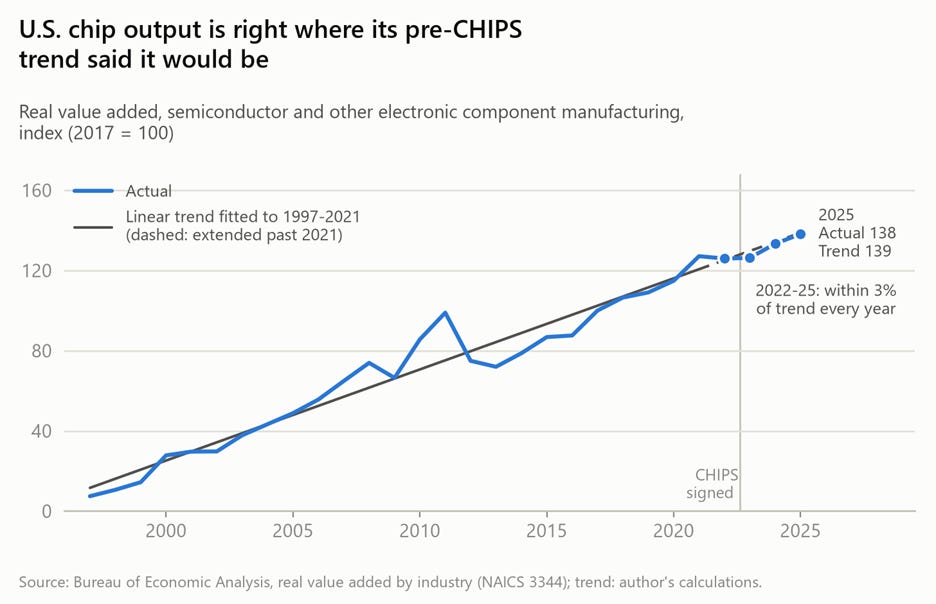
Putting these together, it looks like the Section 48D subsidies were largely a windfall.
Defenders will say firms moved early because they saw subsidies coming. That’s possible, but it is their claim to prove. The evidence can’t tell anticipation apart from a shortage-driven investment cycle that was already under way. Before Congress extends the tax credit or funds another round of grants, the burden of proof should sit with those who want to spend more, not with taxpayers.
If policymakers are serious about supporting a robust and thriving domestic semiconductor industry, one of the ways to do that is by applying neutral cost-recovery rules available to all industries, not through politically allocated subsidies for favored companies.
OBBBA moved substantially in this direction, making full expensing permanent for equipment and domestic R&D while temporarily extending it to certain manufacturing structures. But it stopped short of genuinely neutral cost recovery. If policymakers are serious about supporting a robust domestic semiconductor industry, they should finish the job by applying neutral cost-recovery rules available to all industries.
Another way policymakers could increase output and production in the semiconductor sector would be to stop imposing taxes on the inputs for the very fabrication plants that they’re subsidizing. Fabs depend on more than 100 chemicals and materials, and the United States lacks capacity to scale production for roughly 60% of those inputs. Tariffs on chemicals, materials, equipment components, and construction inputs raise U.S. production and R&D costs.
The Federal Reserve Board’s recent manufacturing survey found that tariff-exposed subsectors experience faster growth in input prices. The computer and electronic products sector, which includes semiconductor manufacturing, saw substantial input-price pressure consistent with margin compression.
Similarly, in a survey of 156 semiconductor executives, 63% identified tariffs as a high concern for the next three years, while respondents reported that tariffs raise production costs and force changes in manufacturing strategy.
The United States still depends heavily on imported equipment, chemicals, materials, and components, so tariff relief would reduce costs across the entire supply chain without selecting particular companies or projects for federal subsidies.
That is the better way to support a semiconductor industry that is already globally competitive: remove economy-wide barriers to investment and production rather than continue sending targeted checks to politically favored firms. Congress should let Section 48D expire and allow the industry to compete on the strength of its underlying fundamentals.