

2026 has been a big year for gas prices. Over the course of the last year, in large part because of huge shifts in global oil markets due to the war in Iran, prices have shot up. This has been an especially salient point in the diesel market, where trucks use more fuel to fill their tanks at a higher price.
Over the course of the past few weeks, this has been especially bad, going from $5.599 a gallon at the end of August to $6.285 a gallon by mid-September. This is a 12.3% increase in just 2 weeks, and at this rate it isn’t hard to imagine diesel rising as high as $7 a gallon as the national average price by October. For trucks with 36-gallon tanks, such as the Ford F150, this would mean spending $252 just to fill up once.
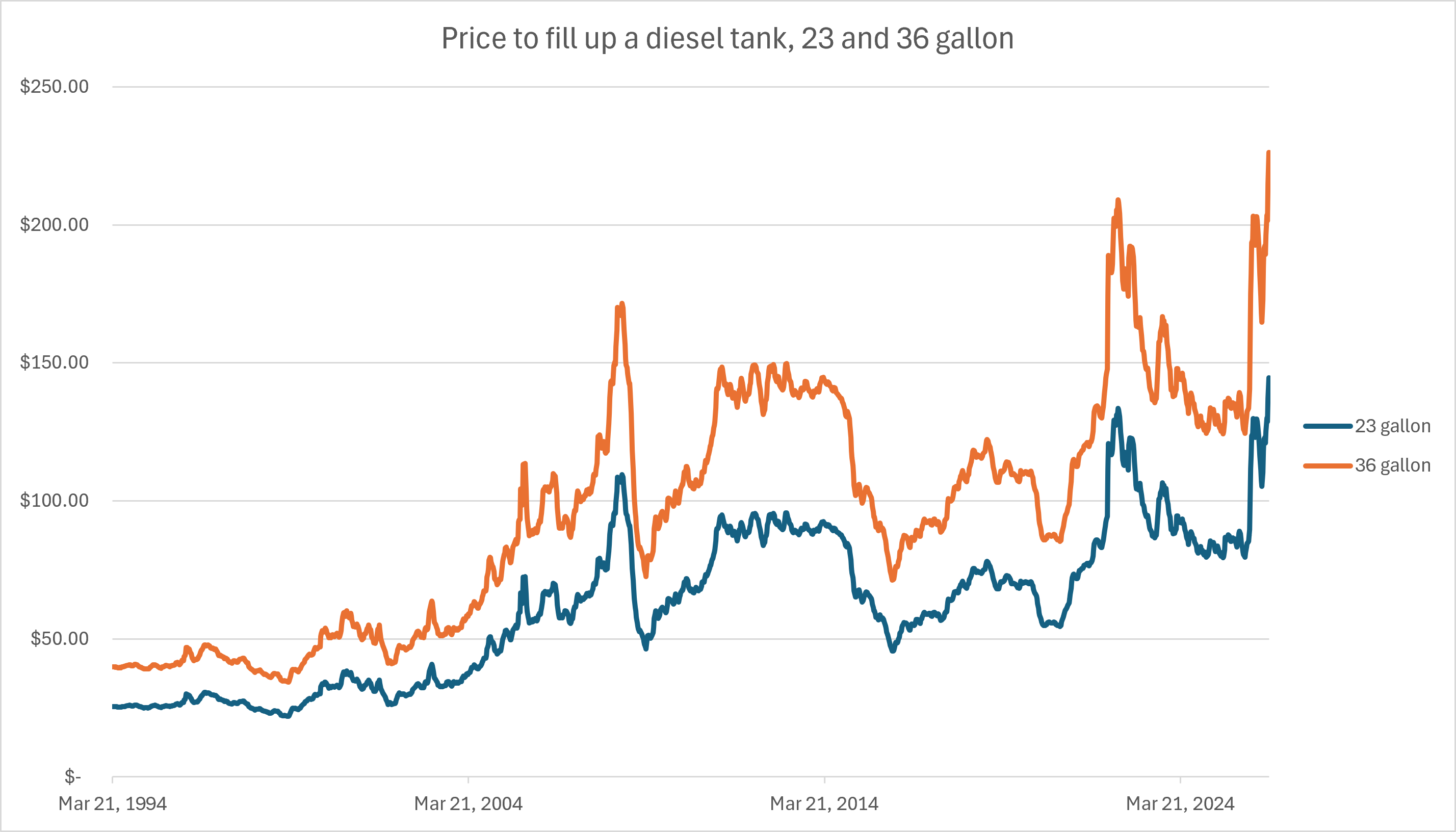
This rise from $6.285 a gallon to $6.999 a gallon would increase the cost of fueling once by $24.7, which is the equivalent of adding almost four gallons that need to be filled without any of the benefits of having the extra space. On top of this, these costs will inevitably be passed through diesel-heavy industries such as agriculture, manufacturing, transportation, and shipping, further decreasing affordability.
Long-range trucking will notice these costs even more than consumer-grade trucks. Semi-trucks typically have tanks ranging from 100-150 gallons in size, and many are fitted for interstate commerce and have two of these, meaning that this cost increase could push truckers to spend over $2,000 each time they want to fully fuel their trucks.
When input costs rise, companies offset them in part by raising retail prices. For diesel, this means that commercial trucks paying more for fuel will lead to higher shipping costs, which could lead to higher grocery and department store prices. This is true as well for agriculture, where the cost of producing each bushel is included in the price of the output.
The war in Iran has caused global shipping to take a hit in large part because of blockades and fighting near the Strait of Hormuz. Currently, about 20% of the world’s oil passes through the Strait, and when supply chains are stressed in this way, prices rise across the board. This becomes especially interesting when one considers how important affordability has been recently, and with the midterms approaching, this gives us a decent look into how the elections are going to go. Few things are as blatantly unpopular as costing Americans millions of dollars in excess fuel costs and rising prices.