

Policymakers are rightly concerned about housing affordability. But as is often the case with seemingly obvious problems, many of the proposed solutions would likely make things worse.
Take a recent Wall Street Journal article by Rep. August Pfluger, in which he outlines his goals for “Reconciliation 2.0.” Among them is a proposal to eliminate the capital-gains tax on primary home sales to expand the housing supply. Rep. Pfluger correctly identifies the core issue—insufficient housing supply—but his proposal wouldn’t increase it in any meaningfully way.
Right now, homeowners can exclude up to $250,000 of capital gains from taxation when they sell an owner-occupied home ($500,000 for married couples). The logic behind this policy is straightforward: most sellers use the proceeds from the sale of one home to buy another, and the tax code aims not to penalize that transition.
Pfluger’s argument hinges on the assumption that homeowners are holding onto their properties because gains above the exclusion would be taxed. If that’s true, lifting the cap would encourage more homeowners to sell, increasing supply and lowering prices.
Maybe. But probably not.
The problem is that most sellers are also buyers. A recent Zillow report showed 57% of sellers in 2025 bought another home. That’s up from 54% in 2024 but down from the unusually high rates of 70% in 2022 and 2023, and from pre-Covid levels above 60%. Even if this policy induced more listings, it would simultaneously create more buyers—diluting any downward pressure on prices. And if we did get a one-time bump in listings, it would do nothing to address the real affordability problem: we’re not building enough homes.
Worse, removing the cap would amplify the tax code’s built-in bias toward homeownership—both relative to renting and as a favored investment vehicle. To qualify for the full exclusion, you only need to have owned and lived in the home for two out of the last five years and not used the exclusion on another home within the past two years. Beyond that, you can claim the benefit indefinitely, every two years. That makes homeownership a uniquely strong, tax-free investment for many people.
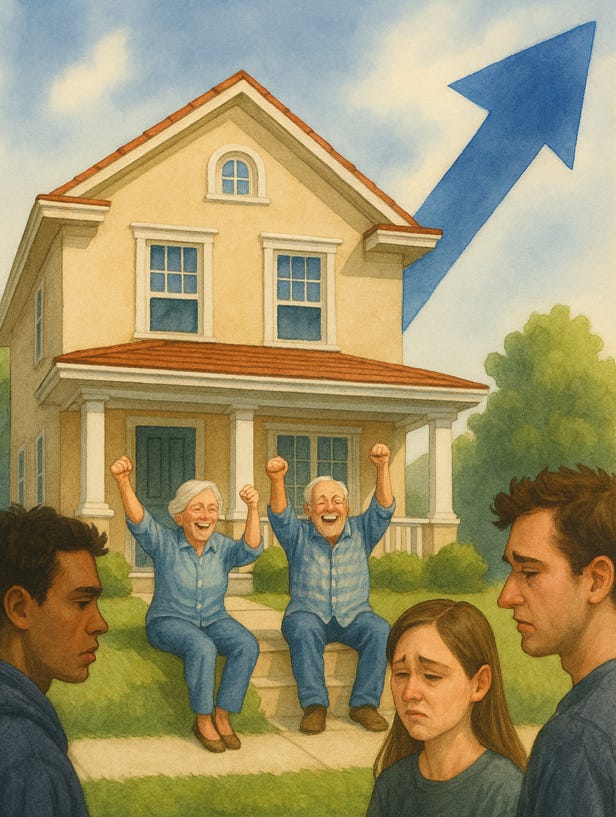
Of course, this would be a windfall for existing homeowners. But they aren’t the ones struggling. The real pain is felt by people trying to become homeowners. Federal tax preferences like the capital gains exclusion and the mortgage interest deduction—combined with restrictive state and local zoning—treat housing as an appreciable asset first and a place to live second. That’s a recipe for entrenched unaffordability.
Rather than expanding a distortive tax preference, policymakers should work to neutralize the tax treatment of capital gains. A straightforward, but unpopular approach, would be to simply eliminate the special exclusion of capital gains for home sales. A more palatable, pro-growth, pro-investment, and pro-affordability approach would be to either pair elimination with a revenue-neutral across-the-board reduction in the capital gains tax rate or to create a universal, revenue-neutral capital gains exclusion that doesn’t privilege certain asset classes over others.
Housing affordability won’t be solved by doubling down on the policies that helped break it. It’s time to rethink the incentives baked into the tax code.
Boomers with sons & daughters aren't celebrating, we are worried about their future because of massive government spending
“Housing affordability won’t be solved by doubling down on the policies that helped break it.”
While I agree that this capital gains exclusion change would do nothing to solve the housing problem, claiming that the existing exclusion for selling a primary residence is any meaningful part of the reason for the problem is also incorrect hyperbole, which obfuscates more than illuminates.