

U.S. borrowing costs are rising even as measures of expected inflation remain broadly stable. Investors are demanding greater compensation for holding long-term debt, while Treasurys appear to be losing the special status that once allowed Washington to borrow more cheaply.
Over the past year, the yield on the 10-year U.S. Treasury— a key benchmark influencing mortgage rates and other borrowing costs—has risen to just above 5%. Between September 18, 2025, and the same date in 2026, the increase was 90 basis points (0.9 percentage points), from 4.11% to 5.01%. Part of this can be attributed to higher expected short-term rates in the future (think recent, and possibly future, Federal Reserve rate hikes). In that same time, however, measures of expected inflation have moved horizontally.
The rise in interest rates is therefore largely driven by growing real (inflation-adjusted) interest rates. To understand what is behind this increase, we need to dissect the real long-term interest rate.
The Rising Term Premium
The term premium is the additional return investors require to hold a long-term bond instead of repeatedly investing in short-term debt. Holding a bond for 10 years exposes investors to uncertainty about future inflation and interest rates. Unexpected inflation erodes the purchasing power of the bond’s fixed payments; rising interest rates reduce its resale value.
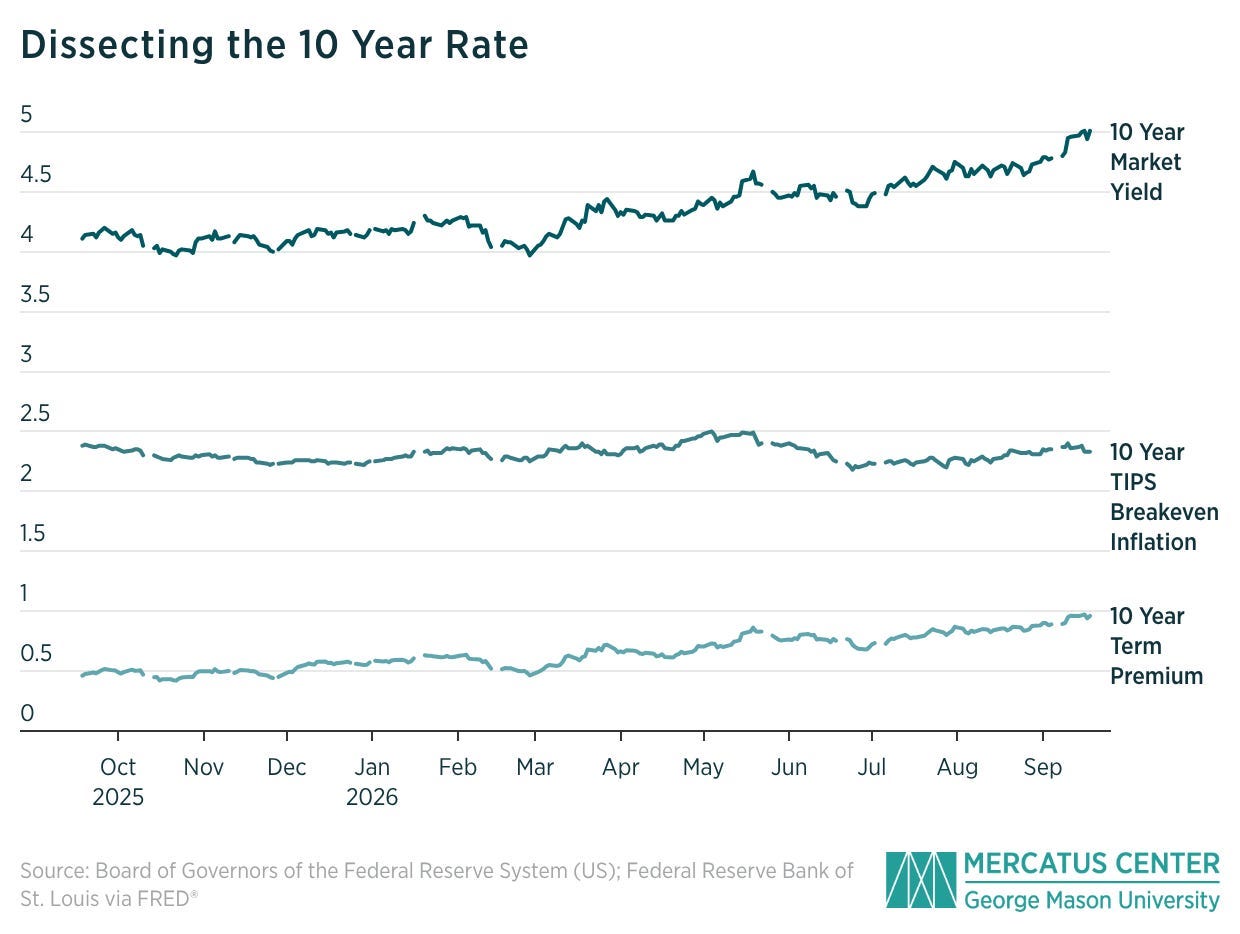
Over the 2025–2026 period, the estimated term premium rose from approximately 46 to 96 basis points, as shown in the figure above—an increase of half a percentage point. Using these estimates, the term premium accounts for roughly 56% of the increase in the 10-year yield. The implication is significant: More than half the rise in yield reflects the market’s demand for greater compensation for holding long-term debt. Understanding why borrowing costs have increased therefore requires examining both the expected path of Federal Reserve policy and what is making investors demand a higher premium to lend for 10 years.
Losing the Convenience Yield
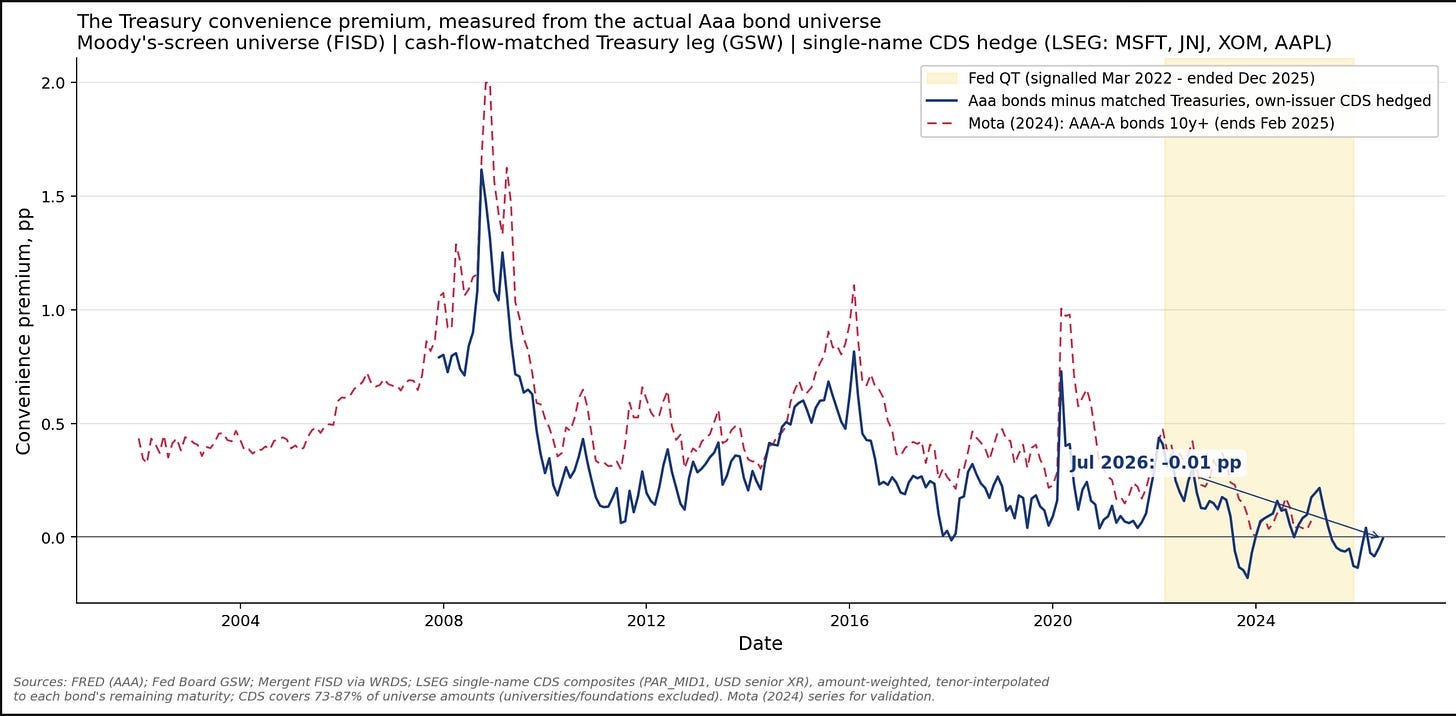
A higher term premium is only part of the story. Treasurys also appear to be losing the discount investors once accepted in return for their safety and liquidity. Traditionally, investors have been willing to forgo a certain amount of yield when holding Treasurys because of their apparent safety and high liquidity. This discount is called the convenience yield. Its size can be measured by comparing a Treasury to a “synthetic” Treasury, constructed by taking another debt security and insuring it.
Stanford economist Hanno Lustig does this by extending MITA finance professor Lira Mota’s approach of comparing yields of Treasuries and AAA-A (highly rated corporate) bonds with insurance against default (credit default swaps). Lustig finds that, as the figure below illustrates, the convenience yield has disappeared.
We can also compare Treasurys with foreign government bonds by using financial contracts (currency swaps) that convert their payments into dollars. Lustig does exactly this by building on work by Wenxin Du and Jesse Schreger and comparing Treasurys to G10 countries’ sovereign bonds using cross-currency basis swaps, as shown in the figure below.
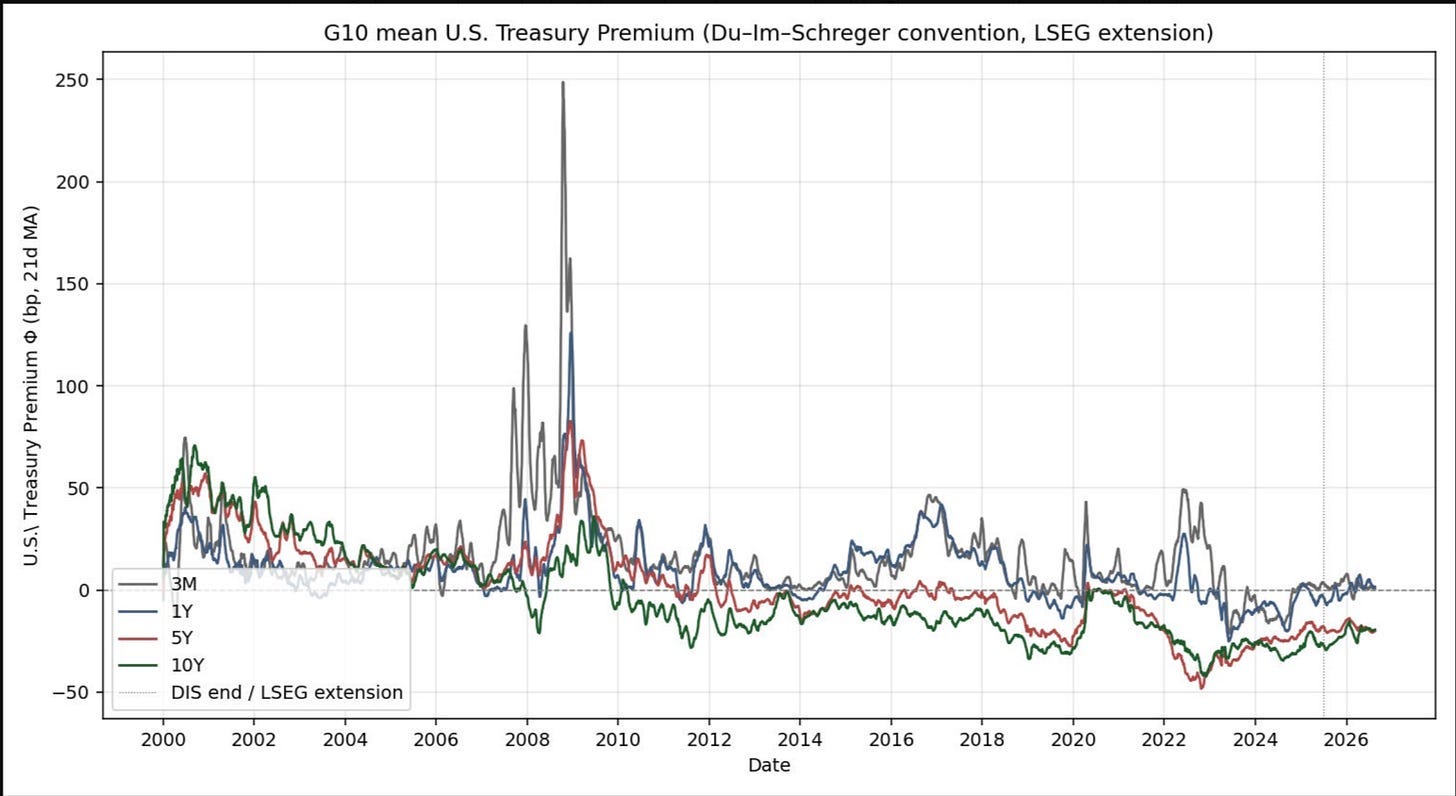
The results of both comparisons are clear: Markets have lost their preference for Treasurys and, at the 5- and 10-year maturities, even prefer the sovereign debt of G10 countries. That fading preference matters even more when the supply of Treasury debt is rapidly rising thanks to ever growing deficits.
Who Absorbs New Debt Issuance?
Part of the picture, when it comes to rising yields and the disappearance of the convenience yield, is the decline of traditional price-insensitive buyers. Foremost among these is the Federal Reserve, which has reduced the size of its balance sheet by over $2.2 trillion from its $8.9 trillion high in April/May 2022, as the figure below demonstrates. Since then, marketable Treasury debt has ballooned by $8.75 trillion. It should not be to anyone’s surprise that when the Fed stopped increasing its exposure to Treasurys just as Treasury issuance surged, rates started to rise.
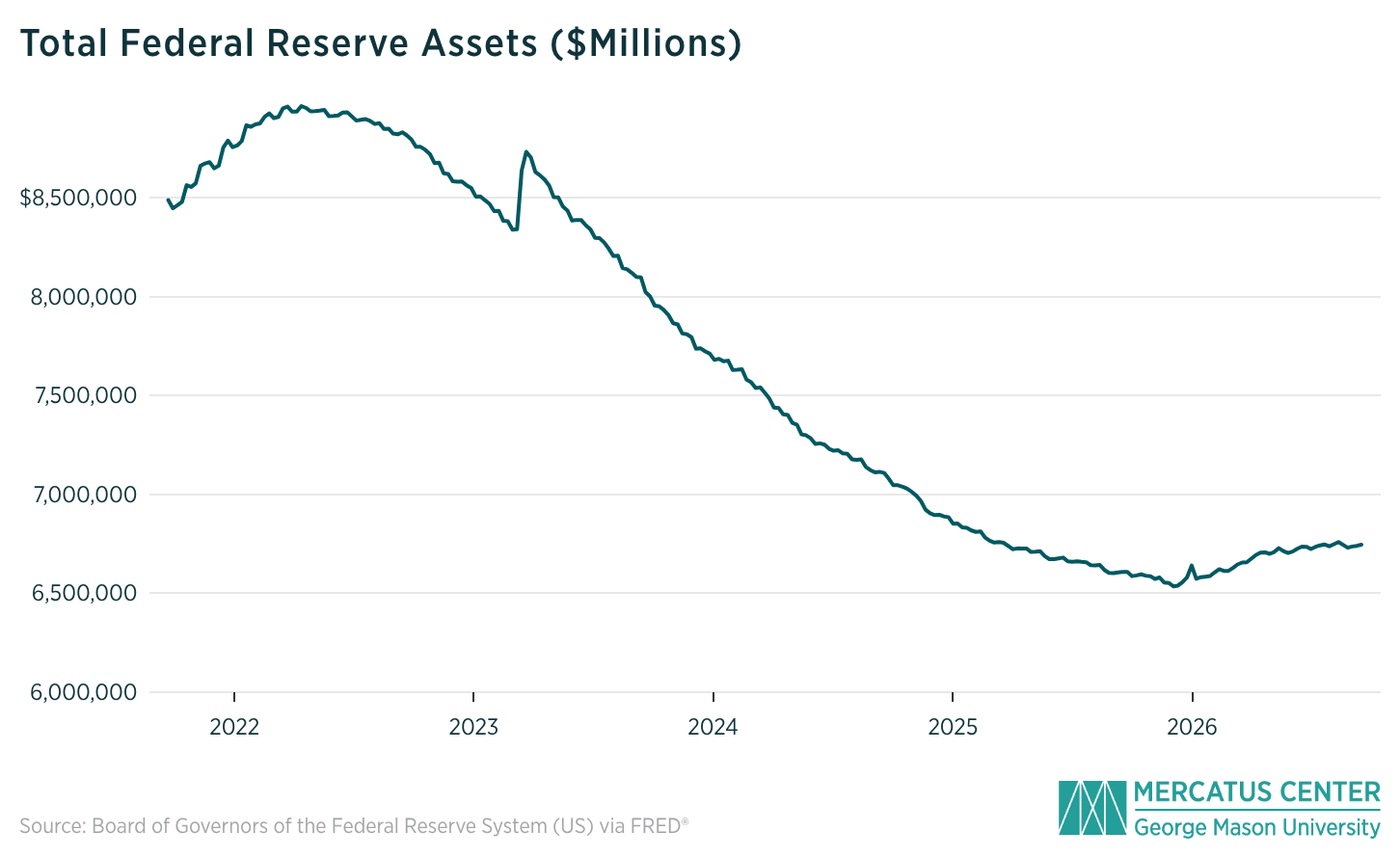
The relevant question is therefore how much additional debt—and how much long-term interest-rate risk—other investors must absorb. If that supply expands faster than investors’ willingness to hold it, prices must fall and yields rise to attract buyers. The maturity of new issuance matters, as does demand from domestic and foreign investors.
As existing debt matures and is refinanced, higher rates gradually feed into the government’s interest bill. Without offsetting revenue increases or spending restraint, that means more borrowing. If investors begin to doubt that future fiscal policy will cover these obligations, inflation expectations could rise alongside already elevated real yields.
With government borrowing on the rise, this creates a difficult prospect: higher financing costs today, growing pressure on the federal budget tomorrow, and potentially greater pressure on the Federal Reserve to intervene.
A growing debt burden must attract willing buyers through attractive rates. Credible deficit-reducing fiscal consolidation would ease that financing pressure. But doing nothing—or worse, pressuring the Fed into a new round of quantitative easing without even any lip-service to future fiscal consolidation—risks turning a problem of higher real yields into one of higher inflation expectations as well.
I think the risk of the US defaulting on its debt must be part of why investors are demanding higher rates.