

* Much of the empirical literature cited in this article was helpfully compiled by George Mason University economist Vincent Geloso, whose public thread on the subject served as a valuable resource.
It seems almost nonsensical that we still have to debate something we’ve long known to be true: Economic freedom improves living standards. Yet last week the medical journal BMJ published a new paper authored by anthropologist and de-growth proponent Jason Hickel and his colleagues. The authors describe the supposed harm caused by International Monetary Fund and World Bank structural adjustment programs in the Global South since the 1980s.
Without presenting any causal evidence, the paper suggests that privatization, deregulation and austerity led to negative impacts on wages, poverty, inequality, maternal mortality, infant mortality and healthcare access.
Notably, this isn’t the first paper in which Hickel has argued that increasing levels of economic freedom in the world led to declining living standards. He has argued in prior publications that China had lower rates of poverty than many market economies when it was a socialist planned economy, and that it was the shift toward economic freedom in the 1980s and 1990s that caused extreme poverty in China.
In 2023 he coauthored an article in which he argued that before the emergence of capitalism, extreme poverty had been virtually nonexistent or rare, while economic freedom was catastrophic for living standards of the vast majority of people in Europe and globally.
In 2024 sociology professor Tibor Rutar checked the robustness of these findings and analyzed additional sources and data that Hickel had not. Rutar concludes:
“The data mostly do not support the part of the critical narrative that suggests the spread of capitalist economic institutions was calamitous for living standards. Instead, they mostly corroborate a narrative, according to which living standards were poorer before the transition to capitalism and started improving afterwards”.
Before even considering causal empirics, correlational data is quite suggestive of what we already know about economic freedom and standards of living. Ample correlational data is available courtesy of the Fraser Institute’s Economic Freedom of the World report.
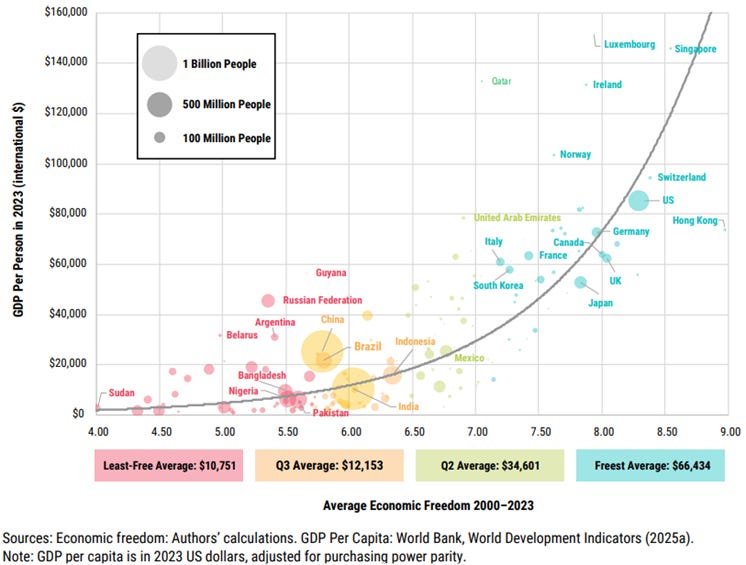
In countries with greater economic freedom, citizens enjoy substantially higher incomes. Those in the freest 25% of countries earn, on average, about 6.2 times as much as those in the least free, as shown in figure 1.
Figure 1. Economic Freedom, GDP per Person and Country Size
The level of income earned by the poorest 10% of the population is much higher in countries with greater economic freedom. The bottom 10% income threshold is 7.8 times higher in the freest quartile than it is in the least free, as shown in figure 2.
Figure 2. Economic Freedom and Bottom 10% Income Threshold
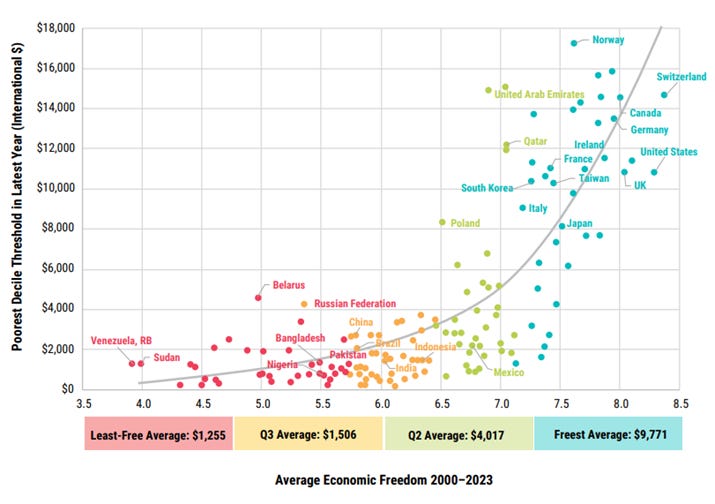
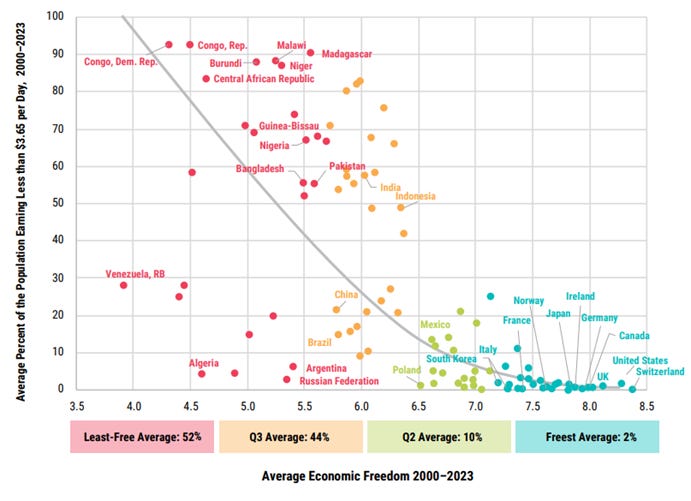
Figure 3 shows that the rate of poverty in the least-free quartile is about 25 times greater than it is in the freest.
Figure 3. Economic Freedom and Poverty
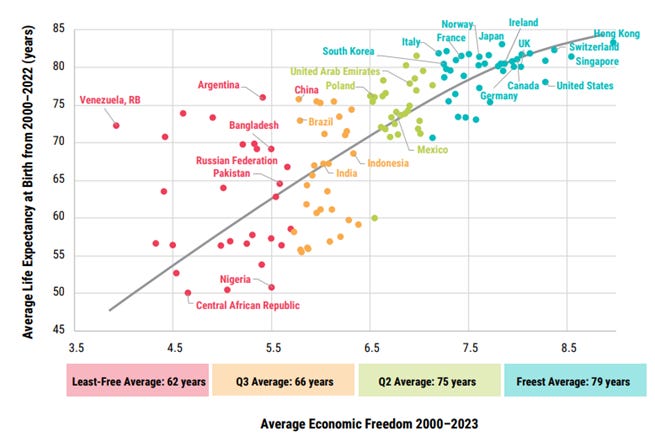
As figure 4 shows, people in the freest quartile live about 17 years longer than those in the least-free quartile.
Figure 4. Economic Freedom and Life Expectancy
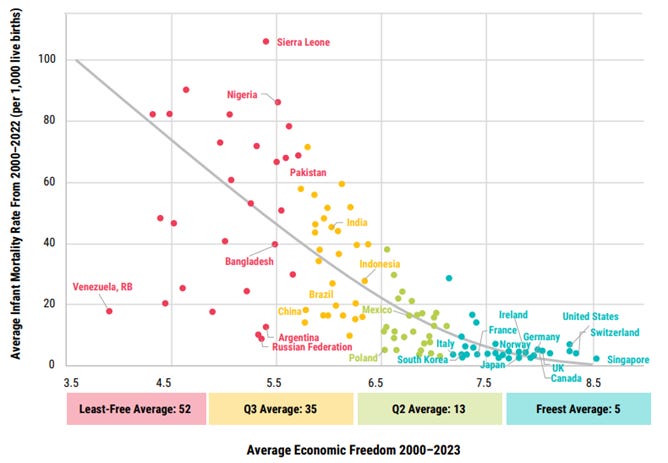
In the least-free countries, infants die at nearly 10 times the rate they do in the freest countries, as shown in figure 5.
Figure 5. Economic Freedom and Infant Mortality
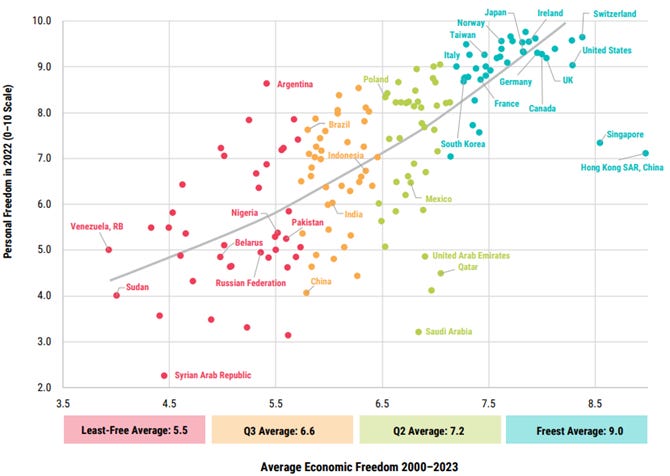
Economic freedom is positively correlated with personal freedoms, as shown in figure 6.
Figure 6. Economic Freedom and Personal Freedom
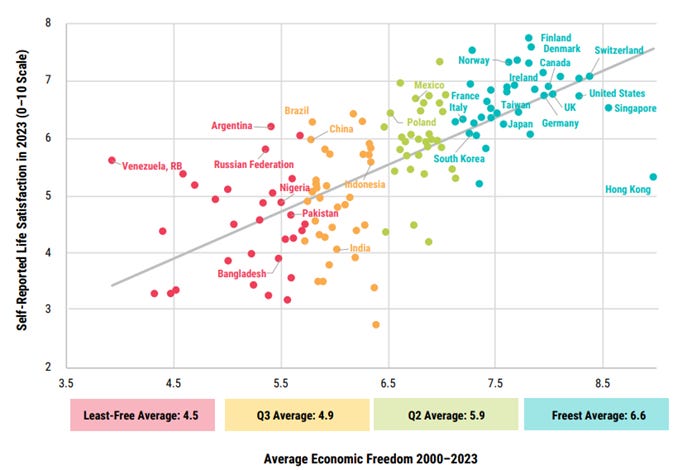
People in economically free societies are more satisfied with their lives, as shown in figure 7.
Figure 7. Economic Freedom and Life Satisfaction
While the newly published BMJ study presents no causal evidence for its conclusion that capitalist reforms hurt living standards, there is extensive empirical, causal evidence that, in most cases, the opposite is true. Vincent Geloso, a professor of economics at George Mason University, created an extensive thread of empirical studies that demonstrate how economic liberalization has boosted growth and enhanced living standards.
A 2013 article published in the Review of Economics and Statistics, for example, used a synthetic controls method (SCM) to demonstrate that most episodes of liberalization enhanced economic growth. Further improvements on the SCM, combined with replications of this 2013 article, corroborate the main findings.
A number of strong papers employ matching methods rather than the SCM. These approaches are appealing because they focus on discrete, “large” increases in economic freedom (using data available since 1970), and they pair economically reforming countries with the closest nonliberalizing counterparts.
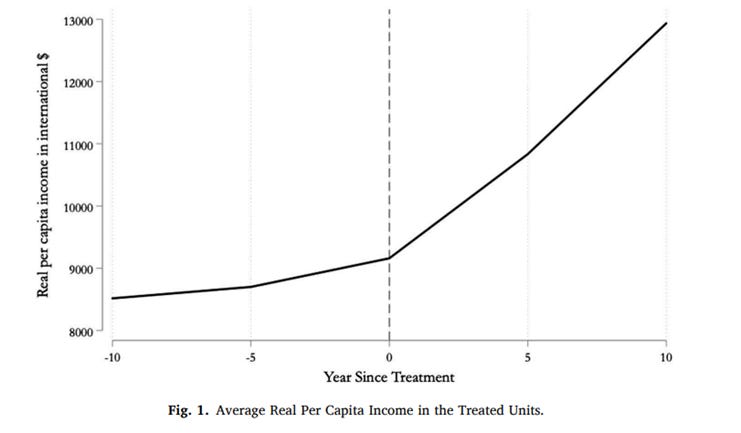
In doing so, matching-method papers also mitigate concerns about heterogeneous treatment effects, which can bias some difference-in-differences (DiD) estimates. For example, a 2021 article in the Journal of Comparative Economics found that countries with sustained economic freedoms were 16% richer 10 years later, as shown in figure 8.
Figure 8. Real Per Capita Income Before and After Economic Reform
However, this estimate may itself be conservative due to the tendency of dictatorial regimes to overstate their GDP level. Recent work by Vincent Geloso and coauthors uses nighttime light data to construct alternative measures of economic activity, following the approach of economist Luis R. Martinez, and reassesses the magnitude of these effects. They find that the true impact of economic freedom on income levels is likely between 1.1 and 1.62 times larger than conventional estimates.
Applied to the earlier figure (16%), this research implies gains closer to roughly 18% to 25% after 10 years. In other words, measurement limitations in standard GDP data may lead the literature to systematically understate the benefits of liberalization.
Other empirical studies have estimated how economic freedom affects the probability that countries move between different income-growth “states,” such as escaping a poverty trap or falling back into one. Using a panel logit model, economists Donatella Saccone and Matteo Migheli find that greater economic freedom generally increases the likelihood of transitioning to higher-income, higher-growth clusters and reduces the risk of remaining trapped in low-income, low-growth states.
Importantly, the economic benefits of liberalization depend on sequencing and context. If liberalizing reforms are applied unevenly, then the results are likely to be disappointing. Imagine a regime that reduces tariffs but fails to establish private property rights.
One 2024 empirical exploration of 49 economic freedom-enhancing reforms found that 10 out of 49 cases experienced low or negative growth post-reform. The authors found that low levels of individualism, low levels of generalized trust and less focus on sound monetary policy were among the key underlying issues driving these disappointing results.
Another key issue is credibility. Autocrats who liberalize the economy can just as easily reverse course, often on short notice. Businesses, workers and investors understand this risk, which dampens their response to reforms. If property rights, market access or regulatory conditions can be withdrawn at any moment, the incentives to invest, expand or take risks remain limited.
Recent evidence supports this view. A study in the Journal of Comparative Economics finds that economic liberalization delivers much stronger results when it is paired with political liberalization. In cases where markets are opened without accompanying democratization, the gains tend to be modest. By contrast, when both economic and political reforms occur together, the benefits are substantially larger.
This finding suggests that disappointing reform episodes are not evidence against liberalization itself, but rather reflect deeper political economy constraints, especially issues of credibility, institutional quality and reform design.
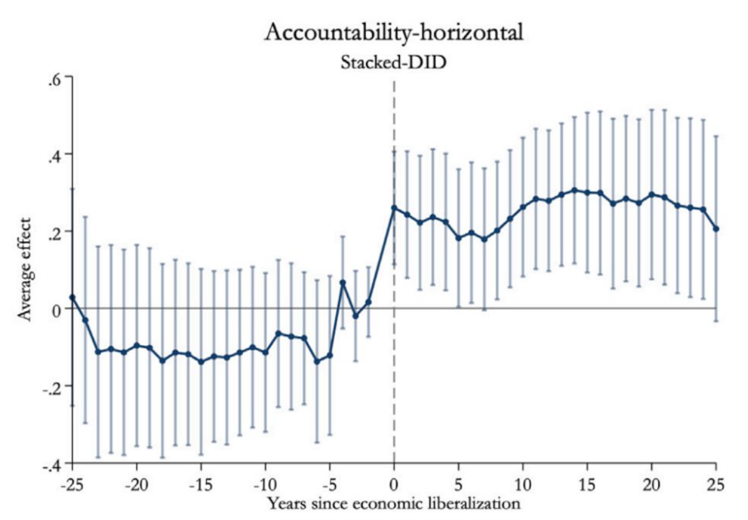
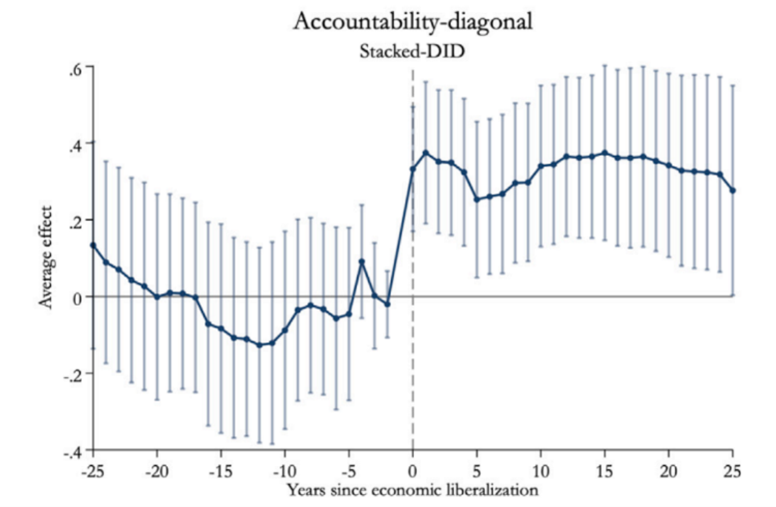
Another possible critique that opponents of market liberalization make is that these reforms weaken institutions and government accountability. Using a doubly-robust DiD approach, recent empirical work finds that capitalistic reforms improve government accountability and imposes greater checks on government power, as shown in figure 9 below.
Figure 9. Response of Government Accountability to Economic Liberalization
Across countries, methods and decades, societies that protect property rights, allow markets to function and limit arbitrary state power are consistently richer, healthier and more upwardly mobile. Economic freedom is not a driver of poverty; it is one of the most reliable paths out of it.
What critics like Hickel mistake for failure is often something else entirely. When liberalization “fails,” it is rarely because markets were allowed to work; it is because they were not. Reforms that lack credibility, are poorly sequenced or are implemented under institutions that cannot sustain them will naturally produce weak results. But that is a critique of political constraints, not of economic freedom itself.
Nice writeup, and thanks for referencing my paper on Hickel and Sullivan (2023). :)
You might be interested in my recent autopsy of Hickel et al.'s BMJ paper and the additional quick-and-dirty causal reanalysis of their main claims: https://statsandsociety.substack.com/p/looking-under-the-hood-of-hickels
"In 2023 he coauthored an article in which he argued that before the emergence of capitalism, extreme poverty had been virtually nonexistent or rare, while economic freedom was catastrophic for living standards of the vast majority of people in Europe and globally."
The only way I can make sense of this is that he means some kind of relative "extreme poverty", so when 90% of the population was barely scraping by, there was little or no extreme poverty. It does jibe with how so many socialists are more scared of income inequality than low average incomes.
It seems so very self-evident to me that liberty is more important than almost anything else, since anything else is one-size-fits-nobody and coercive. How can people do their best when others constrain their activities and steal the fruit of their labor? I just do not understand people who think telling everybody else what to do will not backfire and come back to haunt them in spades, and they will not like it one bit.