

France’s rising debt and borrowing costs do not justify an unconditional European Central Bank (ECB) intervention. The ECB should let market pressure encourage fiscal consolidation, remain ready to contain a broader crisis and condition any French bond purchases on spending cuts and fiscal reform.
France’s ballooning public debt—now around €3.5 trillion, or roughly 118% of GDP—has pushed investors to demand sharply higher compensation for holding French government bonds. The 10-year French yield recently approached 5%, its highest level since 2002, while the difference over Germany’s benchmark 10–year Bund widened to approximately 1.4 percentage points; remarkably, French borrowing costs have now risen even above those of Italy and Greece. As the graph from the FT below shows, French yields, a little over 2 years ago, used to be a whole percentage point below Italian ones.
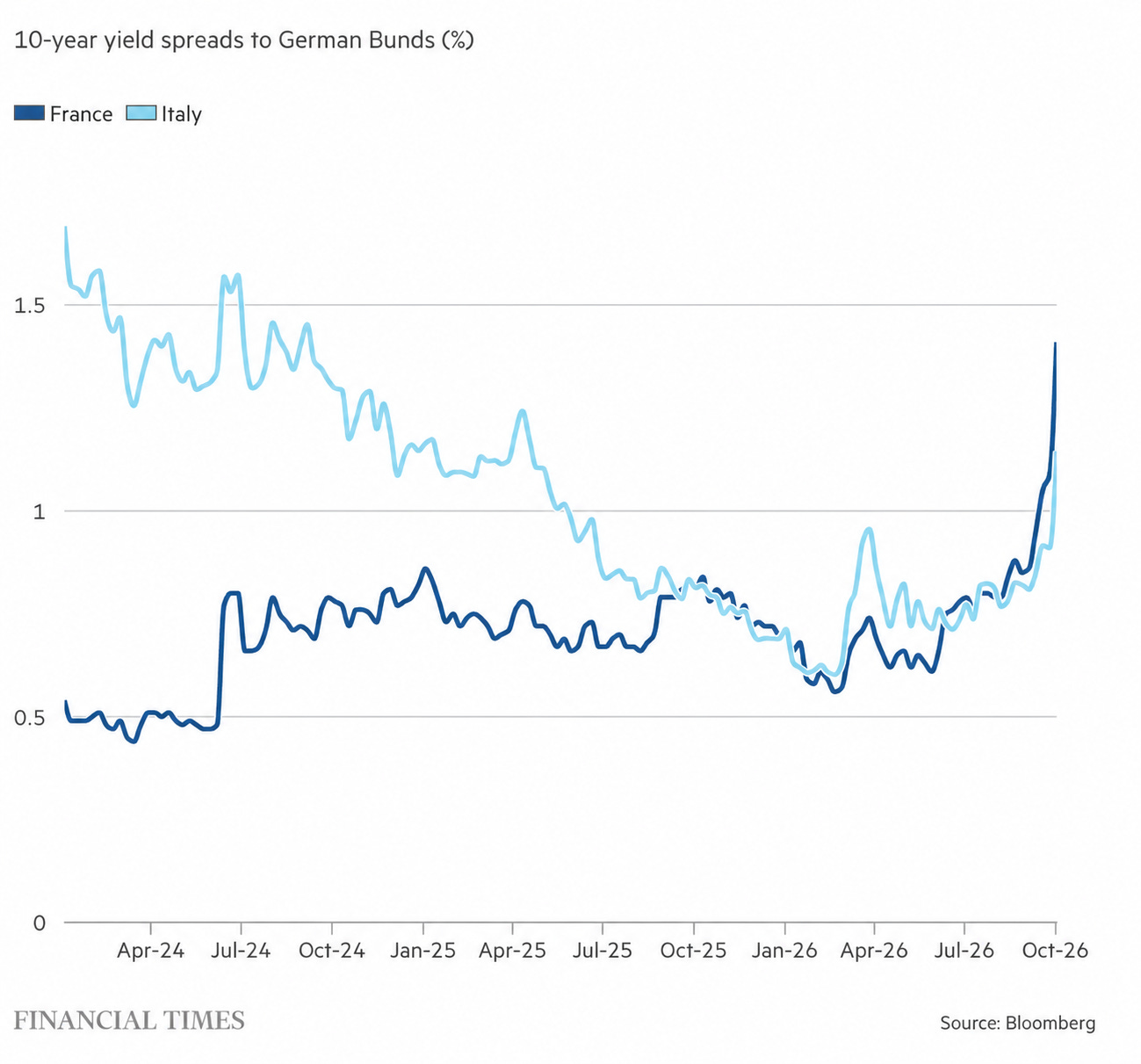
The fiscal outlook offers little relief: the European Commission expects France’s deficit to remain around 5.1% of GDP in 2026, with debt forecast to reach 121% of GDP in 2027 and, under its baseline scenario, approximately 130% by 2034.
Yet despite the movements in spreads, and the growing alarm about French spending and political budgetary gridlock, the ECB has so far stated that it sees no cause to intervene in the French bond market.
Why France does not qualify for ECB intervention
In September, ECB President Christine Lagarde declined to comment directly on widening French spreads, saying they reflected “how markets perceived the strength” of individual sovereign bonds. On October 1, Bundesbank President Joachim Nagel reinforced this position, saying that the ECB’s bond-buying tools were designed to safeguard price stability, “not to target specific sovereign bond spreads” (Reuters).
Two days later in an FT interview, Banque de France governor Emmanuel Moulin was even more explicit: “The conditions are not in place now for an intervention by the ECB,” whose role, he said, is “not to deal with countries’ budget problems.”
The ECB’s current primary tool for intervention, the Transmission Protection Instrument (TPI), is tasked with ensuring that the monetary policy stance is transmitted smoothly across all euro-zone members. It is meant to keep ECB interest-rate decisions from affecting euro-area countries in sharply different ways for reasons unrelated to their finances. When member states’ interest rates diverge for reasons the ECB considers unrelated to “fundamentals”, the TPI can be used to purchase marketable public sector debt within a maturity range of 1–10 years.
However, use of the TPI is conditional on meeting all four criteria, and France violates the first: compliance with the EU Fiscal Framework. The Council opened an Excessive Deficit Procedure (EDP), obliging a deficit correction to above agreed limits, against France on 26 July 2024. In January 2025, it required France to eliminate the excessive deficit by 2029 by restricting the growth of net nationally financed expenditure to 0.8% in 2025, 1.2% annually from 2026–28, and 1.1% in 2029. While the EDP is ongoing, use of the TPI is explicitly prohibited. It is important the ECB sticks to its guidelines; French borrowing costs are a corrective signal, not a malfunction in monetary-policy transmission.
Could bond markets force a course correction?
It is a step forward that the ECB is thus far allowing larger spreads that reflect the fiscal path of member states. Higher interest costs will force French politicians to face the cost of running sustained deficits since 1973 and finally make hard choices. It could try to raise tax revenue; however, according to the OECD, taxes already total 43.5% of GDP, second only to Denmark among OECD countries. Or it could cut public spending, which came in at 57% of GDP, second highest again among OECD states.
How long the ECB can stay out of French public finances comes down to interlocking questions: how long it can withstand French political pressure and how credible non-intervention is to French policymakers. If French policymakers truly believe the ECB won’t stabilize French interest rates through intervention, they might course correct before it comes to a full-blown crisis.
There are some early signs of higher rates disciplining French politics. The 2027 presidential front-runner, Marine Le Pen, recently released a plan for fiscal consolidation (spending cuts, transfer reductions, and/or tax hikes aimed at deficit reduction) at a National Rally (RN) press conference. Sparse on specific details for achieving its goals, it nevertheless outlines pragmatic and necessary spending and debt targets. According to Reuters, it aims to reduce the deficit to 3% by 2030, and 2.5% by 2032, the national debt from 121% to 112% by 2032, cut €140bn in spending net of a minimum of €30bn in tax cuts by 2032, and rein in public spending to below 50% of GDP. It also proposes an eventual golden rule capping debt at 60% of GDP, arriving by cutting net spending by 0.5% each year. Le Pen also promised significant cuts for the first time to healthcare systems, social housing, and civil servant headcounts, a major shift from previous stances.
It is not coincidental that the RN shifted course and promised fiscal reform at a moment in time when the markets see French bonds as risky. It is an early indication that bond market pain is starting to shape political discourse. While Le Pen’s plan lacks credibility, due in part to sparse details and tension with proposals such as reducing the young retirement age from 62 to 60, it does confirm the RN is on the right direction on fiscal matters.
France as a test of ECB discipline
Where does this leave the ECB? Arguably, in a position to address moral hazard in fiscal policy—the risk that governments, expecting central-bank support, will continue taking fiscal risks instead of putting their finances in order. If the ECB does not intervene until fiscal pain concentrates the minds of policymakers on a serious and detailed plan for fiscal consolidation, it will show other member states that there will be no bailouts. If a member with the stature and political weight of France won’t receive an ECB bailout, it will confirm to other states that their fiscal policy is their burden to bear and no one else’s.
The ECB should be ready to react to any bond crisis, and limit spillover and contagion to other eurozone markets, but any purchasing of French bonds should be conditional on spending cuts. Emergency measures should be judiciously applied and not subsidize current or future fiscal excess. The ECB Governing Council will have to walk a tightrope and convince both politicians and markets there will be no bailout, while readying all necessary tools in case of a crisis.
If its resolve fails, and it intervenes to subsidize French borrowing without imposing the needed discipline, it will put France and Germany on a collision course and threaten the existence of the Euro, perhaps the EU itself. Yet, if it can force a course correction, the Euro and ECB will be stronger than ever and send a clear message that it is not there to bail out member states. The crisis unfolding in France is both an existential threat and a golden opportunity. Though difficult and perhaps unlikely, if it can be mastered it could achieve what the ECB originally aspired to be: a truly independent central bank with a single mandate for price stability.
Lovely piece! Is the leadership structure of the ECB structured such that it might be more likely to bail out France on political grounds, or are there enough non-French admins of the bank to make this unlikely ?