


Since Kevin Warsh took office as chairman of the Federal Reserve, the size of the Fed’s balance sheet has come under renewed scrutiny. The roughly $1 trillion Treasury General Account (TGA) at the Fed is a major obstacle to reducing it under the current monetary framework. Treasury chooses how much cash to hold, but the Fed must manage the effect of that choice on bank reserves. This can be seen as fiscal authority infringing upon the independence of the central bank since Treasury’s cash-management priorities help determine the minimum size of the Fed’s balance sheet.
The TGA functions as Treasury’s primary checking account and is held at the Federal Reserve Bank of New York. At the end of September 2026, it held $984 billion, making it one of the Fed’s largest liabilities, alongside bank reserves and currency in circulation. Unlike reserves, the Fed does not pay interest on the TGA balance.
Until 2008, Treasury held much of its cash in Treasury Tax and Loan accounts (TT&L) at commercial banks. These deposits earned interest at 25 basis points below the effective federal funds rate. Keeping Treasury cash at commercial banks also prevented many tax payments from draining reserves out of the banking system. But when the effective federal funds rate fell below 25 basis points in late 2008, the TT&L interest formula turned negative. Treasury moved balances into the TGA. As the Fed expanded reserves, it became easier to accommodate a larger and more variable Treasury balance at the central bank.
According to Treasury, the TGA is a buffer. Its cash policy, adopted in 2015, calls for a balance sufficient to meet at least one week of projected needs, including maturing marketable debt, so that it can continue paying its obligations if borrowing is temporarily disrupted. The scale is substantial: Treasury said in 2025 that weekly cash needs can exceed $800 billion around certain payment dates.
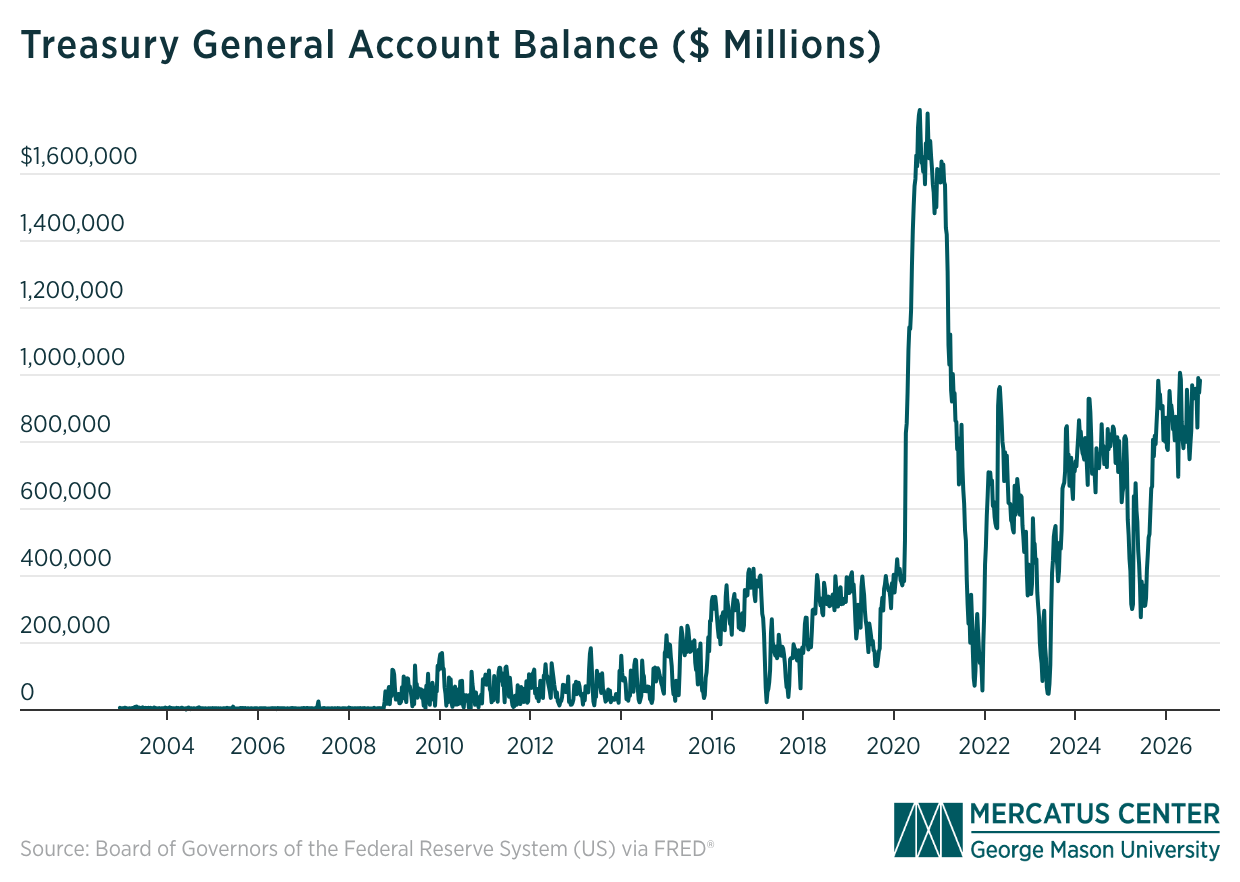
The buffer also gives Treasury room to operate during debt-limit confrontations. During debt-limit suspensions, the Treasury can raise debt through auctions to increase its TGA balance. Even though the 2023 law suspending the debt limit specifically restricted borrowing to create an unusually large balance before that suspension expired, the Treasury still increased the TGA balance from $23.4 billion to $721.9 billion during the suspension.
Suppose debt outstanding is $35 trillion, and Treasury holds $800 billion in the TGA when the limit begins to bind. It can draw on that cash to make payments. Once Congress restores borrowing capacity, Treasury can issue debt to rebuild its normal cash balance. The Treasury’s need for cash before, during, and after a debt-limit impasse produces large swings in an account on the Fed’s balance sheet.
Those swings are transmitted to bank reserves. Taxes and Treasury auctions that increase the TGA generally decrease reserves as payments move from private bank accounts to Treasury’s account at the Fed. When Treasury spends the money, the flow reverses. Seasonal variation in receipts and outlays adds to the movement.
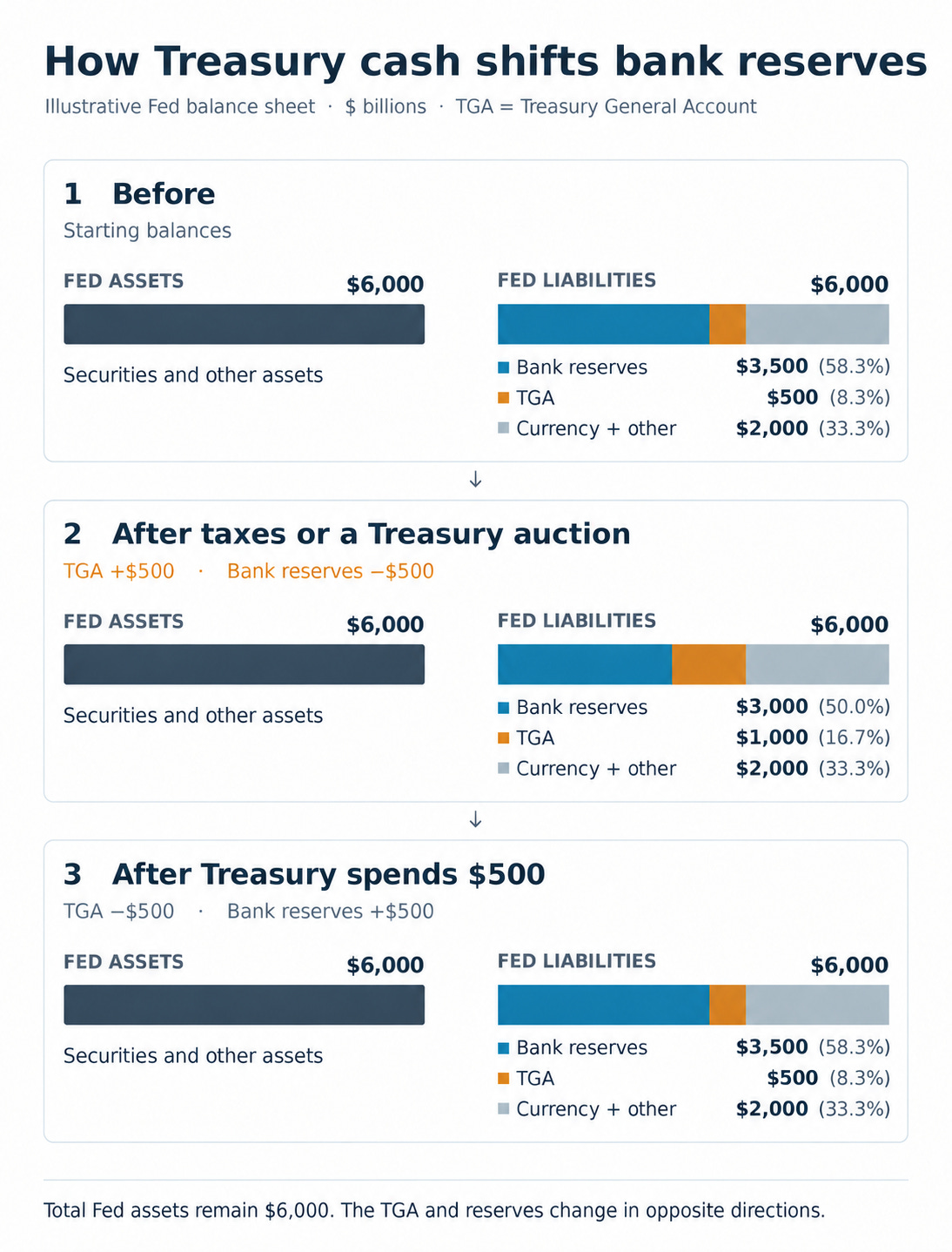
A change in the TGA need not change the total size of the Fed’s balance sheet; it can change its composition instead. If the TGA rises by $500 billion while Fed assets and other liabilities remain constant, reserves fall by $500 billion. That matters because the Fed relies on interest on reserves balances (IORB) as its primary policy tool to keep short-term rates near its target. When reserves are plentiful, a TGA-driven decline has little effect on rates. When reserves approach scarcity, the same decline can push rates upward. After a debt-limit impasse ended in 2019, the TGA rose by roughly $140 billion in the third quarter; Fed staff linked the consequent reserve drain to volatility in money-market rates.
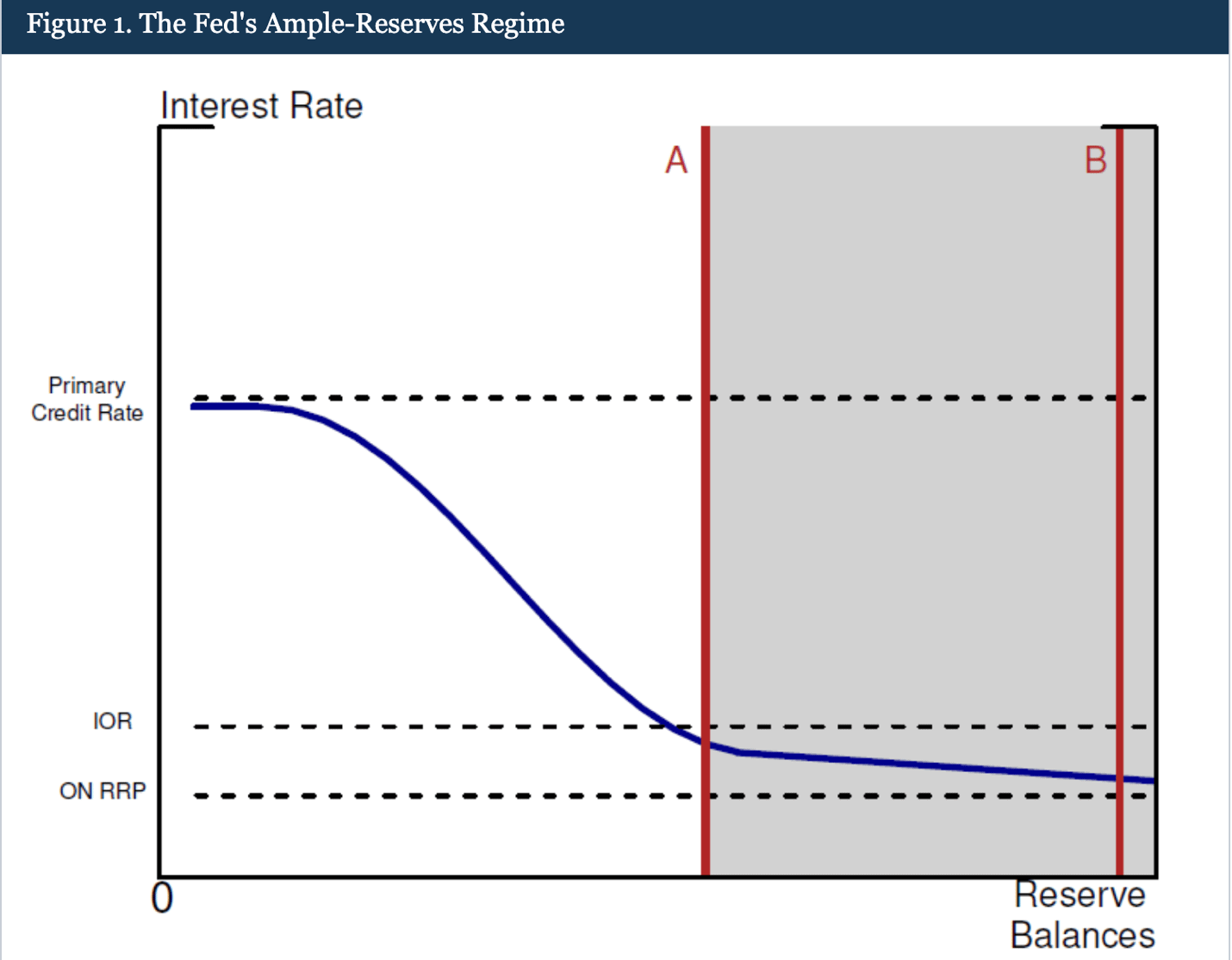
The solution under the current ample-reserves framework is to keep a reserve buffer large enough that Treasury cash flows do not push the banking system into scarcity. That places a floor under balance-sheet reduction, with reserves having to be ample enough to ensure that TGA induced shifts do not move reserve balances outside of its regime range. Using the Fed’s own graph on the ample-reserves regime shown above, excessive balance sheet reduction could cause shifts in the TGA to periodically shift the quantity of reserves left of A, outside of the A-B ample reserve regime range.
Here the hierarchy of priorities becomes clear. Treasury maintains a large cash balance to protect its ability to pay. The Fed then holds additional assets and reserves to accommodate the volatility that balance creates. Fiscal cash management is setting a constraint on monetary-policy implementation.
That constraint is a consequence of the present arrangement, not a law of central banking. Treasury could again place some collateralized balances at commercial banks. The Fed could offset TGA swings through changes in its bill holdings or lending operations. Each option has costs, and the choice among them is a choice about who bears the burden of Treasury’s cash flows. As long as the Fed relies on a large standing reserve buffer, Treasury’s preference for a large, flexible TGA will continue to dictate part of the size of the Fed’s balance sheet. A chairman who wants a smaller balance sheet will find that he can’t get one without the Treasury’s cooperation. That is the independence problem the balance-sheet debate has to confront.