
This is a guest post by Fiscal Policy intern Luke Guest
Zohran Mamdani won the New York City mayorship by promising relief to those struggling. His platform was that of free childcare, free and faster buses, state-owned grocery stores, rent freezes and subsidized affordable housing. In May he congratulated himself for balancing the budget, despite the reality that he has only kicked the can down the road and increased the burden on future taxpayers.[CB1] Aside from this questionable victory, throughout his first six months in office he has struggled to get his plans in motion as his utopian vision collides with legal, financial and practical barriers. He promises that funding is to come—in vague terms—from the pockets of the rich, which has ensured that his base of support has remained strong since January, sitting at 40% as of April.
Mamdani has made some progress toward his promises, but this shouldn’t be seen as a good thing: The results of many of his policies will be counterproductive. He is setting a dangerous precedent by combatting problems with redistribution rather than promotion of growth. For example, the financial sector generates the largest part of NYC’s GDP and should be appreciated; instead, a socialist mayor is pushing a program of punitive taxation that may disincentivize future investment and reduce the desirability of the city as a place for entrepreneurs to settle.
Paying for Progressive Promises
Mamdani’s revenue calculations fail at every level. He asserts that targeted taxation of the “ultra-wealthy” will raise sufficient revenue to cover all his programs, but this is unlikely given an array of rate-based, administrative, and political barriers. First, the combined top marginal tax rate in NYC is 55.6%, already among the highest in the nation. Punitive increases to the tax burden of the top 1% will deteriorate the city’s relationship with its elite and risk capital flight by creating an atmosphere increasingly hostile to entrepreneurship and investment. Not only is this a risk to the fiscal health of the financial capital of the U.S., but the one tax Mamdani actually got passed is likely to raise a trivial sum, making it ineffective even in the short run. Indeed, the pied-a-terre tax, recently passed by state lawmakers, applies only to second homes valued at $1 million or more, and experts expect it to raise a modest $500 million.
This lackluster return is in large part due to administrative flaws in the pied-a-terre tax. CNBC reported that the city’s property assessment and valuation system is ineffective, giving estimates of “10% or less of the true market value,” which could leave large amounts of revenue uncaptured. David Schleicher, a professor of property and urban law at Yale University, suggested that on the numbers alone, New York’s wealthy have little to fear from the tax as enacted—though the psychological shift caused by the changing tone in policy shouldn’t be overlooked. A more accurate tax assessment could cause this critical tax base to take off to new jurisdictions.
Mamdani is vocal about his desire to target the rich, and policies like this evidence his sincerity. No doubt New York’s wealthiest will resent the arbitrary punishment of having their assets subject to harsher laws. Capital flight should be a large concern for NYC, especially given that in fiscal year 2027, the personal income tax share will reach almost 70% of New York State’s total revenue, a historic high. Income tax revenue is disproportionately provided by the top earners, so the effect under these circumstances will be harder hitting.
In the end, Mamdani’s ambitions are coming into conflict with the realities of his actual political power. Local governments within New York State have relatively far-reaching powers to self-determine under Article IX of the NY constitution. But they do not have the authority to increase taxes past a threshold without state approval, and Governor Kathy Hochul has a strong political incentive to hold off on tax hikes as she runs for reelection. The most likely result of Mamdani’s lack of foresight is compromise and backtracking in the coming months.
Mayor Mamdani’s fiscal troubles are also not over. It is true that he has closed the $12 billion budget deficit that he inherited from the previous administration. His methods for doing so, however, should be reason for concern, not applause. The website for the Office of the Mayor explains that a combined $2.97 billion was rescued through “aggressive savings” and “addressing systemic inefficiencies.” But the largest proportion of those “savings” comes from nearly $8 billion in state assistance over two years provided by Governor Hochul, and $1.64 billion from altering the debt payment schedules for pensions. The one-time measures and short-term pension savings that comprise the state bailout will only “delay addressing the deeper structural imbalances in the city’s budget” and get worse year on year, says New York Comptroller Mark Levine.
The total cost of the city’s pension debt will grow because of the extension of the amortization timeline from 2032 to 2037, likely adding billions to taxpayers’ overall burden over time. Deferring pension contributions is effectively borrowing from the taxpayers of the future, who obviously can’t voice their displeasure in the present. Knowing that spending cuts and broad-based taxes are unpopular, Mamdani was able to acquire the state aid he needed because it was mutually beneficial for him and Governor Hochul. She needs the support of Mamdani’s base in her upcoming reelection. The mayor was effective in his control of the narrative and fortunate that New York State is in its strongest fiscal position in 50 years, but his balancing of the budget is far from the resounding success it has been framed as.
Free Childcare
Mamdani has promised a large and expanding program of free childcare. It is doubtful that this program will be financially viable because a free product attracts theoretically unlimited demand and because he is limited in avenues for procuring the necessary funding. Mamdani leaned on Governor Hochul to make the politically popular decision to provide funding, which she did, assigning $1.2 billion for 2,000 free spots of childcare for two-year-olds and promising funding the first two years of the program. This initial funding could be considered a success but is a drop in the bucket in making the program universal.
Mamdani’s goal is to grow the program to 12,000 children by the fall of 2027 and to reach full universality within four years. The Fiscal Policy Institute estimates the new cost of providing universal childcare to children ages two and younger is $2.5 billion at current compensation rates. Importantly, the origins of the funding after the first two years are concerningly unclear, and the projections for cost will immediately be wrong once the program is launched. Once the price signal disappears, families who currently use informal arrangements, relatives and lower-cost options will rationally switch to the free government provision. The future of the program is perpetual underfunding and struggle to close the gap in childcare that it has permanently widened.
State-Run Grocery Stores
Mamdani’s next well-intentioned but inchoate plan is to open five state-run grocery stores to reduce the cost of healthy food, starting with one in East Harlem and one in the Bronx. The effects of this intervention will be small but negative, counterintuitively hurting affordability. Those tasked with running the stores will have their rents and products subsidized, and thus they will lack the mechanism that forces businesses to be wary of their costs. This waste [CB2] will be shouldered by the taxpayer.
Furthermore, the state lacks knowledge that successful grocery chains utilize, from supply-chain management and marketing to optimal pricing and store location. As a result, the first location is set to cost $30 million, far above what an industry leader would spend on opening a branch. The mayor really should have learned from the Sun Fresh grocery store in Kansas City which bled $18 million of public funding since 2015 and still could not be propped up indefinitely, closing in 2025. Sun Fresh illustrates how a subsidized business with socialized losses is doomed to fail.
On top of this, there is the looming problem of limited funding being stretched too thin. A significant $70 million was set aside for this project, and $40 million is predicted to be the cost of just the first two locations—capping the realistic delivery at two stores, not five. Finally, publicly owned stores do not exist in a vacuum; they undercut other supermarkets, the majority of which already operate with razor-thin profit margins. In other words, they threaten the very community-owned grocers which serve New York City neighborhoods. Concerned Chairman of the Multicultural Business Coalition Frank Garcia told news outlets that “The Koreans, the Latinos, the Jewish community [and] our Arab counterparts are against this plan of the mayor” and that they are seriously considering legal action. If other businesses are forced out of the market and then the state options fail—which they will—the public will be left worse off.
Rents and Buses
Enacting rent freezes is one of Mayor Mamdani’s most iconic and vote-winning policy proposals. The City’s Rent Guidelines Board has now carried out his vision, voting 7-1 on the evening of June 25 to freeze rents on one- and two-year leases for NYC’s 1 million rent-regulated apartments. The board, with two-thirds of its members appointed by Mamdani, has essentially ruled in favor of worsening the housing crisis. The economic consensus is that applying price caps is misguided and often results in undesired effects, including higher rents for uncontrolled units, lower mobility and reduced residential construction. A meta-analysis of 112 empirical studies on the effects of rent controls by Konstantin A. Kholodilin illustrates this, as shown in the figure below.
As of June, Free and faster buses have been limited to pilot programs for lack of funding.
Effects of rent control according to empirical studies
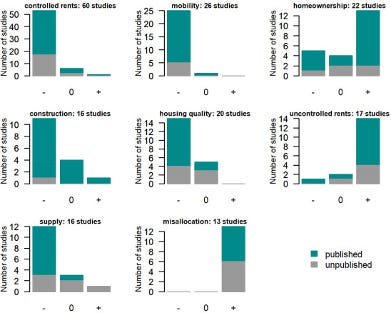
Notes: From left to right, the bars show findings of a negative effect, no effect, or a positive effect. Gray shading indicates unpublished studies.
Conclusion
Young, educated New Yorkers came out in droves to vote for Mamdani. His zero-sum, “me-first,” us versus them socialism appeals to the disillusioned but is economically unsound. His “achievements” will be a drop in the bucket for the issues they seek to address. Two thousand free childcare spots do little to cover the needs of the 500,000 under-fives in NYC. Five (or, more likely, two) government-subsidized grocery stores will have a negligible effect in a city that has 24,000. If Mamdani does scale his operation up, it will run into the financial and legal issues discussed above. He can pursue socialism more aggressively, incur the economic consequences and conservative backlash and alienate the already divided moderates, as was the case with David Dinkins’s policies in the early 1990s. Or he can continue to celebrate his inconsequential successes without ever breaking the indomitable capitalist spirit of New York City.
And that you didn't read any of the rest of what I wrote proves you are a bot.
“Young, educated New Yorkers came out in droves to vote for Mamdani.”
Er, I think you mean young, miseducated New Yorkers..
Having a lot of schooling, or even having a credential, does not make one “educated.”