

Two weeks ago, I argued that Jason Hickel’s broad case against economic freedom does not withstand serious scrutiny. The historical record, the correlational evidence and, most importantly, the causal empirical literature all point in the opposite direction: Societies with greater economic freedom tend to become richer, healthier and more prosperous, and countries that liberalize generally improve their long-run performance.
Now a new comment on Hickel et al.’s BMJ Global Health paper further weakens the original argument. In “Comment on: Structural adjustment: damages, reparations and pathways to non-recurrence,” Justin Callais, Vincent Geloso, Christian Lessmann and Joseph Steinberg take aim at the paper’s core empirical claims. Hickel’s paper criticized structural adjustment programs (SAPs), which were implemented by organizations such as the World Bank and the International Monetary Fund to help developing countries stabilize their economies and reduce their debt.
Callais and his coauthors find, however, that the evidence on SAPs is mixed and heterogeneous, and Hickel et al. do not provide a credible basis for sweeping claims that these programs broadly caused collapsing wages, rising poverty and worsening health across the Global South.
That matters, because the Hickel paper has already begun circulating as if it settled the debate. It did not.
The first problem with Hickel’s critique of SAPs is one of timing and aggregation. Hickel and his coauthors present regional averages, especially for sub-Saharan Africa, and treat the time period around 1980 as if it were the common moment when structural adjustment began. But that is not how the underlying history actually unfolded. Countries entered these programs at different times, under different conditions and with very different institutional settings. Compressing all those factors into a single regional narrative obscures more than it reveals.
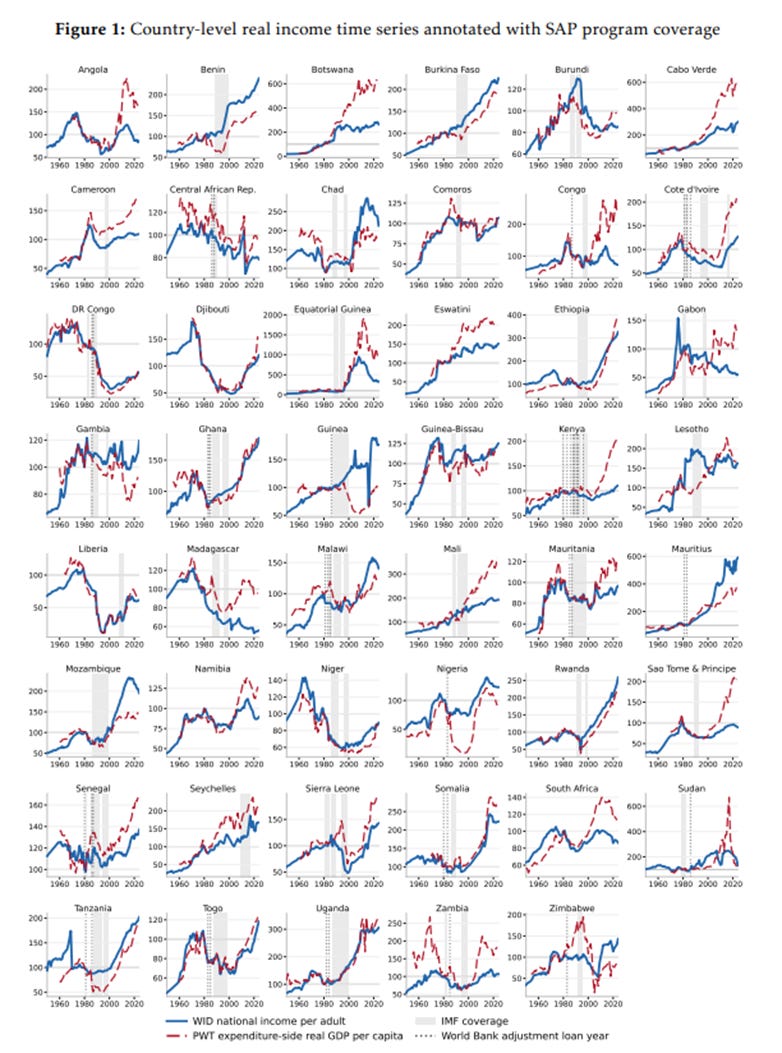
Once the data are disaggregated to the country level, Hickel’s simple morality tale begins to fall apart, as shown above in figure 1 from Callais et al. Some countries experienced severe economic declines in the 1980s without ever entering SAPs. Others received such programs and later saw substantial improvements in living standards. That does not prove the programs were beneficial. But it does show that the claim “SAPs caused the regional collapse” is far too crude to survive contact with the underlying variation.
This is a recurring problem in bad empirical work: averaging across heterogeneous countries and then treating the average pattern as causal evidence. Regional aggregates are descriptive, not a way of identifying causal effects.
The second and even deeper problem is that correlation is not causation. Countries do not enter IMF and World Bank programs at random. They typically do so when they are already in severe economic distress: fiscal crisis, balance-of-payments pressure, debt problems, inflation, external shocks or political instability. In other words, the countries that receive these programs are often already on a downward trajectory, as figure B.4 from Callais et al. demonstrates.
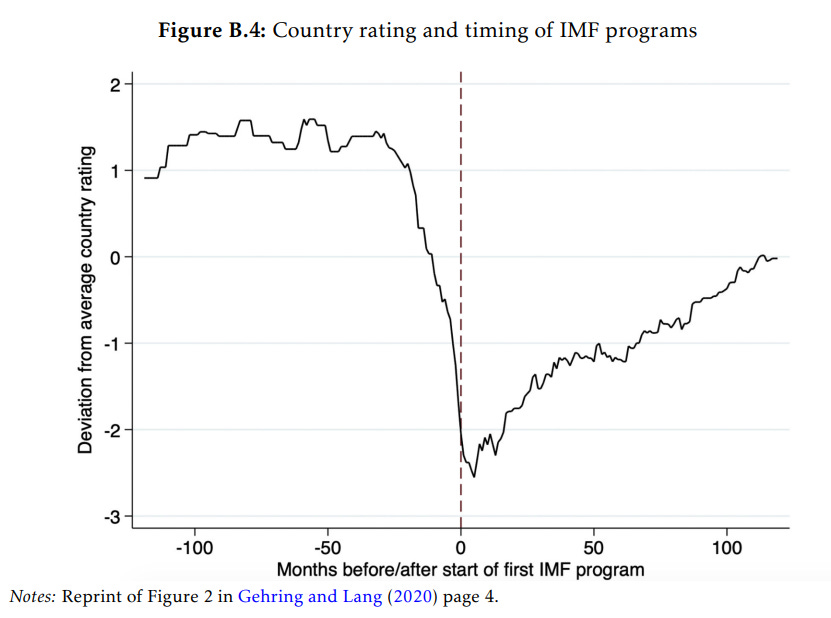
That creates an obvious selection problem. If a country is spiraling economically and then enters a structural adjustment program, one cannot simply compare outcomes before and after and declare the program responsible for the deterioration. The deterioration may have been the very reason the program was adopted in the first place.
And the broader global context makes it even harder to tell what caused what. Many developing countries in the 1980s were hit by oil shocks, global recession, collapsing export prices, rising interest rates following U.S. monetary tightening, debt crises, conflicts, droughts and in some cases the spread of HIV. A credible causal analysis would need to disentangle these competing forces carefully; Hickel et al. do not provide that analysis. As Callais, Geloso, Lessmann and Steinberg note, repeated and staggered treatment timing, selection into treatment and heterogeneity across programs make clean causal inference especially difficult here.
This is why simple “before and after” storytelling is not enough. It is also why dramatic visual claims should be treated with caution. A graph can be rhetorically powerful yet methodologically empty.
The third major issue is conceptual: Structural adjustment is not the same thing as market liberalization. Hickel and his coauthors repeatedly treat SAPs as though they were equivalent to “neoliberal shock therapy” or free-market reform. But this is a serious conflation. Participation in an SAP does not mean a country actually implemented liberalizing reforms in any meaningful sense.
Countries’ compliance with IMF and World Bank conditions was often weak, partial, delayed, waived or renegotiated. In many cases, the formal existence of a program tells us little about whether privatization, deregulation, trade liberalization, fiscal consolidation or credible property-rights reform actually occurred. So even if one could establish some causal effect of SAP participation, that would still not establish a causal effect of genuine economic liberalization.
That distinction matters because the literature on actual liberalization using more credible methods generally points in the opposite direction from Hickel’s thesis. As I discussed in my earlier piece, studies using synthetic controls, matching methods and related approaches tend to find that liberalization raises income and improves a range of welfare outcomes. If many SAPs involved limited or failed reform, then poor outcomes associated with them cannot be straightforwardly blamed on economic freedom.
This is exactly why critics of markets so often slide carelessly between categories. They move from “an IMF program existed” to “free markets were imposed” to “free markets caused suffering.” But each step in that argument requires proof, and in this case the proof is missing.
The Callais et al. comment also raises further concerns about data quality and interpretation. Some of Hickel et al.’s claims appear to rely on nonstandard sources, factual mistakes and questionable readings of published figures. One especially striking example concerns wage declines in Brazil and Colombia. Hickel and coauthors reportedly cite enormous wage collapses that should immediately raise eyebrows. But the underlying source reveals that the numbers come from an index of legal minimum wages, not average wages, and the index values appear to have been misread as percentage declines. That is the kind of basic numerical error that should make readers much more skeptical of the larger argument.
When a paper offers headline-grabbing claims that align neatly with an ideological narrative, the burden of proof should rise, not fall. Extraordinary claims about millions of people being impoverished or killed by “neoliberalism” require extraordinary empirical care. They cannot rest on loose aggregation, bad counterfactuals, selection bias and category confusion.
None of this proves that every structural adjustment program was beneficial. The more defensible conclusion is the one Callais and his coauthors actually draw: The evidence is mixed, heterogeneous and context-dependent. Some programs may have failed. Some may have done harm. Others may have helped stabilize economies or paved the way for later improvements. The reality is varied, not monolithic.
Once we separate failed or weakly implemented adjustment programs from genuine liberalization, the broader record of economic freedom remains what it has long been: overwhelmingly favorable. Countries that secure property rights, reduce arbitrary state interference, open trade, stabilize money and permit markets to function tend to do better, not worse. That does not mean reform is automatic or costless. It means that the serious empirical question is not whether economic freedom is generally good for development, but which institutional and political conditions allow its benefits to emerge most fully.
So the new comment paper does more than identify flaws in one viral BMJ article. It reveals a familiar pattern in anti-market scholarship: Start with an ideological conclusion, use broad aggregates and weak causal reasoning to dramatize it, then smuggle in the claim that crises associated with debt, corruption, conflict or state failure were really the fault of “capitalism.” Once the data are examined carefully, the argument looks far less impressive.
The Hickel paper should not be treated as a decisive indictment of structural adjustment, much less of economic freedom. At most, it is an example of how not to make that case, and the larger lesson remains intact. Economic freedom is not the cause of mass poverty in the developing world. More often, it is one of the few durable routes out of it.
This is so important. The amount of time they spent driving anti-imf narratives into my head during undergrad (majors history and polisci) was honestly astounding, and it’s something of a cornerstone for anti-market ideology overall, especially among third-worldists.
"Once we separate failed or weakly implemented adjustment programs from genuine liberalization, the broader record of economic freedom remains what it has long been: overwhelmingly favorable."
You seem to be conflating SAPs with economic freedom. Economic freedom is an outcome. SAPs is a tool.
Indeed the reality is varied and context-specific. SAPs were implemented in sub-Saharan Africa and not in East Asia. The results are stark. SAPs were wholly inappropriate for the African context at the time.