

In 1974, Congress decided it wanted to have better control and understanding of the budget. Through the Congressional Budget and Impoundment Act of 1974, the Congressional Budget Office (CBO) was founded and, among other things, was tasked with scoring each new bill to see how it would affect fiscal outcomes. As far as this informs how each bill will go on to affect the economy, this is something that the CBO does rather well. Their forecasting, however, which allows us to understand the future of government revenues and outlays, is a bit more dubious.
Generally speaking, economists have an ambivalent attitude toward their predictive accuracy. Douglas Elmendorf, who once served as the director of the CBO, said, “The CBO was much more accurate than the guesswork by many individuals. [It] turned out to be not exactly right but much more right than most of the critics.” This is a bit of a compliment, but from the way it was phrased, it sounds as if he was giving the organization a C, or a C+. Certainly, Elmendorf wasn’t saying that the CBO is a paragon of predictive excellence.
Luckily, we don’t only have to rely on expert testimony when determining whether they are effective forecasters. Each year, the CBO releases a set of long-term projections, so to check their accuracy, we need only to look at their methodology (to ensure that it’s sound) and the general trajectory of their predictions. If they release a statement in 2025 saying that the economy will be perfect in 2055 but in 2026, they say that the economy will be ruined by 2056, it’s reasonable to assume that their models are, at the very least, unstable.
When reviewing the numbers, we unfortunately see exactly this. The following table shows their long-term projections for the debt-to-GDP ratio released between 2023 and 2026.
Base Year: 30-Year Debt-to-GDP ratio projection
2023: 181%
2024: 166%
2025: 156%
2026: 175%
It should be noted that initially the debt-to-GDP estimate in 2023 was 195% but was later lowered to 181%.
Of course, predictions are hard, and no one should expect CBO to be able to estimate precisely what the government will choose to spend money on ten years from now. It is strange, though, that their predictions vary so much year-over-year. To make matters worse, they don’t ever explain their methodology, so we are left to guess how they came to these conclusions without knowing whether or not they did something that actually makes sense.
Regardless of what they did, we can infer that their method was far too dependent on the initial state of the system. If the base year strongly affects the long-term fiscal outlook, then the model is weighing the base year far too highly. Using other information that they’ve presented on things like the 10-year fiscal projections, we can assume that they are linearly extrapolating the current year’s deficits, meaning that changes in discretionary spending in the current year have huge effects on long-term projections. A truly predictive model would take older information, condition current information on said information, and use that to produce forward-looking projections.
As it stands, this currently satisfies the requirements laid down in the CBIA of 1974. They provide the forecasting, as described. Legal requirements, however, don’t establish optimality. The point of predictions is to inform us about the future, so if they aren’t accomplishing this, then why would we waste our time and energy creating them?
To further highlight this point, we can compare the CBO’s projections to historical trends or even other predictive models. In this case, we are looking at the 10-year Treasury note yield instead of the long-term debt-to-GDP ratio.
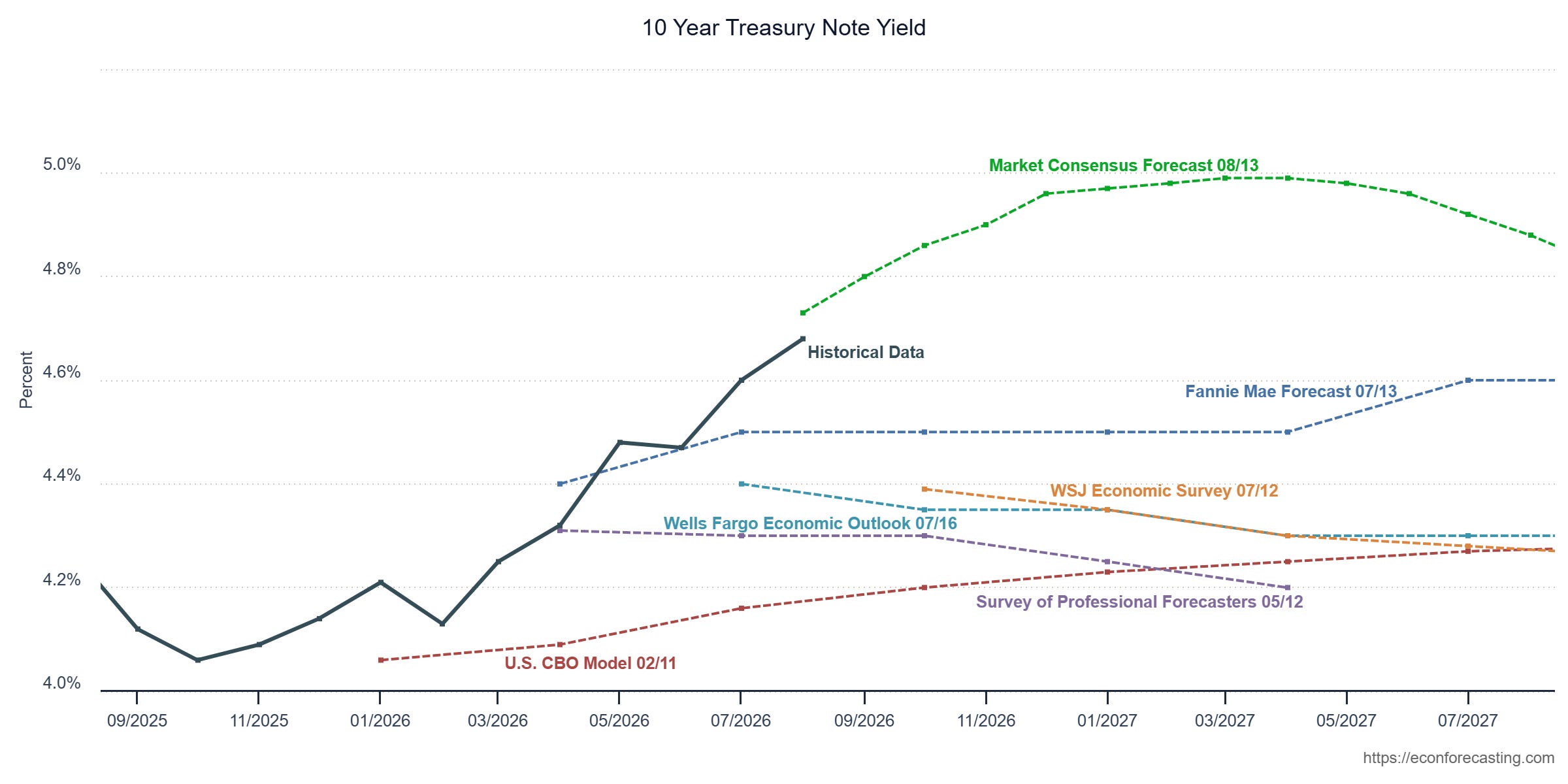
From this chart, we can see that, as of recently, the CBO has underestimated the actual 10-year Treasury yield. Note that they are not the only organization that does this; plenty of other groups have similar, though certainly less inaccurate, estimates. Further, they’ve been known historically to instead overestimate these yields, and rather highly at that. It seems, then, that their projections are quite chaotic and almost random; this isn’t terribly shocking. Predictions, especially economic ones, are incredibly challenging, and by critiquing the CBO and its methods, I don’t mean to imply that they could easily implement one specific shift and everything would change.
The fundamental issue with the CBO is that their incentives don’t align with producing accurate projections. Instead of optimizing their methodologies to best respond to new leaps in data science and statistics, they focus on following through on the promises they’ve made to Congress through the establishment of their office. In this way, they are constrained by the law instead of being bolstered by it, and Congress has diminished its ability to understand macroeconomic trends.
One potential solution could be to introduce a private market incentive. One way to do this would be to have a competition each year to see who can produce the best predictions, and at the end of the year, the model with the least “loss,” or inaccuracy, would receive a cash prize. Since this is an objective metric of accuracy, it wouldn’t be subject to perverse incentives in the same way as today. Another important thing about this competition is that all of the models would be posted publicly for anyone to see, meaning that economists and data scientists could easily use and access the best predictive models for their work. In this way, the government could serve to bolster economic research instead of being something of a confounding factor as it is today.
I have always considered the CBO as mostly a cover for Democrat policies, rather than real forecasts of actual expected results. Just an opinion.