

As policymakers return from summer recess in September, the Senate Agriculture Committee will be reconvening committee members to vote on funding for the farm bill.
Originally created during the fallout of the Great Depression, the farm bill (officially the Agricultural Adjustment Act of 1933) was intended to provide financial support to poor farmers and struggling agricultural workers. Over the decades, the nature of the farm bill has evolved into a mega spending bill giving handouts to wealthy landowners, breaking down economic dynamism in the agricultural industry and expanding food assistance programs in ways that weaken work incentives and encourage dependence on government support.
In its February 2026 baseline projection, the Congressional Budget Office (CBO) estimated a mandatory spending baseline of around $1.4 trillion in farm subsidies and food stamp costs for the coming decade (2027-36).
Farm Subsidies
The scale of the federal crop insurance program has more than doubled in its coverage of acres over the past decade and a half. At the same time, commodity program subsidies make up more than 10 percent of total farm bill funding. Combined, farmers will receive around $300 billion in federal government subsidies in the coming decade.
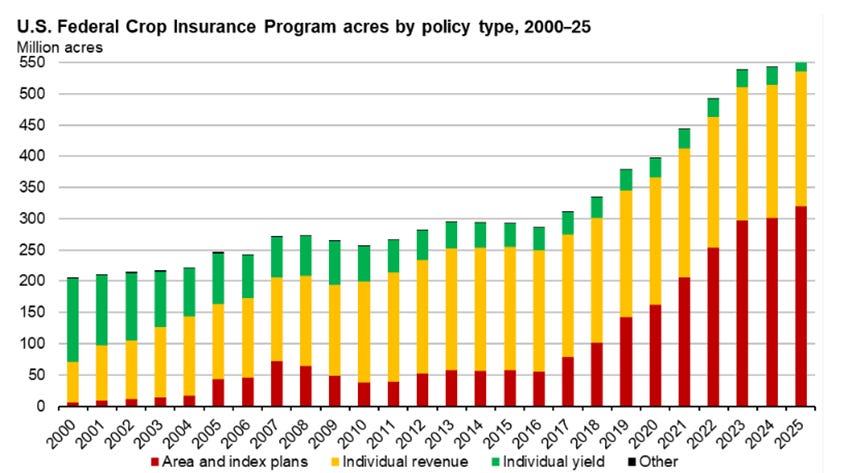
Source: US Department of Agriculture
While in 1960, the average household income of a farmer was 35% lower than the national average household income, by 1990 it had reached parity, and by 2024 the average farm household income was 32% higher than the national average household income. As of 2024, average farm household income was almost $160,000.
Despite this, policymakers often claim that farm subsidies go toward alleviating rural poverty. In reality, it is the largest and wealthiest farms that benefit most from billions of dollars in federal subsidies. According to the 2022 Census of Agriculture, only 19% of the value of farm subsidies goes to small farms (with sales of less than $100,000), while 58% of the value of subsidies goes to large farms (sales of $500,000 or more).
The average small farm recipient received an average annual government payment of $5,651, while the average large farm recipient received an average annual government payment of $60,592. This data hardly paints the picture of a subsidy program targeting the most vulnerable farmers.
In addition to the regressive nature of farm subsidies, financing crop production and subsidized crop insurance dissuades farmers from making decisions to improve market efficiency. Instead, federal subsidies lead to overproduction, distorted land use and inflated land prices.
Subsidies may also increase the cost of food because they act as nontariff barriers to agricultural products from overseas. As Montana State University economist Vincent Smith explains, “By subsidizing crop insurance, taxpayers are encouraging farmers to work less efficiently, produce fewer crops, and make smaller contributions to the overall productivity of the U.S. economy.”
SNAP Program Funding
Farm subsidies aside, by far the largest and burgeoning portion of the farm bill is the nutrition title of the bill, which includes nutrition assistance to low-income households through the Supplemental Nutrition Assistance Program (SNAP). This portion of the farm bill comprises 72% of total spending, or nearly $1 trillion in total outlays over 2027-36.
When the SNAP program was first expanded nationally in the early 1970s, there were around 4 million SNAP recipients, or about 1 in 50 Americans. Today there are over 37 million SNAP receipts, or about 1 in 9 Americans. The 9-fold increase in beneficiaries wasn’t driven by a surge in poverty; in fact, the poverty rate in recent years has been notably lower than that of the early 1970s.
Notably, the SNAP program expanded significantly during the COVID-19 pandemic in 2020, and enrollment remained very elevated at about 43 million participants through 2024. This was largely driven by the waiving of work-training requirements and significant increases in benefit generosity under the Biden administration.
In an effort to constrain the excessive growth of the SNAP program, policymakers enacted reforms within the OBBBA in 2025 that place some of the funding responsibilities on state governments. Historically, SNAP benefit costs were fully funded by the federal government, while administrative costs were split evenly between states and the federal government. Beginning in 2027, states will be responsible for 75 percent of administrative costs, with the federal government covering only 25 percent.
More importantly, for the first time in the program’s history, states will also share direct responsibility for benefit costs themselves. Under the new structure, states will cover between 5 and 15 percent of benefit costs depending on their payment error rates. States with high erroneous payment rates will pay more, while states with lower error rates will pay less.
Under the previous structure, states faced weak incentives to aggressively reduce payment errors because the federal government absorbed nearly the entire cost of mistakes. The new system introduces real fiscal consequences for poor administration.
Policymakers Must Not Backslide on SNAP Cost Sharing Reform
Unsurprisingly, state policymakers are resisting SNAP cost-sharing requirements. The latest draft of the farm bill would postpone SNAP cost-sharing requirements until fiscal year 2029 in order to secure additional farm subsidies. Earlier this month, Senate Democrats rejected this proposal, instead demanding these changes be delayed to fiscal year 2030. This would push the timeline back to October 2029, which happens to be post-Presidential election, and a new administration could repeal the requirements before they take effect.
As the Cato Institute’s Romia Boccia puts it, “Once Congress establishes a precedent for delaying accountability, it becomes easier to delay it again, or for a future Congress to abandon the measure altogether.” She further adds that backsliding “would effectively hand a future Democratic administration a window to repeal the requirements before they take effect.”
A Better Path Forward
As I noted the last time policymakers were debating the farm bill in 2022:
True food security and abundance is not likely to come from endless expansions of government welfare programs. Rather, it will be achieved through innovations in agricultural technology. The adoption of vertical farming—the practice of growing crops in vertically stacked layers—would lower transportation costs, reduce carbon emissions and increase the freshness of our food. The development of genetically modified foods would engineer more nutritious foods at lower prices than traditional methods of livestock farming.
Achieving abundance through innovation will also involve moving away from the old model of subsidizing big agribusiness. Policymakers should look to New Zealand for inspiration. In 1984, the government of New Zealand (a country four times as dependent on farming as the U.S.) ended all farm subsidies. The result was a significant increase in productivity, earnings and output. Land use in New Zealand was diversified, the quality of produce improved and food costs decreased.
Once market signals were allowed to operate unfettered, farmers in New Zealand realized that lands formerly used for sheep grazing, farmers were paid a subsidy per head of sheep, were better suited for growing grapes. This led to the launch of the very lucrative New Zealand wine industry.
As the farm bill debate returns in September, policymakers should use this time to reevaluate the costs, regressive nature and market-distorting effects of this old, outdated model. That means resisting efforts to shower large agribusinesses with still more subsidies, preserving the new fiscal accountability built into SNAP, and beginning the longer-term process of unwinding federal interference in agricultural markets. The lesson from New Zealand is that agriculture does not need government protection from market forces to thrive. Quite the opposite: competition, innovation and market discipline are what allow farmers, and consumers, to prosper.
The farm bill was created to address the economic conditions of the 1930s. Nearly a century later, Congress should stop treating those emergency interventions as permanent features of the American economy.
If only we could end the entire thing. Excellent article.
I don’t suppose you have data on profit versus just revenue. Not that this negates the problems associated with the farm bill and who is receiving the subsidies, but in my ignorance, I find that to be relevant.